Overview
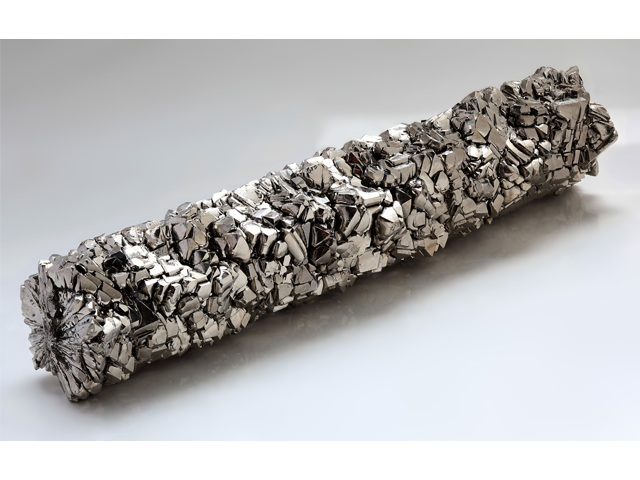
Titanium (Ti) is a lustrous-white metal of low density (4.51 g/cm3) with high mechanical strength. The light metal has a high melting point (1,668°C). Its boiling point is 3,500°C. Despite its high melting point, titanium metal is not suitable for high temperature applications, since its mechanical strength drops sharply when the temperature exceeds 426°C. The range of applications using titanium metal widened during the 20th century, particularly with advancements in transportation technology, such as gas turbine engines that incorporate titanium alloys. The titanium market is divided into two main segments: the titanium metal market and the titanium dioxide (TiO2) market. More than 90% of the world's titanium ore is used to produce titanium dioxide, which is primarily utilized as a pigment [Hu et al.,2022]. In contrast, just over 5% of the world's titanium ore is used for titanium metal production, with its primary product being titanium sponge. Titanium sponge serves as an intermediate material between titanium ore and titanium ingots [Georgitzikis et al.,2022], the primary form of titanium metal. Titanium sponges and scraps are also essential material in the production of ferro-titanium.
| Global production | Global producers | EU consumption | EU share | EU suppliers | Import reliance |
|---|---|---|---|---|---|
| 277,780t | China 64% Japan 19% Russia 8% Kazakhstan 5% Saudi Arabia 3% | 24,772t | 9% | United States 23% Japan 16% China 16% Russia 14% United Kingdom 9% Kazakhstan 9% Ukraine 3% Saudi Arabia 3% Switzerland 3% | 100% |
!!! ->This is sponge production; we should also have a table on ingots !!!
Titanium is primarily produced from orthomagmatic iron-titanium oxide (FeTiO3) deposits, where it is predominantly concentrated in ilmenite. Another major source is heavy-mineral sand deposits, where titanium occurs in both ilmenite and rutile, the latter being a high-purity titanium mineral [Woodruff et al.,2013]. Titanium is also found in leucoxene, an alteration product of ilmenite composed mainly of TiO2-rich minerals, such as rutile and anatase. Anatase, a less common polymorph of rutile, typically forms in hydrothermal veins and weathered igneous rocks.
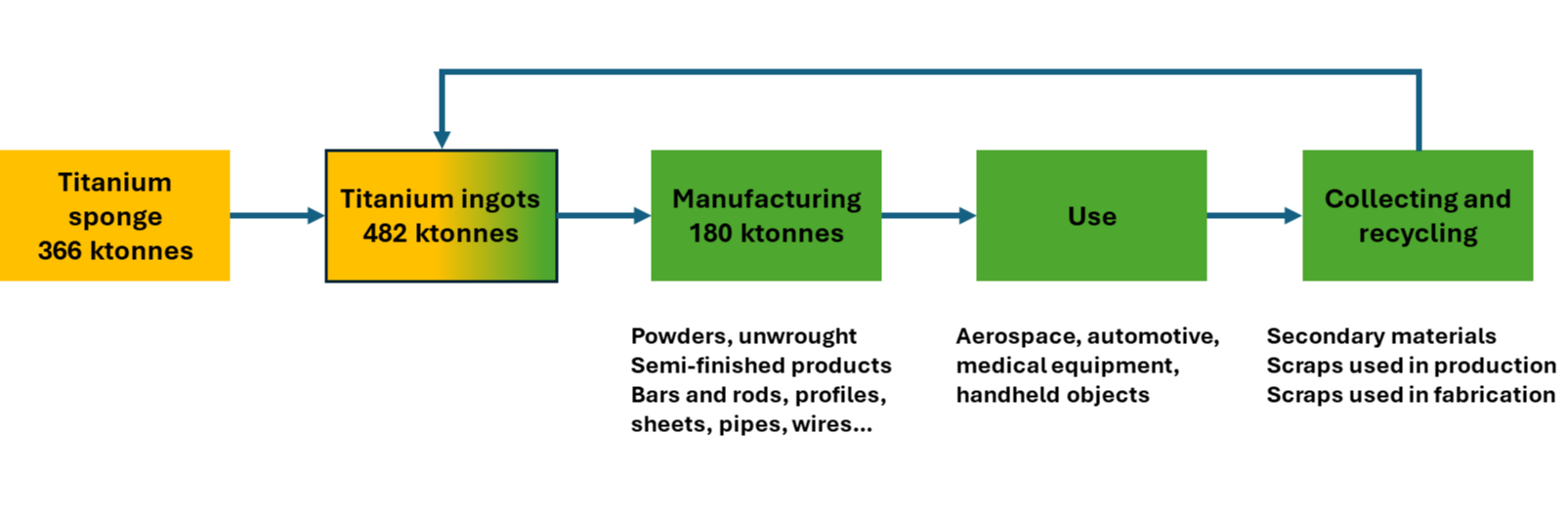
The primary source of titanium metal recycling is in-house scraps generated during metal manufacturing processes, contributing to a high overall recycling rate, including in-house cascade recycling. The main contaminants in titanium scrap, oxygen and iron, present challenges for recycling. High-grade titanium scraps, with low oxygen and iron content, need to be cleaned before being remelted to produce titanium and titanium alloy ingots. In contrast, low-grade titanium scraps, with higher oxygen and iron concentrations, are primarily used as raw materials for ferro-titanium production in the steel industry [Takeda et al.,2020].
The end-of-life recycling input rate for titanium is estimated at 19%, based on the UNEP methodology [UNEP,2011] [SCRREEN workshop,2019], with most of this old scrap being used for ferro-titanium production. During the melting process of a titanium ingot, the scrap incorporation rate is typically around 30%. However, depending on the technology used, it can reach up to 75% [Louvigné,2021].
Scrap is a high-value raw material in its own right for titanium metal production, particularly in processes utilizing advanced recycling technologies. The [UNEP,2011] report provides global data on titanium scrap utilization, indicating: 2,716 kt of recycled end-of-life material input (old scrap); 1,630 kt of scrap used in fabrication (new and old scrap); 244 kt of scrap used in production (new and old scrap).
Titanium serves a range of industrial markets due to its remarkable properties. If most of the titanium ore is used for the production of pigments, for example paints and the paper industry, titanium metal has advantageous characteristics, including being lightweight, having high mechanical strength, a high melting point, and small thermal expansion. These characteristics make titanium and titanium alloys important for many applications such as in the aerospace industry, or for medical purposes [Louvigné,2021].
Being lightweight, titanium use results in better performance, with lower fuel consumption when used in transportation, aerospace, sports equipment and other related industries. Titanium metal has a distinct tendency to build a passive film of TiO2 (titanium dioxide), which leads to a high corrosion resistance for the metal.
| Use | Percentage | Substitute | Sub share | Cost | Performance |
|---|---|---|---|---|---|
| Aerospace | 45% | no substitute | 100% | No substitute | |
| Medical equipment | 25% | no substitute | 100% | No substitute | |
| Hand held objects | 10% | no substitute | 100% | No substitute | |
| Automotive | 10% | no substitute | 100% | No substitute | |
| Automotive | 10% | in high strength applicances: aluminum, composites, intermetallics, steel, superalloys | 0% | No substitute | |
| Nuclear heat exchanger | 5% | not assessed below 10% | 100% | No substitute | |
| Plant engineering (e.g. seawater desalination) | 5% | not assessed below 10% | 100% | No substitute |
For the metallic form, due to the outstanding properties of titanium, only a few materials can compete with its strength-to-weight ratio and corrosion resistance. When a good corrosion resistance is necessary, titanium can be substituted by aluminium, nickel, specialty steels or zirconium alloys [Tercero Espinoza et al.,2015] [USGS,2022]. For applications where high strength is required, titanium competes with superalloys, steel, composites, aluminium and intermetallics [USGS,2022]. Zirconium and magnesium can serve as substitutes for titanium in medical applications [SCRREEN C Titanium expert network,2022], as well as certain stainless steels or cobalt-chromium alloys [ACNIS,2025]. Zirconia is also an excellent substitute for dental implants.
Titanium metal demand is expected to grow in the coming years, driven by the continued increase in demand from the aerospace and defense sectors. However, supply may struggle to keep pace with this growth due to rising geopolitical tensions with Russia, including the potential for supply disruptions in the form of customs sanctions or export restrictions. Nevertheless, recent increases in titanium metal production in Japan and the commissioning of new production facilities in the Middle East (Saudi Arabia) have helped to ease some of the supply pressure. Additionally, opening up supply channels from China is also a possibility, though this raises new concerns about dependency. Securing scrap flows is another critical issue, particularly in Europe, where efforts are being made to retain and decontaminate scrap domestically. This recycled material, combined with sponge titanium, plays a key role in ingot production [Buesa Olavarrieta et al.,2025].
Metallic titanium can be found in water streams, and it can bioaccumulate in various animal species. Impacts on the trophic chain are still under study, but the presence of this material in the environment is suspected of causing serious threats to human and non-human animals, vegetation, and bacteria [Markowska?Szczupak et al.,2020]. The International Titanium Association (ITA) prepared a set of compliance Guidelines to support companies to comply with relevant antitrust laws. In addition, members of ITA also adopted a special resolution according to which ITA meetings and facilities shall not be used to exchange information on the price of titanium [ITA,2022].
Market analysis, trade and prices
| Global production | Global producers | EU consumption | EU share | EU suppliers | Import reliance |
|---|---|---|---|---|---|
| 277,780t | China 64% Japan 19% Russia 8% Kazakhstan 5% Saudi Arabia 3% | 24,772t | 9% | United States 23% Japan 16% China 16% Russia 14% United Kingdom 9% Kazakhstan 9% Ukraine 3% Saudi Arabia 3% Switzerland 3% | 100% |
Warning : In table 3, global producers refer to titanium sponge producers, whereas EU suppliers concern a more broader range of products, as explained below.
Between 2019 and 2024, China produced an average of 277,800 tonnes of titanium metal per year, making it the world’s leading producer. However, most Chinese manufacturers are not certified by major players in the aerospace industry. As a result, the metal components derived from chinese titanium metal are rarely integrated into the aerospace supply chains of aircraft manufactured in Europe. Consequently, the European Union sources its titanium primarily from the United States, which no longer produces sponge itself but instead manufactures ingots, some of which are made using scrap metal originating from European machining companies [Buesa Olavarrieta et al.,2025]. Ukraine was also a key supplier to the EU until the outbreak of war with Russia in 2022 [Georgitzikis et al.,2022]. Russia exports mainly semi-finished and finished products.
| Processing/refining | |
|---|---|
| CN Code | Title |
| 81082000 | Unwrought titanium; titanium powders |
| 81083000 | Titanium waste and scrap (excl. ash and residues containing titanium) |
| 81089030 | Titanium bars, rods, profiles and wire, n.e.s. |
| 81089050 | Titanium plates, sheets, strip and foil |
| 81089060 | Tubes and pipes, of titanium |
| 81089090 | Articles of titanium, n.e.s. |
Unwrought titanium; titanium powders (CN code 81082000) refers to raw titanium in its primary form, either as sponge or as ingots, and powder, typically used for further processing or alloy production.
Titanium waste and scrap (excluding ash and residues containing titanium) (CN code 81083000) designates recyclable titanium materialsgenerated during machining or manufacturing processes (scrap), excluding titanium recovered from ash or residues.
Titanium bars, rods, profiles and wire, not elsewhere specified (CN code 81089030) covers semi-finished titanium products shaped as bars, rods, profiles, or wire, intended for use in industrial or structural applications.
Titanium plates, sheets, strip and foil (CN code 81089050) corresponds to flat-rolled titanium products in various thicknesses, including plates, sheets, strips, and foils, commonly used in aerospace, medical, and industrial sectors.
Tubes and pipes, of titanium (CN code 81089060) applies to hollow cylindrical titanium products, such as tubes and pipes, used for transporting fluids or in structural applications requiring corrosion resistance.
Articles of titanium, not elsewhere specified (CN code 81089090) encompasses finished or semi-finished titanium items that do not fall under other specific classifications, including assembled or custom-manufactured components.
Nearly half of the titanium bars, rods, profiles, and wire are imported from the United States.
The annual export quantity of flat-rolled titanium products is insignificant compared to imports. Imports experienced a sharp decline during the COVID period but began to rise again afterward, returning to pre-crisis levels as early as 2022. In 2024, imports of semi-finished titanium metal products come primarily from Japan, the United States, China, and Russia. However, supplies from Russia have been decreasing since 2022, following the outbreak of the war with Ukraine.
A similar trend can be observed for titanium articles, although with a slightly more nuanced picture regarding imports from Russia, which remain relatively significant. The largest import volumes come from the United Kingdom.
Unwrought titanium includes sponge and ingots. Powders are also classified under this category. Imports account for the vast majority of trade, reaching 18 323 tonnes in 2024. The main suppliers were Kazakhstan, Japan, United States and China.
Titanium scrap, like sponge, is a key raw material for producing titanium metal ingots. While exports had dominated over the past two decades, the gap between EU imports and exports has narrowed in recent years. In 2024, a large part of the EU's titanium metal scrap was exported to the USA (some through the UK), before being reimported to be smelted into ingots in Europe, or smelted into ingots in the US which were then imported to Europe. Russia was a major supplier during the 2010s.
Imports and exports of tubes and pipes made of titanium have been declining over the past ten years, with China now being by far the main source of supply.
Since 2019, titanium sponge prices have experienced significant fluctuations. Prices fell sharply during the COVID-19 pandemic due to weakened aerospace demand, reaching a low in 2021. However, prices began to recover, driven by rising as global demand, particularly from the aerospace and defense sectors. The war in Ukraine in 2022 further tightened global supply, especially in Europe, contributing to upward pressure on prices. By 2023 and 2024, prices had stabilized at relatively high levels, supported by strong demand and ongoing supply constraints from key producers, while showing lately a slight downward trend.
Titanium's demand is heavily dependent on industrial activity [Georgitzikis et al.,2022]. Prior to the Covid-19 crisis, titanium demand reached a record high in 2019, with more than 160 kt tonnes of titanium consumed all over the world, primarily driven by the aerospace sector [Georgitzikis et al.,2022]. With the collapse of aviation activity in 2020 following Covid-19 pandemic, the demand of titanium dropped by 30% in 2020 to 113 kt and, further, to 90 kt in 2021 [Georgitzikis et al.,2022]. Beyond 2021, the annual growth rate of demand is anticipated at about 12% until 2026, and the level of consumption of 2019 is expected to be seen after 2026. Nevertheless, increased defence budgets over the coming years in the aftermath of Russia's conflict with Ukraine may increase the future demand [Georgitzikis et al.,2022].
On the supply side, western aerospace companies have reportedly been creating stocks or looking to diversify their supply base to get ahead of any supply disruption before the conflict between Russian and Ukraine [Georgitzikis et al.,2022]. Due to the increasing likelihood of sanctions against Russia and the shutdown of Ukrainian production, the global supply of titanium sponge may shift in favor of other producers. In April 2022, the Japanese company Toho Titanium Co. reportedly increased its output of aerospace-grade titanium as U.S. aviation industry customers sought alternatives to Russian supply [Suga,2022]. The Japanese company also partnered with The National Titanium Dioxide Company Ltd. (Cristal) to launch a facility in Saudi Arabia dedicated to producing titanium sponge. This facility utilizes titanium tetrachloride supplied by the neighboring Tronox plant and employs Toho's proprietary technology [Buesa Olavarrieta et al.,2025]. It has an annual production capacity of 15,600 tonnes. Production began in 2020 and reached full capacity in 2024.
Meanwhile, China continues to expand its titanium sponge production capacity. However, most of chinese titanium sponge and metal are still not certified for use in the most critical aerospace applications by major aircraft manufacturers [Buesa Olavarrieta et al.,2025]. This situation could evolve in the coming years, especially if supply chain tensions persist.
Demand
EU consumption at the titanium processing stage is represented by HS codes for materials such as CN 26209960 (slag, ash, and residues mainly containing titanium, which are used as precursors for TiO2), CN 28230000 (titanium oxides), CN 72029100 (ferro-titanium and ferro-silico-titanium), CN 81081010 and CN 81082000 (unwrought titanium and titanium powders), and CN 81083000 (titanium waste and scrap, excluding ash and residues containing titanium). Import and export data for these materials are also derived from Eurostat Comext (2022). Due to the distinct markets for titanium metal and titanium oxide, it is not feasible to aggregate all these materials based on their titanium content. For titanium metal (unwrought, powders, and ferro-titanium), since there is no EU production, demand is calculated as imports minus exports, while titanium oxides and ashes are managed together for analysis.
The EU's trade balance in titanium metal is globally in deficit, although some finished and semi-finished products are also produced on the continent and exported.
Titanium serves a range of industrial markets due to its remarkable properties. If most of the titanium ore is used for the production of pigments [Louvigné,2021], titanium metal has advantageous characteristics, including being lightweight, having high mechanical strength, a high melting point, and small thermal expansion. These characteristics make titanium and titanium alloys important for many applications such as in the aerospace industry, or for medical purposes. Being lightweight, titanium use results in better performance, with lower fuel consumption when used in transportation, aerospace, sports equipment and other related industries. Titanium metal has a distinct tendency to build a passive film of TiO2 (titanium dioxide), which leads to a high corrosion resistance for the metal. Civil aerospace is the major demand sector for titanium metal demand, which also increased globally and particularly in Europe within the past decade.
The relevant industry sectors and their 2 and 4-digit NACE codes are summarised in Table 5. The main EU titanium metal applications (superalloys, hard materials, pigments, catalysts, magnets, and batteries) are predominantly concentrated in sectors like fabricated metal products (C25), manufacture of machinery and equipment n (C28) and manufacture of motor vehicles, trailers and semi-trailers (C29). From 2011 to 2022, those sectors show consistent growth
| Applications | 2-digit NACE sector | Value added of NACE 2 sector | 4-digit CPA |
|---|---|---|---|
| Aerospace | C30 - Manufacture of other transport equipment | 75,800M€ | C30 - Manufacture of other transport equipment |
| Medical equipment | C28 - Manufacture of machinery and equipment n.e.c. | 280,306M€ | C28 - Manufacture of machinery and equipment n.e.c. |
| Automotive | C29 - Manufacture of motor vehicles, trailers and semi-trailers | 240,806M€ | C29 - Manufacture of motor vehicles, trailers and semi-trailers |
| Hand held objects | C25 - Manufacture of fabricated metal products, except machinery and equipment | 220,000M€ | C25 - Manufacture of fabricated metal products, except machinery and equipment |
| Nuclear heat exchanger | C25 - Manufacture of fabricated metal products, except machinery and equipment | 220,000M€ | C25 - Manufacture of fabricated metal products, except machinery and equipment |
| Plant engineering (e.g. seawater desalination) | C25 - Manufacture of fabricated metal products, except machinery and equipment | 220,000M€ | C25 - Manufacture of fabricated metal products, except machinery and equipment |
The aeronautics sector largely dominates demand of titanium metal in Europe, followed by industrial applications and, more marginally, military applications and consumer goods [Louvigné,2021]. Due to its corrosion resistance, titanium and its alloys are used in chemical industry as well as petrochemical and nuclear plants. Some titanium alloys can be used at working temperatures up to 600°C.
Litghter than steel, titanium alloys are stronger than aluminium alloys at elevated temperatures. Due to their high tensile strength to density ratio, high corrosion resistance, and ability to withstand moderately high temperatures without creeping, titanium alloys are used in several parts of aircrafts like engine, airframe structures and other components [Buesa Olavarrieta et al.,2025]. Around half of all titanium metal produced is used in civil and defense aircraft engines and frames.
Titanium is widely used in the medical field due to its biocompatibility, strength, and corrosion resistance. It is commonly used for implants such as joint replacements, dental implants, and bone fixation devices. Its properties make it ideal for long-term use in the human body [Enghag,2004] [Reade,2019].
In the automotive industry, titanium is used in high-performance vehicles due to its lightweight and high-strength properties. The development of hydrogen vehicles could require titanium in several key components due to the metal's unique properties. Titanium plays a significant role in the development of electrolyzers, particularly in the production of hydrogen through electrolysis [Seck et al.,2023].
Titanium is used in various handheld products due to its lightweight and durability. It is found in items such as tools, watches, golf clubs, bicycles and smartphone [Uhlmann,2001] [Reade,2019].
Due to its corrosion resistance, particularly in saline environments, makes it perfect for seawater desalination processes. Titanium and its alloys are also used in chemical and petrochemical industries [Louvigné,2021].
Titanium is used in nuclear heat exchangers because of its corrosion resistance to high-radiation and high-temperature environments. It's also an essential material for various critical components in the nuclear sector, including condensers, waste management, reactor internals, etc. [Buesa Olavarrieta et al.,2025].
| Use | Percentage | Substitute | Sub share | Cost | Performance |
|---|---|---|---|---|---|
| Aerospace | 45% | no substitute | 100% | No substitute | |
| Medical equipment | 25% | no substitute | 100% | No substitute | |
| Hand held objects | 10% | no substitute | 100% | No substitute | |
| Automotive | 10% | no substitute | 100% | No substitute | |
| Automotive | 10% | in high strength applicances: aluminum, composites, intermetallics, steel, superalloys | 0% | No substitute | |
| Nuclear heat exchanger | 5% | not assessed below 10% | 100% | No substitute | |
| Plant engineering (e.g. seawater desalination) | 5% | not assessed below 10% | 100% | No substitute |
The substitution options for titanium are summed up in Table 4 and described in the subsections below. However, alternatives may not always match titanium in terms of strength, corrosion resistance, or performance under extreme conditions.
Titanium is widely used in aerospace for its high strength-to-weight ratio, but aluminum alloys, nickel alloys, steels and composites can serve as alternatives for less critical components [Srivastava et al.,2024].
Zirconium and magnesium can serve as substitutes for titanium in medical applications [SCRREEN CRM expert network,2022], as well as certain stainless steels or cobalt-chromium alloys [ACNIS,2025].
In the automotive industry, steel and aluminum alloys are often used in place of titanium, offering lighter weight at a lower cost, though they typically lack titanium's strength and durability [Isaka et al.,2022].
For handheld objects, stainless steel and aluminum alloys are common substitutes for titanium, providing good durability at a lower price.
In desalination plants, stainless steel and nickel-based alloys can replace titanium due to their resistance to corrosion [Nickel Institute,2020].
For nuclear heat exchangers, stainless steel and nickel alloys are often used as substitutes for titanium, offering similar corrosion resistance and strength at high temperatures [Rodriguez,1997].
Supply
There is currently no primary titanium ore mining or titanium sponge production within the EU [Idoine et al.,2024]. However, France, Italy, and Romania produce small but significant volumes of titanium ingots, using imported sponge and scrap—mainly sourced from the machining of aerospace components within the continent [Buesa Olavarrieta et al.,2025]. According to [Eurostat,2021], the EU reported an average annual production of 571kt of titanium compounds (including pigments, oxides, etc.) at the processing stage between 2016 and 2020. Production is concentrated mainly in Germany and Finland. During the same period, the EU imported approximately 1.6 million tonnes of metallic titanium and titanium compounds per year. However, estimating the exact quantities of each product remains difficult due to gaps in the Eurostat database.
Metallic titanium is primarily imported from China, while titanium compounds, typically containing 41 to 65 wt% Ti, re sourced from a diverse range of countries, including Norway, South Africa, and the United Kingdom. On the export side, around 93 kt of metallic titanium and titanium compounds were exported annually to third countries over the same period, with Mexico, India, and Taiwan being the main trading partners [Eurostat,2021].

Titanium is primarily extracted from orthomagmatic iron-titanium oxide (Fe-Ti oxide) deposits, where it is mainly hosted in ilmenite. Another major source is heavy mineral sand deposits, where titanium occurs in both ilmenite and rutile [Woodruff et al.,2013]. A potentially significant hard-rock source of titanium is eclogitic rocks, in which rutile is the principal Ti-bearing phase. Globally, only a small fraction of mined titanium minerals is used in metallic form.
Titanium is widely distributed throughout the Earth's lithosphere, as its ionic radius is similar to that of several common elements, allowing it to substitute into many mineral structures. As a result, titanium occurs in most rocks, soils, and minerals. However, only a few titanium-bearing minerals contain more than 1% Ti, making them economically viable sources.
The main sources of titanium metal and titanium dioxide are ilmenite (which accounts for over 90% of global production) and rutile, a high-grade titanium mineral composed primarily of TiO?. Additional sources include anatase (notably in Brazil), leucoxene (an altered ilmenite), and synthetic rutile. Another significant source is titaniferous slag, a by-product of smelting titanomagnetite ores, which can contain up to 95% titanium dioxide [Enghag,2004].
Heavy mineral sand exploration and mining projects have been active in Australia, Mozambique, Tanzania, Madagascar,and Sri Lanka [USGS,2025]. According to [Minerals4EU,2019], some titanium exploration has also been reported in Spain, Sweden, Poland, Ukraine, and Romania, although no further details are available.
The resources and reserves of most titanium deposits are typically estimated based on the quantity and composition of mineral concentrates. This approach is particularly important for orthomagmatic iron-titanium-oxide deposits, where ilmenite is the primary economically valuable Ti-bearing mineral. In such deposits, the economic potential of titanium is generally assessed through the expected recovery of ilmenite during ore processing. This is due to the varied textural occurrences of ilmenite: it may be present as discrete grains, but also as exsolution lamellae within composite grains of magnetite and ilmenite. These intergrowths are commonly referred to as ilmenomagnetite or titanomagnetite.
According to the [USGS,2025], global resources of anatase, ilmenite, and rutile are estimated to exceed 2 billion tonnes, with ilmenite accounting for approximately 90% of the total. In terms of reserves, the world holds more than 510 Mt of ilmenite and less than 50 Mt of rutile. An overview of global ilmenite and rutile reserves is provided in Table?4. Australia alone accounts for over one-third of the world’s reported reserves, with around 38% (180?Mt of ilmenite and 35?Mt of rutile). Other major producers include China, which contributes approximately 20% of the total, and Canada with 9%. For rutile, the majority of global reserves are concentrated in Australia (76%), followed by South Africa (13%) and Sierra Leone (6%), although production in Sierra Leone is declining.
| Country | Classification | Quantity (Mt of ore) | Grade (% Titanium) | Reporting code | Reporting date | Deposit, Source | ||
|---|---|---|---|---|---|---|---|---|
According to the European Minerals Yearbook [Minerals4EU,2022], titanium resources within the EU are located in France, Slovakia, Portugal, Sweden, and Finland. The majority of these resources are concentrated in Finland and Sweden, which together account for approximately 42.2 million tonnes (Mt) of titanium, equivalent to 70.4?Mt of TiO?. Table 15 presents an overview of titanium resources in the EU. For Finland, only the largest deposits are listed.
| Country | Classification | Quantity (Mt of ore) | Grade (% Titanium) | Reporting code | Reporting date | Source | ||
|---|---|---|---|---|---|---|---|---|
According to the [USGS,2025], there are no significant titanium reserves within the EU. Elsewhere in Europe, Norway holds approximately 8% of global ilmenite reserves, while Ukraine accounts for about 1% (ilmenite and rutile).
According to the [USGS,2025], global mine production of titanium mineral concentrates was estimated at approximately 8.9 Mt of ilmenite and 0.45 Mt of rutile in 2024, for a combined total of 9.4 Mt. These figures confirm that ilmenite remains by far the dominant titanium-bearing mineral produced worldwide, reflecting its role as the primary source for both titanium dioxide and, to a lesser extent, metallic titanium.
Whether derived from ilmenite or rutile, most titanium mineral production originates from placer-type deposits, particularly heavy-mineral sands, where these minerals are naturally concentrated by sedimentary processes. These sands represent the most accessible and economically viable source of titanium globally.
In 2024, the main producing countries included China, which led global output with an estimated 35% of total production, largely from ilmenite deposits. Mozambique and South Africa followed, contributing approximately 20% and 15%, respectively, mainly from heavy-mineral sand operations. Despite holding some of the largest known reserves and resources of titanium minerals, Australia accounted for only about 6% of global mine production in 2024, highlighting a gap between geological potential and current output levels.
In Europe, Norway and Ukraine were the two main producers of titanium mineral concentrates. Norway contributed around 4%, primarily from hard-rock ilmenite mining operations, while Ukraine provided about 1%, from both ilmenite and lesser rutile production.
Alternative estimates from sources such as the British Geological Survey [Idoine et al.,2025] and the World Mining Data [Reichl, & Schatz,2024] show slight differences in absolute production figures. However, the general trends regarding the dominance of ilmenite, the importance of heavy-mineral sands, and the leading role of China, Mozambique, and South Africa remain consistent across datasets.
A key source for titanium recycling is in-house scrap, generated during fabrication processes of titanium products for the aeronautic industry, and the actual recycling rate of titanium, including the in-house cascade recycling rate, is high. Depending on the type of melting furnace used, up to 80–90% of scrap can be reintroduced into the melting process for ingot production. However, to be reused effectively, these scraps must first be properly cleaned and processed [Buesa Olavarrieta et al.,2025].
The main challenges in recycling titanium scrap relate to contamination by oxygen and iron, which are critical impurities. High-grade titanium scrap, with low oxygen and iron content, is suitable for remelting into titanium and titanium alloy ingots. However, a significant share of the titanium production scrap generated in EU manufacturing facilities is currently exported, primarily to the United States and the United Kingdom, for cleaning [Buesa Olavarrieta et al.,2025].
In contrast, low-grade titanium scrap, which contains higher levels of oxygen and iron, is not suitable for remelting into high-purity ingots. Instead, it is typically used as a raw material for ferro-titanium production, which is widely used as an alloying agent in the steel industry [Takeda et al.,2020].
Approximately 1,000 tonnes of old scrap were recycled annually, representing about 6% of total titanium use. Despite ongoing efforts, recycled titanium continues to meet only a small fraction of total demand, largely due to the rapid growth in global consumption [UNEP,2011].
Using the methodology developed by [UNEP,2011], the end-of-life recycling input rate (EOL-RIR) for titanium is estimated at 19% [SCRREEN workshop,2019]. According to [UNEP,2011], the global use of titanium scrap includes: 2,716 kt of end-of-life (old) scrap, 1,630 kt of scrap used during fabrication (new and old), and 244 kt of scrap reused in the production process.
The recycling and processing of titanium scrap has a long industrial history, with patents dating back to the 1950s. The introduction of cold hearth melting technologies in the 1980s significantly increased the capacity for processing secondary titanium [Newman,2015].
In parallel, titanium recovery from red mud, a by-product of alumina production, has been investigated in numerous laboratory and pilot-scale studies. Although not yet adopted at industrial scale, recovery typically involves high-pressure acid leaching (often using hydrochloric acid), followed by precipitation and solvent extraction. This process can yield a titanium oxide-rich concentrate containing more than 20% Ti, often alongside other valuable metals such as alumina and scandium [Grudinsky et al.,2022].
In 2012, about 35,000 t of new scrap were recycled; 1,000 t were used by the super-alloy industry [UNEP,2011].
Titanium is primarily obtained from the minerals rutile, ilmenite, and, more rarely, anatase (beta-titanium dioxide). Other titanium-bearing minerals include perovskite, sphene, and titanite. Titanium can be mined from intrusive crystalline rocks, weathered rock, and unconsolidated sediments. About half of all titanium mined comes from unconsolidated sediments known as shoreline placer deposits. Placers are alluvial deposits formed by rivers as they reach the sea. Suspended sediments have different densities, referred to as specific gravities. As a river’s speed fluctuates, it deposits different sediments, forming separate sediment layers. Titanium ores, ilmenite and rutile, are both found worldwide in placers [Woodruff et al.,2013].
Placer mining is conducted either by wet dredging or dry mining. The choice depends on the presence and depth of the water table where the deposit is located. In wet dredging, an artificial pond is created by excavating below the water table. Sometimes water pumps are used to fill mining ponds. A suction bucket wheel attached to a floating dredge removes heavy mineral sediments from the ground, which are then concentrated by passing through inclined cylindrical trommel screens. While rotating, smaller material that cannot be processed falls through the screens. Particles that pass through are further sorted by a spiral concentrator, where a chute sorts particles suspended in water based on size and density. High-density particles stay close to the inside of the spiral chute’s cross-section, while lower-density particles move toward the outer edge, allowing sorted sediments to be collected in separate containers.
Dry mining of ilmenite and rutile uses conventional mechanical excavation with excavators, scrapers, loaders, and bulldozers. Similar to wet dredging, the sediments are concentrated following the same process but without water in the spiral concentrator. After concentration, the minerals go through a feed preparation plant where attrition scrubbers clean them, followed by additional gravity concentration before froth flotation, which removes sulfides or other unwanted local sediments. The final step is dry milling, combining magnetic and electrostatic separation to improve ore quality. Titanium ores such as ilmenite and rutile are conductive due to their iron content and can be easily separated from zircon and unwanted silicates. After dry milling, the ore is ready for further processing [Fang et al.,2019]
Other considerations
The CPL regulation categorises the titanium dioxide (TiO2) powderwith aerodynamic diameter smaller than 10 μm as carcinogenic level 2, suspected of causing cancer, given the scientifically confirmed evidence of its hazard to health when inhaled [CPL,2008]. According to [IARC,2006], TiO2 carcinogenicity is classified as 2B, possibly carcinogenic, while titanium alloys carcinogenicity is classified as 3, not classifiable as to its carcinogenicity to humans. TiO2 is also contained in the food additive E171, used to provide white colour and opacity to foodstuff, and is suspected by scientists of being carcinogenic. Thus, following the precautionary principle, the Commission Regulation [European Commission,2022] stating that TiO2 shall no longer be used as a food additive in the European market, except for medicines and drugs. Moreover, the regulation defines a period of three years during which the Commission shall consult the European Medicines Agency about the necessity to maintain or remove E171 from the list of food additives allowed in the EU ([European Commission,2022]. Finally, [Kim et al.,2019] studied dental titanium bio-implants and showed that corrosion could lead to deposits of particles of Ti and Ti-alloys in the bones. This could cause inflammatory reactions and eventually to failing osseointegration of the implant.
Metallic titanium can be found in water streams, and it can bioaccumulate in various animal species. Impacts on the trophic chain are still under study, but the presence of this material in the environment is suspected of causing serious threats to human and non-human animals, vegetation, and bacteria [Markowska?Szczupak et al.,2020].
An LCA study of novel and sustainable lubrication methods for machining pure titanium and titanium alloys shows that optimized fluidification systems allow for reducing energy consumption and, in general, impact on the natural environment and human health [Gupta et al.,2016] [Khanna et al.,2021].
An LCA study on titanium oxide nanorods used as electron transport layers for perovskite solar cells, with a lifetime of three years, demonstrated that the lifecycle greenhouse gas emissions are 182 g of CO2eq/kWh, which is slightly higher than the established solar technologies. On the other side, the energy payback time is about one year, which is lower than competitor technologies. Thus, the study demonstrates that TiO2 nanorods are a promising technology for solar energy production but that their efficiency rate must be incremented to be competitive with alternative technologies [Rao et al.,2021].
On the other hand, the assessment of production methods of TiO2 nanoparticles show that the routes with the lowest environmental impacts in terms of global warming potential and energy consumption are those based on the use of chemicals, like the sol-gel process. Physical methods have higher energy demand but facilitate a wider spectrum of industrial applications [Wu et al.,2019].
The International Titanium Association (ITA) prepared a set of compliance Guidelines to support companies to comply with relevant antitrust laws. In addition, members of ITA also adopted a special resolution according to which ITA meetings and facilities shall not be used to exchange information on the price of titanium [ITA,2022].
The ITA also provide information on the NFPA Standard of Combustible Metals, published back in 2012, where chapter 12 is specifically dedicated to safety guidelines for handling titanium [NFPA,2012].
Specifically regarding the use of titanium in the dentistry sector, the GermanS3 guideline on titanium hypersensitivity in implant dentistry was developed [Müller?Heupt et al.,2022].
Table 15 presents the countries where titanium product exports account for more than 0.1% of total national export value.

In Mozambique, Madagascar, Senegal, and Kenya, titanium exports represent over 2% of total exports. In these countries, nearly all titanium is exported in the form of ores and concentrates. In contrast, Kazakhstan exports titanium exclusively as unwrought metal and powders. Meanwhile, Ukraine has a diversified export profile, with 82% of titanium exports consisting of ores and concentrates, and the remaining 18% as unwrought metal and powders.
| Country | Export value (USD) | Share in total exports |
|---|---|---|
In 2001, the company Tiomin (K) started operations to build a new titanium mine in the Kwale region, in Kenya. As a result, between 2001 and 2007, at least 7,000 people were displaced from their homeland and forced to move to other villages or cities. The Kenyan government provided the displaced population with economic compensation, but for most, this was insufficient and unable to replace the loss, since their land played a central role in people’s lives and was considered sacred [Abuya,2016].
Since 2013, the Australian company Base Titanium Limited has been extracting the mineral in the Kwale region. The company established an Environment and Community Affairs department to raise community awareness by providing project information to stakeholders through discussion, drama, formal presentations, and display events in schools and village centres. The company aspires to help develop the local community by providing social infrastructure and educational opportunities, promoting livelihood upliftment and enhancement programmes, and improving community health. Mining operations have thus led to enhanced education, health, and nutrition levels. However, excavations have resulted in the displacement of people, animals, and farming areas, and caused conflicts over land ownership, land use, and land value, in addition to increasing dust, noise, and water pollution. Furthermore, the company’s efforts have unintentionally created a dependency culture among the local community of Kwale County. The closure of the mine, expected by late 2023, is expected to reduce employment and lead to migration of former Base Titanium workers [Evers,2020].
Quebec Iron and Titanium Madagascar Minerals (QMM) is currently exploiting titanium in Taolagnaro, southeast Madagascar. Since the start of operations in 2013, the local population has strongly opposed the project through strikes, road blockages, and the trapping of about 200 QMM workers. Soil excavations and the construction of a dam have reduced access to water and harmed the area’s livelihoods, in addition to diminishing fishing stocks and access to fishing sites. In terms of environmental impacts, titanium mining has significantly altered the biodiversity and habitat of the area, which is fundamental to the local economy, as it supports farming and grazing and is becoming a growing source of income through ecological tourism [Seagle,2012] [Zaehringer et al.,2024].
In Ninh Thuan province, Vietnam, the company Quang Thuan started operations in August 2012. In December 2012, the provincial government ordered a temporary suspension of the business, in addition to requesting an Environmental Impact Assessment and the establishment of clean water facilities for the local population. In 2013, the company obtained permission to restart operations in part of the mining area, despite not having provided a water treatment facility to the local villagers. In 2014, when Quang Thuan resumed full activity, the local population went on strike, blocking Vietnam National Highway 1 and setting fire to one of the company’s factories [EJAtlas,2022]. According to recent reports, the mine is still operating, and a landslide caused the death of four workers in October 2022 [VNExpress,2022].
In the United States, the 2010s saw the closure of several titanium sponge production facilities, including Timet’s plant in Henderson, Nevada, and Allegheny Technologies’ Rowley plant in Utah. While rising production costs and foreign competition played a role, social and environmental concerns were also central. The chlorine-based Kroll process used in sponge production generated hazardous waste and air emissions, including chlorine gas leaks and waste magnesium chloride, raising public health and environmental justice issues in surrounding communities. Regulatory pressure and increased scrutiny from the Environmental Protection Agency (EPA) contributed to plant shutdowns, highlighting the ethical challenges of balancing industrial production with environmental and social responsibility [EPA,2016].
-
REPTiS – Responsible Extraction and Processing of Titanium (2024-ongoing). The EU-funded REPTiS project aims to develop a sustainable and energy-efficient solution for extracting and processing titanium and other primary raw materials from strategic partner countries into EU supply chains with minimal waste. This initiative will involve collaboration with Ukraine throughout the value chain, from open-pit ilmenite ore mining and carbon-free titanium powder production to full-scale deployment within the EU. The project will demonstrate titanium extraction and processing as a Critical Raw Material, focusing on achieving zero-waste manufacturing through energy and resource efficiency, thereby contributing to the European Green Deal [REPTIS,2024].
-
EURO-Titan: Decarbonized Titanium Recovery from Production Residues (2021–2025). The project EURO-Titan aims to establish a low-carbon and fully traceable titanium production system in Europe. It focuses on valorizing alumina (bauxite) and titanium dioxide (TiO?) production residues as raw materials. The process uses green hydrogen and electric furnaces powered by renewable energy, combined with artificial intelligence optimization to enhance energy efficiency. The goal is to reduce CO? emissions by more than 90% compared to the traditional Kroll process. By-products and wastewater are valorized within a circular system, supporting sustainable titanium production [EURO-Titan,2021].
-
HyCat: In-situ fabricated hydrogen evolution catalysts for alkaline water electrolysis (2020- 2022). The HyCat4 project focused on developing a cost-effective electrocatalyst for hydrogen production through alkaline water electrolysis, aiming to reduce reliance on expensive and scarce platinum. The approach involved fabricating a TiO? nanostructure coated with copper and platinum nanoparticles. Pilot-scale testing demonstrated that a 2.5 kW electrolyser could generate approximately 1 kg of hydrogen per day, which is sufficient to power a household. The project concluded in 2022 [HyCat,2020].
-
MMTec: New aerospace advanced cost-effective materials and rapid manufacturing technologies (2015-2019). MMTec sought to revolutionize aerospace manufacturing by introducing rapid, cost-efficient methods for producing titanium-aluminium alloy components. The project aimed for a 45% reduction in both cost and production time. It successfully implemented a new machining system that allowed reliable deposition of TiO2 nanoparticles. Demonstrators, including an aircraft blade, an exhaust flange, and a turbine impeller; showed up to 45% weight reduction and significant performance improvements [MMTech,2015].
-
DefTiMOFs: Defective Titanium Metal-Organic Frameworks (2022-2025). DefTiMOFs is exploring the largely untapped potential of titanium-based metal-organic frameworks (Ti-MOFs), which are promising for gas storage, catalysis, and energy applications. The project is developing high-throughput synthesis techniques to control defect chemistry, porosity, and particle size. Advanced synchrotron methods are used to analyze structural defects at atomic resolution. The project is ongoing and scheduled to conclude in 2025 [DefTiMOFs,2022].
-
TiPlate: Industrial Titanium-Plating Process for the Manufacturing of Light-Weight Composite Parts (2020-2023). TiPlate, led by Israeli firm Polymertal, developed an industrial titanium plating process for manufacturing lightweight, corrosion-resistant polymer-metal hybrid components. Combining 3D printing and advanced metal post-treatment techniques, the project targeted the aerospace and medical sectors. The EU-funded initiative concluded in 2023 and achieved key advancements in cost-effective titanium surface treatment for complex parts [TiPlate,2020].
-
TICOAJO: TItanium COmposite Adhesive JOints (2017-2019). The TICOAJO project addressed the need for stronger, more reliable adhesive joints between titanium and carbon-fibre-reinforced polymers in next-generation aircraft. These joints are critical for aerodynamic efficiency and drag reduction. The project experimentally characterized fracture properties across a range of conditions (static, fatigue, temperature) to support future design tools. It concluded in 2019 with a comprehensive dataset on hybrid joint behavior [TICOAJO,2017].
-
GOTA: Greater Operating Temperature Alloy (2012-2016). The GOTA project focused on developing titanium alloys capable of withstanding extreme operating temperatures (up to 500°C) for use in aircraft engine compressor casings. It demonstrated the industrial manufacturability of the selected alloy through processes such as ring rolling, centrifugal casting, and welding. The project ended in 2016 with the validation of alloy performance and production methods [GOTA,2012].