Overview
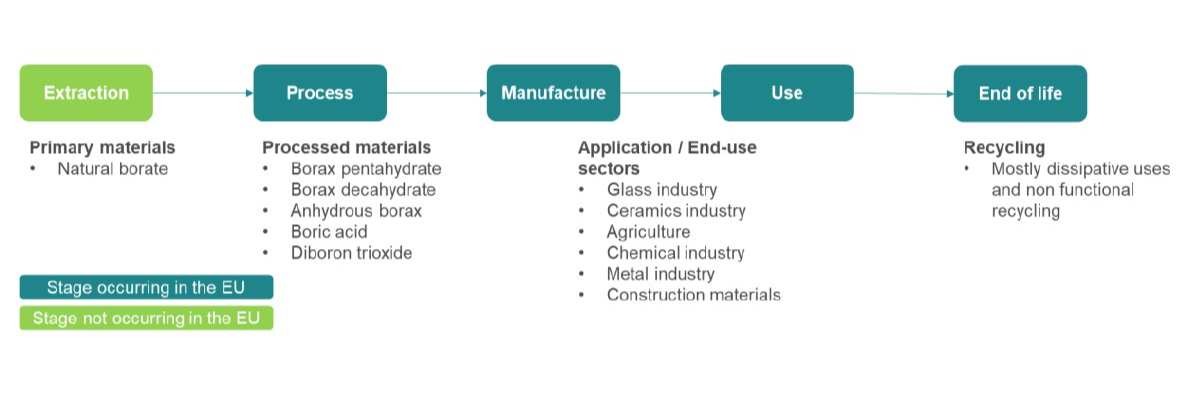
Borates are naturally occurring minerals containing boron (B, atomic number 5). The industry defines borates as any compound that contains or supplies boric oxide (B2O3). Borates are inorganic salts of boron (B) with major deposits found in Turkey and California. Natural borates occur under the form of boron-containing minerals such as colemanite, ulexite, tincal, and kernite. Those minerals are processed into several chemical forms, including borax pentahydrate, borax decahydrate, anhydrous borax, boric acid and diboron trioxide. A large share of natural borates and refined borates are used in the glass and ceramics industries, where borates ensure a low coefficient of thermal expansion. It improves the resistance of those materials to high temperature and prevents cracking (such as in pyrex cookware, or laboratory equipment).
Borates are also essential for agriculture and are used as such in fertilisers, as boron is a necessary element for plant growth. Boron can be found in most plants, in particular in fruits. Borates are used in the chemical industry, in some metals and construction materials, for various properties: borates can be used as a wood preservative and a fungicide, they can improve the physical strength of some materials. Finally, there are other uses with non-significant amounts, but of high economic importance, such as boron used in NdFeB magnets or semiconductor manufacturing.
| Global production | Global producers | EU consumption | EU share | EU suppliers | Import reliance |
|---|---|---|---|---|---|
| 4,797,898t | Turkey 46% United States 22% Chile 7% Bolivia 7% China 6% Peru 5% Argentina 4% | 13,383t | 0% | Turkey 99% | 100% |
| Global production | Global producers | EU consumption | EU share | EU suppliers | Import reliance |
|---|---|---|---|---|---|
| 5,862,737t | Turkey 46% United States 22% Kazakhstan 9% Chile 7% Bolivia 5% China 4% Peru 3% Argentina 2% | 44,701t | 1% | Turkey 69% United States 18% United Kingdom 2% | 100% |
The annual price evolution of bulk industrial-grade boron oxide (B2O3) (~98–99% purity) over the period 2000–2024 is presented in Figure 2. Boron oxide prices exhibited two major periods of increase during this timeframe. The first occurred between 2011 and 2012, when prices rose sharply from approximately €216/t to €390/t, while the second and more pronounced increase took place after 2021, with prices rising from around €326/t in 2021 to approximately €550/t in 2023 [USGS (boron),2026]. Overall, the long-term price trend indicates moderate historical price stability interrupted by periods of strong market pressure, likely associated with increased energy and processing costs, supply-chain constraints, and rising demand from the glass, ceramics, and specialty chemical sectors. It should be noted that specialty and ultra-high-purity boron oxide used in semiconductors, optics, and electronics is far more expensive [criticalstrategicmetals (boron),NA].
Figure 3 presents the EU sourcing of borates and global borate production during the 2019–2023 period, distinguishing between the extraction and processing stages of the value chain. The diagrams relating to extraction represent the supply of raw borate materials, while the processing diagrams illustrate the distribution of refined and processed borate products used in industrial applications.At the extraction stage, the EU demonstrates an extremely high dependence on Turkey, which accounts for 98.8% of EU borate supply, with only 1.2% originating from the rest of the world. In terms of global extraction, Turkey is also the leading producer, representing 46.7% of worldwide borate extraction. It is followed by United States with 22.2%, Chile with 8.1%, China and Bolivia with 6.1% each, as well as Peru (4.1%) and Argentina (4.0%).At the processing stage, Turkey continues to dominate EU borate supply, accounting for 67.5% of processed borates entering the EU market, followed by the United States with 19.3% and the United Kingdom with 3.1%, while the remaining share is distributed among several smaller suppliers, including Russia, China, Peru, Chile, Argentina, India, and Japan. Globally, Turkey also leads borate processing activities with a 48.1% share, followed by the United States (23.9%), Kazakhstan (7.7%), Chile (5.8%), Bolivia (4.3%), and China (4.0%). Overall, the figure highlights both the dominant position of Turkey within the global borate industry and the significant strategic dependence of the EU on Turkish borate supply across the entire value chain.
The nature of end uses limits the potential for functional recycling of boron/borates, as many applications involve consumable products such as fertilisers, chemicals, and detergents that are fully depleted during use. In other cases, only non-functional recycling is feasible. For example, separation of borosilicate glass from boron-free container and flat glass is not possible; consequently, waste borosilicate glass is typically redirected into conventional glass production, where it may cause defects in the final product.
Borates are a key input material in the production of fibreglass insulation, textile fibreglass, borosilicate glass, ceramics and fertilisers. These applications account for over three-quarters of borates consumption.
The borates imported in the EU are mostly embodied in glass products. The next common application of borates imports is the supply to ceramics and frits industry followed by fertilisers. Borates also have applications within the construction, metallurgy and chemicals industries. Other applications and uses include as construction materials, abrasives, catalysts, coatings, and detergents.
| Use | Percentage | Substitute | Sub share | Cost | Performance |
|---|---|---|---|---|---|
| Glass | 56% | No substitute | 93% | No substitute | |
| Glass | 56% | Silica in CFRP | 2% | Slightly higher costs (up to 2 times) | Reduced |
| Glass | 56% | Cellulose | 2% | Similar or lower costs | Reduced |
| Glass | 56% | Rock wool | 2% | Slightly higher costs (up to 2 times) | Reduced |
| Glass | 56% | ECR glass fiber | 1% | Slightly higher costs (up to 2 times) | Reduced |
| Fertilizers | 16% | No substitute | 100% | No substitute | |
| Frits and ceramics | 10% | No substitute | 98% | No substitute | |
| Frits and ceramics | 10% | Phosphate | 2% | Similar or lower costs | Reduced |
| Chemical manufacture | 9% | Not assessed, below 10 % | 100% | No substitute |
Borates have very limited substitutability across most applications. In the dominant use sector, glass (55.06%), about 93% of demand has no substitute, while only small shares can be partially replaced by alternatives such as silica in CFRP (2%), cellulose (2%), rock wool (2%), and ECR glass fibre (1%), all of which generally involve reduced performance and often higher costs. In frits and ceramics (16.85%), substitution is also limited, with 98% of use having no substitute and only about 2% potentially replaced by phosphates, again with performance trade-offs. Fertilizers (14.61%) show no viable substitutes (100%), reflecting boron’s essential role as a micronutrient. In smaller sectors such as construction materials, chemical manufacturing, and metals (each 4.49%), substitution is largely not assessed but generally considered negligible (mostly <10% potential substitution), indicating strong dependence on borates across all major end uses. Overall, the data highlight that borate substitution is technically constrained and, where possible, typically involves reduced performance or higher costs.
Global boron demand is expected to grow strongly over the next decade, driven by decarbonisation-related applications such as wind energy, solar power, electric vehicles, energy-efficient buildings, and energy storage. Demand is projected to increase at a CAGR of around 4–5%, potentially reaching 1.5–2.5 times current levels by 2030, with energy-transition uses becoming the dominant driver of consumption. In contrast, supply growth remains limited due to the concentration of production in a few countries, mainly Turkey and the United States, and the absence of significant new capacity in the short term. Although several projects may add future supply, they are unlikely to fully offset rising demand in the near term, creating a structural supply–demand imbalance. This is expected to sustain upward pressure on prices and increase supply risk for key industries such as glass, ceramics, composites, automotive, and chemicals.
Crystalline silica is regulated under EU CLP legislation due to its hazardous properties, with occupational exposure to respirable silica dust linked to serious health risks such as silicosis and lung cancer. EU and international limits (e.g. 0.1 mg/m³ in the EU and 0.05 mg/m³ in the USA) aim to reduce exposure, supported by initiatives like NEPSI. Silica sand extraction can also cause environmental impacts including land disturbance, dust emissions, and ecosystem disruption, although rehabilitation can provide ecological benefits. At the same time, silica is a key enabler of low-carbon technologies, including insulation and glazing in buildings, wind turbine blade composites, cleaner combustion systems, and high-voltage energy infrastructure, with applications ranging from construction-grade materials to ultra-high-purity electronics. Boron compounds are widely used in glass, detergents, flame retardants, and fertilizers, and occur naturally in groundwater and food. While essential in small amounts, high exposure can be toxic, with health concerns linked mainly to reproductive effects, and regulated exposure limits in air and drinking water. Boron production is highly concentrated in a few countries and involves environmentally intensive refining processes. Despite these constraints, boron plays an increasing role in low-carbon technologies, including hydrogen storage, advanced batteries, and high-performance materials for energy, electronics, and thermal management applications.
Market analysis, trade and prices
| Global production | Global producers | EU consumption | EU share | EU suppliers | Import reliance |
|---|---|---|---|---|---|
| 4,797,898t | Turkey 46% United States 22% Chile 7% Bolivia 7% China 6% Peru 5% Argentina 4% | 13,383t | 0% | Turkey 99% | 100% |
| Global production | Global producers | EU consumption | EU share | EU suppliers | Import reliance |
|---|---|---|---|---|---|
| 5,862,737t | Turkey 46% United States 22% Kazakhstan 9% Chile 7% Bolivia 5% China 4% Peru 3% Argentina 2% | 44,701t | 1% | Turkey 69% United States 18% United Kingdom 2% | 100% |
Turkey and USA are both the biggest world producers and EU suppliers
| Mining | Processing/refining | ||
|---|---|---|---|
| CN Code | Title | CN Code | Title |
| 25280000 | Borates, natural, and concentrates thereof, whether or not calcined, and natural boric acids containing <= 85% of H3BO3 calculated on the dry weight (excl. borates separated from natural brine) | 28045010 | Boron |
| 28100010 | Diboron trioxide | ||
| 28100090 | Oxides of boron and boric acids (excl. diboron trioxide) | ||
| 28401100 | Anhydrous disodium tetraborate 'refined borax' | ||
| 28401910 | Disodium tetraborate pentahydrate | ||
| 28401990 | Disodium tetraborate 'refined borax' (excl. anhydrous and disodium tetraborate pentahydrate) | ||
| 28402010 | Borates of sodium, anhydrous (excl. disodium tetraborate 'refined borax') | ||
| 28402090 | Borates (excl. of sodium, anhydrous, and disodium tetraborate 'refined borax') | ||
| 28499010 | Carbides of boron, whether or not chemically defined | ||
The code 2528 00 00 is used to indicate borates, natural and concentrates thereof, whether or not calcined, and natural boric acids containing ≤ 85% of H?BO? calculated on the dry weight (excluding borates separated from natural brine), used in the production of processed/refined products indicated in Table 6.
Figure 5 shows EU trade flows of borates under CN code Oxides of boron and boric acids (excluding diboron trioxide) (CN 2810 00 90) from 2000 to 2024. The trend of imports appears to be highly irregular, with a maximum value of 22,278.1 t in 2003 and a minimum value of 10,811 t in 2013. Exports show an overall increasing trend, with an average value of 6,476 tonnes between 2010 and 2021, although a sharp decrease was observed thereafter. Since 2021, the average export value has been 1,316 tonnes. Figure 6 shows the main countries from which the European Union imported oxides of boron and boric acids (excluding diboron trioxide) (CN 2810 00 90) between 2000 and 2024. The main suppliers to the European Union are, in order of importance, Turkey, the United States, Peru, and the United Kingdom. Note that imports from the United Kingdom gradually decreased from 1,867,044 t in 2020 to 141,365 t in 2024.
Figure 7 shows EU trade flows of Borate CN code Borates (excl. of sodium, anhydrous, and disodium tetraborate 'refined borax') (CN 2840 20 90) from 2000 to 2024. Import and export trends appear to be fairly regular, with 2024 marking 996t for imports and 218t for exports.
Figure 8 shows the main countries from which the European Union imported Borates (excl. of sodium, anhydrous, and disodium tetraborate 'refined borax') (CN 2840 20 90) in the years between 2000 and 2024. The main suppliers to the European Union are, in order of importance, China,Turkey, Peru and India.
Figure 17 shows EU trade flows of Borate CN code Boron (CN 2804 50 10) from 2000 to 2024. The trend of imports, over the years, show a negative trend with 121,207t in 2000 to 3,632t in 2024 with a maximum value of 672,617t in 2014. Exports have followed a more regular pattern tending, over the years, toward a slight increase.
Figure 18 shows the main countries from which the European Union imported Boron (CN 2804 50 10) in the years between 2000 and 2024. The UK has consistently been the main supplier over the years, with a peak supply in 2014 of 522,063t. Since 2015, imports have decreased dramatically.
Figure 9 shows EU trade flows of Borate CN code Diboron trioxide (CN 2810 00 10) from 2000 to 2024. The trend of imports appears to be very irregular with a minimum value of 122.105t in 2009 and a maximum value of 2,444.937t in 2021. Exports, on the contrary, appear to be more regular.
Figure 10 shows the main countries from which the European Union imported Diboron trioxide (CN 2810 00 10) in the years between 2000 and 2024. The major suppliers, above all, between 2019 and 2024, were Turkey with an average value of 945.288t and, to a lesser extent, the United States with an average value of 154.277t.
Figure 15 shows EU trade flows of Borate CN code Anhydrous disodium tetraborate 'refined borax' (CN 2840 11 00) from 2000 to 2024. The trend of imports is regular until 2015 with an average value of 2.810,045t and a major growth from 2016 to 2024 for an average value of 4.262,743t. Very low exports until 2008 increase considerably to an average of 2.074,93t.
Figure 16 shows the main countries from which the European Union imported Anhydrous disodium tetraborate 'refined borax' (CN 2840 11 00) in the years between 2000 and 2024. The European Union's largest supplier is the United States, with the quantity of exports in 2024 amounting to 1.130,635t. Also in the same year, the European Union imported from the rest of the world an amount equal to 2.774,502t.
Figure 11 shows EU trade flows of Borate CN code Disodium tetraborate pentahydrate (CN 2840 19 10) from 2000 to 2024 . Regular trend between 2009 and 2024, with a slight increase in the last three years. Exports after a trend with appreciable values around 28,000t between 2015 and 2021, mark a decline in the last three years.
Figure 12 shows the main countries from which the European Union imported Disodium tetraborate pentahydrate (CN 2840 19 10) in the years between 2000 and 2024. The European Union's largest supplier over the past 20 years has been Turkey, with a 2024 supply of 30,881,871t
Figure 13 shows EU trade flows of Borate CN code Disodium tetraborate 'refined borax' (excl. anhydrous and disodium tetraborate pentahydrate) (CN 2840 19 90) from 2000 to 2024. Negative trend with two peaks marked in 2017 (2,904.474t) and 2021 (3,940.085t). 2024 consolidates its imports with a value of 656.161t.
Figure 14 shows the main countries from which the European Union imported Disodium tetraborate 'refined borax' (excl. anhydrous and disodium tetraborate pentahydrate) (CN 2840 19 90) in the years between 2000 and 2024. Over the past 16 years, the main supplier to the European Union has been Turkey, with a supply of 651.079 tonnes in 2024.
Figure 21 shows the trend of imports and exports of natural B2O3 and concentrates (CN 25280000) in the European Union, over a period from 2012 to 2024. You notice that the trend of exports is quite regular over the years, while a slight negative trend of imports is also evident between 2020 and 2024. In 2012 the EU imported about 16.582,84 tonnes of Borate ore compared to 13,351.397 tonnes in 2024 with a peak of 21,184.469 tonnes in 2017. Exports followed a similar trend although with a lower order of magnitude. The European Union exported in 2012 a quantity of 1,107.837 tonnes and in 2024 almost 1,193.00 tonnes with the highest value of 2,657.11 tonnes in 2021.
Figure 22 shows that Turkey is, by far, the largest supplier of natural B2O3 and concentrates (CN 25280000) of European Union with a 99 percent share of total imports, with supplies ranging from 16,237,546 tonnes in 2012 to 13,223.522 tonnes in 2024.
Figure 19 shows EU trade flows of Borate CN code Borates of sodium, anhydrous (excl. disodium tetraborate 'refined borax') (CN 2840 20 10) from 2000 to 2024. Between 2012 (764,507t) and 2020 (3.111,83t), a strong upward trend can be observed, while between 2022 and 2024, a slump is observed. Exports are consistently very low. Figure 20 shows the main countries from which the European Union imported Borates of sodium, anhydrous (excl. disodium tetraborate 'refined borax') (CN 2840 20 10) in the years between 2000 and 2024. Between 2012 and 2021, the European Union's largest supplier was Turkey, overtaken by imports from other parts of the world in the collapse years 2022/2024.
Figure 23 shows EU trade flows of borates under CN code Carbides of boron, whether or not chemically defined (CN 2849 90 10) from 2000 to 2024. Starting from 2009, a strongly positive trend in imports is evident. Exports, after a period of strong growth from 2008 to 2012, have been at lower levels since 2013.Figure 24 shows the main countries from which the European Union imported carbides of boron, whether or not chemically defined (CN 2849 90 10), between 2000 and 2024. In the 2000s, China was already the largest exporter to the EU, with volumes lower than 200 t annually. A sharp increase in imports is observed from 2017 to 2024, with China, by far, the largest exporter.
The annual price evolution of bulk industrial-grade boron oxide (~98–99% purity) over the period 2000–2024 is presented in Figure 25. Overall, boron oxide prices remained relatively stable during the early 2000s, generally fluctuating between approximately €180–250/t, reflecting the relatively concentrated but balanced structure of the global borates market. Two major price escalation periods can nevertheless be identified. The first occurred between 2011 and 2012, when prices increased sharply from about €216/t to €390/t (+~80%), likely associated with higher global commodity prices, increased energy costs, and stronger demand from the glass and ceramics sectors. A second and more pronounced increase took place after 2021, with prices rising from approximately €326/t in 2021 to around €550/t in 2023 (+~69%) [USGS (boron),2026]. This latter increase coincided with global inflationary pressures, energy market disruptions, supply-chain bottlenecks, and increasing demand for boron-containing products used in fiberglass, specialty glass, detergents, fertilizers, and clean-energy technologies [criticalstrategicmetals (boron),NA].
Global boron demand is projected to increase significantly over the next decade, supported by accelerating deployment of decarbonisation technologies such as wind energy, solar power, electric vehicles, energy-efficient buildings, and advanced energy storage systems. Overall borates demand is expected to grow at a compound annual growth rate (CAGR) of around 4–5%, with total consumption potentially rising by 1.5–2.5 times by 2030 compared to current levels. Growth is increasingly concentrated in energy-transition applications, which are expected to expand from roughly 20–30% of total demand today to more than 60% by 2030, particularly driven by glass wool insulation, high-performance glazing, wind turbine composites, and battery technologies. In contrast, supply growth remains limited, as global production is highly concentrated in a small number of countries—primarily Turkey and the United States—and no major new large-scale capacity is expected to fully enter the market in the short term. Although several new projects (e.g. in Serbia and North America) may add future capacity, their impact is unlikely to fully balance demand growth in the near to medium term. This structural imbalance is expected to keep the market tight and support a potential 25–40% price increase over the next 4–5 years, while increasing supply risk for downstream industries such as glass, ceramics, automotive components, composites, and chemicals [aranca,2023] [fortunebusinessinsights (boron),2026].
Demand
World borates consumption was about 2,290 ktonnes in B?O? content, or 821 ktonnes in B content, in 2018 [(Orocobre, 2021). Total EU apparent consumption of borates between 2016 and 2020 was estimated at 33,000 t per year (B content). Natural borates account for one-third of total consumption, while processed/refined borates account for two-thirds.Borates extraction stage EU consumption is presented under HS code CN 25280000 – Natural borates and their concentrates. Import and export data are extracted from Eurostat Comext (2022). Production data is extracted from WMD (2022). Based on Eurostat Comext (2021) and WMD (2022), the average import reliance of borates at the extraction stage is 100%, of which 99% comes from Turkey.Borates processing stage EU consumption is presented under HS codes CN 28100010 – Diboron trioxide, CN 281000 – Oxides of boron and boric acids, CN 284011 – Anhydrous disodium tetraborate (refined borax), and CN 284019 – Disodium tetraborate, not anhydrous. Import and export data are extracted from Eurostat Comext (2022) [Eurostat Comext,2022]. Production data are extracted from Eurostat Prodcom [Eurostat Prodcom,2023] using PRCCODE 20136230 (borates; perborates), PRCCODE 20132465 (oxides of boron and boric acids, excluding diboron trioxide), and PRCCODE 20132462 (diboron trioxide). Based on Eurostat Comext (2022) and Eurostat Prodcom (2022), the average import reliance of borates at the processing stage is 53.5% for the period 2008–2020.
Figure 26 shows the import and export data of Borate (CN 25280000) within the European Union. The information was published to a time frame from 2012 to 2023.
Based on the average 2018-2022 (WMD, Prodcom. Eurostat), the import dependence of boron ores is 100% at the extraction stage, of which 99% from Turkey. As for boron derivates, import reaches also a share of 100%.
Borates are a key input material in the production of fibreglass insulation, textile fibreglass, borosilicate glass, ceramics and fertilisers. These applications account for over three-quarters of borates consumption. The borates imported in the EU are mostly embodied in glass products.
The next common application of borates imports is the supply to ceramics and frits industry followed by fertilisers. Borates also have applications within the construction, metallurgy and chemicals industries. Other applications and uses include construction materials, abrasives, catalysts, coatings, and detergents.
Borates are a key input material in the production of fibreglass insulation, textile fibreglass, borosilicate glass, ceramics and fertilisers. These applications account for over three-quarters of borates consumption. The borates imported in the EU are mostly embodied in glass products. The next common application of borates imports is the supply to ceramics and frits industry followed by fertilisers. Borates also have applications within the construction, metallurgy and chemicals industries. Other applications and uses include as construction materials, abrasives, catalysts, coatings, and detergents.
| Applications | 2-digit NACE sector | Value added of NACE 2 sector | 4-digit CPA |
|---|---|---|---|
| Glass | C23 - Manufacture of other non-metallic mineral products | 90,000M€ | C23 - Manufacture of other non-metallic mineral products |
| Fertilizers | C20 - Manufacture of chemicals and chemical products | 146,000M€ | C20 - Manufacture of chemicals and chemical products |
| Frits and ceramics | C23 - Manufacture of other non-metallic mineral products | 90,000M€ | C23 - Manufacture of other non-metallic mineral products |
| Chemical manufacture | C20 - Manufacture of chemicals and chemical products | 146,000M€ | C20 - Manufacture of chemicals and chemical products |
-
Boron is a naturally-occurring element: Trace amounts are found in soil, water, plants and animals. The element boron does not exists by itself in nature. It combines with oxygen and other elements to form salts called borates.
-
Boron is essential for plant life: It is integral to a plant's reproductive cycle, aiding with flowering, pollen production, germination, and seed and fruit development.
-
The first confirmed use of borates was in the 8th century: Arabian gold and silversmiths used them. It is thought that ancient Babylonian goldsmiths could have used borates as far back as 2,000 BCE.
-
Borates are used in cleaning: Borates’ unique properties enhance stain removal, whiten and brighten fabrics, and soften water, which is why they are used to produce laundry detergents, household or industrial cleaners and personal care products.
-
Borates are used in space travel: They coat the ceramic tiles on the underside of a space shuttle to help it withstand the thermal shock of re-entry. Thermal shock occurs when temperatures change suddenly, as when the shuttle leaves the freezing temperatures of space and re-enters the Earth’s atmosphere.
-
Borates are an important ingredient in insulation fiberglass: This is the largest single use for the mineral worldwide.
-
Borates play a critical role in high-tech products: Such as the tough cover heat-resistant glass in smartphones, tablets and other electronic displays (Rio Tinto).
-
Boron in: ceramics, enamels, and glazes.
-
Boric acid: ensures the long-term health of wood materials by protecting them from fire, moisture, fungi and pests.
The glass industry dominates the demand for borates worldwide. Natural (e.g. colemanite concentrates, ulexite) or refined borates (e.g. borax pentahydrate, boric acid) can be added as raw materials during the manufacturing of glass depending on the application and the required quality.
The boron in borosilicate glass imparts increased mechanical strength and resistance to chemical corrosion, as well as improved resistance to high temperatures and thermal shocks due to a low coefficient of thermal expansion. Borosilicate glass consists of considerable levels of SiO2 and B2O3 as major glass–forming oxides, and are typically made of 70–80 SiO2, 7–13 B2O3, 4–8 Na2O or K2O, and 2–8 Al2O3 (in wt. %). Glass having 7–13 wt. % B2O3 is recognized as low–BSG, and is majorly employed to manufacture chemical equipment, lamps, and tube envelopes. Glasses with 15–25 % B2O3 is classified as high–BSG, which is also grouped as leachable alkali–BSG having an optimum composition of 62.7 SiO2, 26.9 B2O3, 6.6 Na2O and 3.5 Al2O3 (in wt. %) [Bekir KARASU et al.,2020] .
One of the largest uses of borates in Europe is in insulation and textile fibreglass. In both insulation and textile fibre glass, borates act as a powerful flux and lower glass batch melting temperatures. They also control the relationship between temperature, viscosity and surface tension to create optimal glass fiberisation. Furthermore, boron addition to the glass melt facilitates the production process as it lowers the glass batch melting temperature, favours fiberisation and inhibits crystallisation of the glass.
Glass products can be grouped in two categories:
-
Insulation glass: Insulation fibreglass (IFG) used in construction, vehicles, appliances and machinery for thermal and acoustic insulation;
-
Other glass (excl. insulation): Textile fiberglass (TFG) used in the manufacture of composite materials (glass-reinforced plastics), and borosilicate glass used in heat-resistant glass cookware and glass panels (e.g. for oven doors), laboratory glassware, pharmaceutical packaging, light bulbs, solar panels, and LCD screens.
Borates are essential ingredient to produce frits used by the ceramic industry in ceramic glazes and enamels for chemical, thermal cycling, and wear resistance.
Boron is an essential micronutrient for plant growth, crop yield and seed development. Although only low amounts of boron are required, its deficiency in soil can have severe effects on crops.
Borates are used in laundry detergents, household and industrial cleaning products. Borates enhance stain removal and bleaching, provide alkaline buffering, soften water and improve surfactant performance.
Borates are used to treat wood to ward off insects and other pests (as wood preservatives) and in fire retardants.
Boron compounds used in metalworking and automotive fluids mainly include boric acid, borax (sodium borates), borate esters, and potassium borates. These compounds are added to metalworking fluids, antifreeze, hydraulic fluids, and brake fluids because they provide corrosion inhibition, pH buffering, lubrication, thermal stability, and anti-wear properties.
| Use | Percentage | Substitute | Sub share | Cost | Performance |
|---|---|---|---|---|---|
| Glass | 56% | No substitute | 93% | No substitute | |
| Glass | 56% | Silica in CFRP | 2% | Slightly higher costs (up to 2 times) | Reduced |
| Glass | 56% | Cellulose | 2% | Similar or lower costs | Reduced |
| Glass | 56% | Rock wool | 2% | Slightly higher costs (up to 2 times) | Reduced |
| Glass | 56% | ECR glass fiber | 1% | Slightly higher costs (up to 2 times) | Reduced |
| Fertilizers | 16% | No substitute | 100% | No substitute | |
| Frits and ceramics | 10% | No substitute | 98% | No substitute | |
| Frits and ceramics | 10% | Phosphate | 2% | Similar or lower costs | Reduced |
| Chemical manufacture | 9% | Not assessed, below 10 % | 100% | No substitute |
Borates have very limited substitutability across most applications, reflecting their unique physicochemical properties and the specific functional roles they play in industrial processes. In the dominant use sector, glass (55.06% of total demand), approximately 93% of demand has no viable substitute. Only small shares can be partially replaced by alternatives such as silica in carbon fibre-reinforced polymers (CFRP) (2%), cellulose (2%), rock wool (2%), and ECR glass fibre (1%). However, these alternatives typically involve compromises in product performance, including reduced thermal resistance, lower chemical durability, or inferior mechanical properties, and they are often associated with higher production costs. In case of frits and ceramics (16.85%), substitution is similarly constrained. Around 98% of borate use in this sector has no viable substitute, while only approximately 2% can potentially be replaced by phosphates. Even in these limited cases, substitution generally leads to changes in melting behaviour, glaze stability, or final product quality, making borates difficult to replace without affecting performance or process efficiency. In case of fertilizers (14.61%), no technically viable substitutes are identified (100% non-substitutable). This reflects the essential role of boron as a micronutrient for plant growth, where deficiency cannot be compensated by other elements without directly affecting crop yield and quality. For smaller application sectors such as construction materials, chemical manufacturing, and metals (each accounting for around 4.49% of demand), substitution is generally not assessed in detail but is widely considered negligible, typically below 10% potential substitution. In these uses, borates perform highly specific functions such as fluxing, corrosion inhibition, or chemical stabilization, for which alternative materials either do not exist or fail to provide comparable efficiency.
The substitution of other materials for boron is possible in detergents, enamels, insulation, and soaps. Sodium percarbonate can replace borates in detergents and requires lower temperatures to undergo hydrolysis, which is an environmental consideration. Some enamels can use other glass-producing substances, such as phosphates. Insulation substitutes include cellulose, foams, and mineral wools. In soaps, sodium and potassium salts of fatty acids can act as cleaning and emulsifying agents [USGS,2025].
Substitute materials for TFT-LCD glass include rare earth elements such as lanthanum, yttrium, cerium, or Erbium. The rare earth elements are added to reduce the boron content in flat panel display glass [Borates Today,2022]. In the criticality assessment, no substitution is considered available for the use of borates in the applications of ‘Glass’.
Potential substitutes for boron compounds in frits and ceramics include phosphates, lithium compounds, feldspar, fluorides, and alkaline-earth oxides such as calcium and magnesium oxides, which can partially replace borates as fluxing agents. However, borates remain difficult to substitute because they uniquely lower melting temperatures, improve glaze viscosity, enhance chemical durability, and reduce firing times [help.glazy,NA].
Potential substitutes for boron compounds in fertilizers are extremely limited because boron is an essential micronutrient required for plant growth, cell wall formation, and reproductive development. In practice, there are no direct chemical substitutes for boron in agricultural applications, although improved soil management, organic matter addition, and precision fertilization techniques can help optimize boron efficiency and reduce demand. However, boron deficiency cannot be compensated by other nutrients without negatively affecting crop yield and quality.
Substitutes for boron compounds include zeolites, sodium carbonate, citrates, sodium silicates, and polycarboxylates, which can replace borates in water softening, buffering, and cleaning functions. However, substitution is often only partial because borates provide efficient buffering and cleaning performance that typically requires more complex multi-additive formulations to replicate.
Supply
The EU imported Boron, between 2018 and 2022, in the amount of 31,189t. 99% of these imports came from Turkey. In this same period, the EU consumed 96.270t in derivative products. 63.538t or 66% were supplied from Turkey while 3.851t or 4% from the United Kingdom.The intermediate refined borates include: diboron trioxide, oxides of boron and boric acids excluding diboron trioxide, anhydrous disodium tetraborate, disodium tetraborate penthahydrate and disodium tetraborate decahydrate. The EU does not extract borates [World Mining Data,2024] and has no known reserves [European Commission,2020] . Therefore, the EU is entirely reliant on imports of primary products (import reliance of 100%). Likewise, there are no manufacturing/processing plants to refine borates in the EU [SCRREEN workshop,2019].
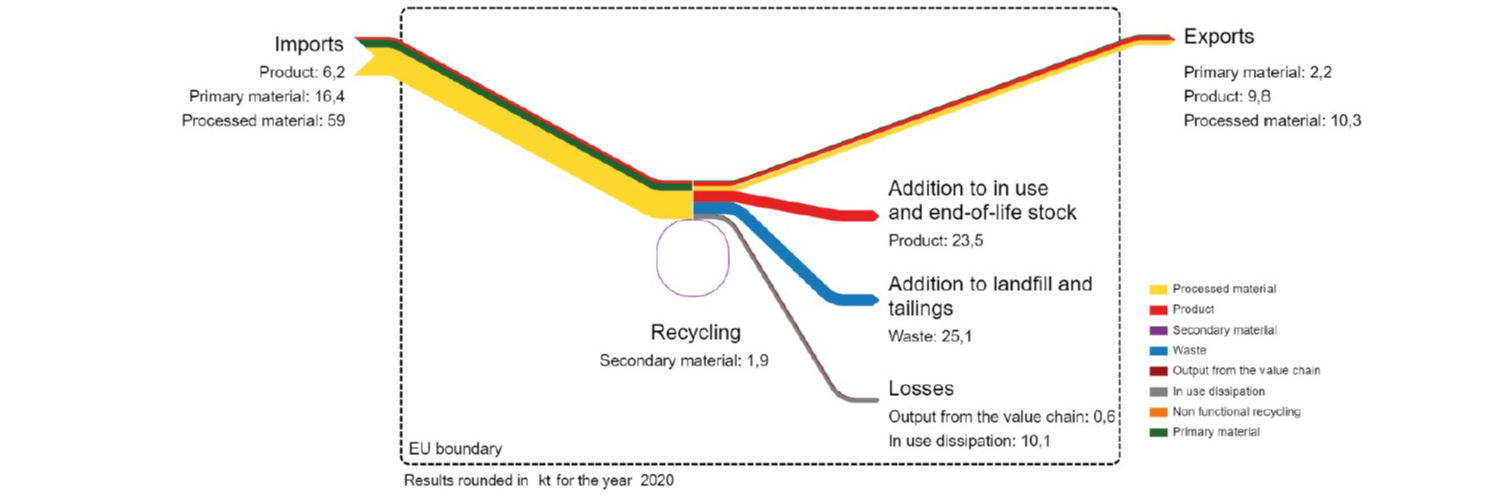
Figure 31 presents a simplified Material Flow Analysis (MFA) of borates in the EU for 2012, showing inputs, internal flows, stocks, losses, and outputs in tonnes per year within the EU-28 boundary. The system is dominated by imports, including about 15,700 t of primary material, 60,100 t of processed material, and a negligible amount of waste (~76 t), which together constitute the main supply to the EU economy, supplemented only marginally by functional recycling (~465 t of secondary material). Within the system, a portion of borates accumulates in in-use stock (about 5,960 t), while the majority flows through use and processing stages toward end-of-life. At end-of-life, the largest outflow is to landfill and tailings (approximately 31,600 t), followed by substantial losses through dissipation in use (~14,500 t) and non-functional recycling losses (~33,700 t), indicating limited material recovery. Exports are relatively small, with about 13,500 t of products leaving the EU and negligible quantities of secondary material and waste exported (0–36 t). Overall, the diagram illustrates a predominantly linear system with strong import dependence, significant dissipative losses, and only limited circularity through recycling and stock retention [rmis ,2015].
Most of the world’s commercial borate deposits are mined by open pit methods. Brines from Searles Lake, and presumably the Chinese sources, are recovered by either controlled evaporation or carbonation. Boric acid is one of the final products produced from most of the processes [Helvaci, Cahit.,2019] .
Borates are naturally occurring minerals containing boron (B). Boron does not occur naturally as a native element but is found in combination with oxygen and other elements in salts, commonly called “borates”. Boron is a relatively rare element in nature, and the average content in the Earth’s crust is reported between 10 and 17 ppm [Rudnick, Roberta & Gao, Shan.,2013].There are over 250 borate minerals occurring naturally, the most common being sodium, calcium, or magnesium salts (Helvaci 2017). Four of these account for 90% of the minerals used by the industry: the sodium borates tincal and kernite, the calcium borate colemanite, and the sodium-calcium borate ulexite [USGS,2025]. Ore quality is typically measured as a function of its diboron trioxide (B2O3) equivalent content. Deposits of borates are generally associated with arid climates and volcanically active areas. Deposits of borates are generally associated with arid climates and volcanically active areas; the largest are found in Turkey and the Mojave Desert in California of the United States. In the Puna region of the Andean belt of South America, which includes parts of Argentina, Peru, Bolivia, and Chile, commercial deposits of borates occur in brines.
| Country | Resources (tonnes) |
|---|---|
According to the USGS, major borate reserves are concentrated in a limited number of countries (Table 10) and occur in various mineral forms, specifically:Turkey (refined borates), United States (unspecified mineral species), Russia (datolite), Chile (ulexite), China (boric oxide equivalent), and Peru (crude borates) [USGS (boron),2026].
| Country | Reserves (million tonnes) |
|---|---|
| Turkey | 950 |
| US | 48 |
| Russia | 40 |
| Chile | 35 |
| China | 9.1 |
| Peru | 4 |
Known reserves of borate minerals are large, particularly in Turkey, South America, and the USA, and production from Turkey and the USA will continue to dominate the world market. However, borates from other areas will probably take up an increasing share of the world market [Helvac?, Cahit,2005] .
Due to the rapid depletion of raw material resources in the world and its use in many branches of industry, importance of boron is increasing day by day. Turkey, which has the highest boron reserves in the world is followed by Russia, South America and the United States [ETIMADEN,2025].
Jadar project in Serbia could potentially supply a significant proportion of global demand for borates. Jadar lithium-borate deposit in Serbia, estimated to contain 21 million t of B2O3 as an equivalent borate remains subject to receiving all relevant approvals, permits and licenses and ongoing engagement with local communities, the Government of Serbia and civil society [Rio Tinto,2024]. The first saleable production will be expected in 2026. In addition, two Australia-based mine developers confirmed that production of high-quality boron products would be possible from their projects in California and Nevada. The most significant is the Rhyolite Ridge project in Nevada, developed by ioneer (an Australian company), which is one of the largest known lithium–boron resources in North America, with estimated resources of around 146 million tonnes of ore containing lithium and boron. The project is expected to produce approximately 170,000 tonnes of boric acid annually alongside lithium products over a long mine life exceeding 25 years, supporting EV and energy-storage supply chains [fluor,NA]. In California, the Fort Cady boron project (developed by 5E Advanced Materials) targets a large colemanite deposit of about 41 million tonnes of ore, with planned production of boric acid and potassium sulphate over an estimated 20+ year mine life [nsenergybusiness (boron),2019].
Eti Maden organization focused on boron product supply in Asia–Pacific markets, provides more detailed data concerning boron reserves estimated as B2O3 equivalent [etimadenapac,NA]:
|
Countries |
Total Reserve (Thousand-ton B2O3) |
Distribution (%) |
|
|
|
|
|
Turkey |
948,712 |
73,4 |
|
Russia |
100,00 |
7,7 |
|
USA |
80,00 |
6,2 |
|
Chile |
41,00 |
3,2 |
|
China |
36,00 |
2,8 |
|
Peru |
22,00 |
1,7 |
|
Serbia |
21,00 |
1,6 |
|
Bolivia |
19,00 |
1,5 |
|
Kazakhstan |
15,00 |
1,2 |
|
Argentina |
9,00 |
0,7 |
|
|
|
|
|
Total |
1,291.712 |
100 |
| Country | Classification | Quantity (Mt of ore) | Grade (% Borate ) | Reporting code | Reporting date | Deposit, Source | ||
|---|---|---|---|---|---|---|---|---|
Borate resources are not known to exist within the European Union.
| Country | Classification | Quantity (Mt of ore) | Grade (% Borate) | Reporting code | Reporting date | Source | ||
|---|---|---|---|---|---|---|---|---|
Borate reserves are not known to exist within the European Union.
Data from WMD and USG (figures 32&33) are given in boron content
Functional recycling of boron/borates is generally not feasible due to the inherent characteristics of end-use applications, as many products are consumed during use (e.g. fertilisers, chemicals, and detergents), or only non-functional recycling is possible. For instance, the separation of borosilicate glass from boron-free container and flat glass is not practicable; consequently, waste borosilicate glass is typically incorporated into conventional glass production, which may result in defects in the final product. Likewise, waste ceramics are predominantly downcycled into construction materials [BIO by Deloitte,2015].
| MSA Flow | Value | ||
|---|---|---|---|
The recycling of biogenic wastes (e.g. manure, other animal by-products, and bio- and food waste) may be regarded as functional recycling, as it can substitute boron-containing industrial fertilisers [Mathieux et al.,2017]. More recently, increasing attention has been given to the recovery of elemental boron from spent end-of-life Nd-Fe-B magnets. Although not yet implemented at commercial scale, this approach enables the simultaneous recovery of rare earth elements (REEs), iron, and boron through a sequence of (a) pre-treatment roasting of magnet scrap at 800 °C, (b) acid dissolution using HCl under pressure, and (c) separation of REEs, Fe, and B via oxalic acid precipitation and solvent extraction. Under these conditions, boron is recovered as sodium borate with a purity exceeding 97% [Liu, F. et al.,2019].
Waste recycling has become an important issue in the environmental sustainability of mining operations. Beneficiation of borate ores produces a boron-bearing sludge, which utilization in ceramic manufacturing may lower the process energy demand. A case-study was carried out on a sludge coming from the processed ore of an evaporite located at the Tincalayu mine in the Salta province, Argentina. The use in vitrified tiles of this sludge was appraised addressing key-points in processing and product performances. The sludge was added to stoneware batches (up to 10% wt.) and tested at the laboratory scale. It consists of feldspars, quartz, illite and chlorite, plus ulexite (6.4% B2O3) that turns this sludge into a powerful flux. The waste had a minor effect during milling but allowed an improved compaction. The reactivity during firing was increased: the maximum temperature can be reduced from 1200 °C down to 1140 °C, according to the amount of sludge added. Stoneware tiles have a suitable technical performance, but the sludge tends to lower bulk density and increase closed porosity. Although the influence on phase composition is apparently limited, the sludge can significantly change the melt composition (enriched in boron and alkaline-earth oxides) which governs the sintering behavior. The actual amount of boron sludge recyclable in vitrified tiles is up to 5% by weight [Zanelli, C. et al.,2019].
Boric acid consists the main intermediate material for the technological applications in which the use of B is taking place. Boric acid is industrially produced based on the reaction of colemanite (Ca2B6O11·5H2O) and sulfuric acid at 88–90 oC according to the following reaction:
Ca2B6O11·5H2O + 2H2SO4 +6H2O → 6H3BO3 +2CaSO4·2H2O

Flowsheet of colemanite processing for the production of boric acid (Kuskay and Bulutcu, 2011)
Reaction is carried out in a 4-stage cascade reaction system and its duration is 3–3.5 h in order to eliminate supersaturation of gypsum (2CaSO4·2H2O) and to avoid its precipitation during boric acid crystallization. At the end of each successive reaction step, precipitated gypsum and inert solids are filtered. The cakes obtained at each step are washed and the filtrate is recycled to the next reaction step. The produced liquor (boric acid content is approximately 18%) is crystallized in a 3-stage crystallization unit composed by adiabatic vacuum crystallizers. The moisture content is reduced approximately to 7% through centrifugation. The final product is crystallized via drying in a fluidized bed drier [Kuskay, B., Bulutcu, A.N.,2011].
Other considerations
Boron compounds are used in the manufacture of glass, soaps and detergents and as flame retardants. Naturally occurring boron is present in groundwater primarily as a result of leaching from rocks and soils containing borates and borosilicates [WHO boron chemical,2022]. Boron is a trace element that is naturally present in many foods and available as a dietary supplement. [NIH ,2022]. No data are available on adverse effects of high boron intakes from food or water. Short- and long-term oral exposures to boric acid or borax in laboratory animals have demonstrated that the male reproductive tract is a consistent target of toxicity [WHO boron chemical,2022]. Symptoms associated with accidental consumption of boric acid or borax (sodium borate), contained in some household cleaning products and pesticides, include nausea, gastrointestinal discomfort, vomiting, diarrhea, skin flushing, rash, excitation, convulsions, depression, and vascular collapse. On the other side, a few clinical studies in humans suggests that boron might be helpful for reducing the symptoms of osteoarthritis and might be important for bone growth and formation [NIH ,2022]. The oxide of boron, boron trioxide, is identified as toxic for reproduction [ECHA, European Chemicals Agency,2025] . The limit value of boron oxide in air is estimated at 10 mg/m3 in European countries, while according to the USA OSHA it is estimated at 15 mg/ m3 [GESTIS,2025] . [WHO boron chemical, 2022] developed a set of ‘Guidelines for drinking water quality’, where the guideline value for boron is set at 2.4 mg/l.
The environmental impact of boron refining processes is reported to be significantly higher than that of mining and beneficiation stages, primarily due to the intensive use of processing chemicals. Key inputs such as sulphuric acid, steam, hydrogen peroxide, and sodium perborate are identified as major contributors to environmental burdens, with sodium perborate in particular associated with the highest impact among refined boron products. In addition, it has been noted that there is currently limited available data on the environmental impacts of boric acid production via solvent extraction from salt-lake brines, despite the importance of boron for industrial, agricultural, and wider societal applications [Türkbay R., et al.,2022], [Wu, J. et al.,2021].
Normative requirements for borates are defined by application-specific industrial standards and regulatory limits that control composition, purity, and safe use. In glass manufacturing, boron is incorporated as B2O3 typically in the range of ~5–15 wt.% in borosilicate and specialty glasses, where it is regulated through established glass product standards ensuring controlled thermal expansion, chemical durability, and melting behavior [ASTM C162 Standard (glass),2010].
In the fertiliser sector, boron is treated as an essential micronutrient but is tightly controlled due to toxicity risks, with allowable concentrations and product safety requirements defined under EU Regulation (EU) 2019/1009, which governs fertilising products placed on the EU market [eur-lex.europa (fertilizers),2019].
The main global producers of boron ores are six countries: Turkey (49.7%), the United States (23.7%), Chile (8.4%), Bolivia (5.6%), China (4.7%), and Argentina (3.1%). These countries also represent the principal exporters of processed borates, although with slightly different shares. When comparing borate exports to the total export volumes of these countries, borates account for approximately 1% of total exports in most cases, with Bolivia as an exception at around 7%. At first glance, this suggests that borate mining and processing have a limited macroeconomic impact. However, a more detailed assessment shows that more than 90% of global borate production and processing is concentrated in just six countries, making their role—particularly that of Turkey and the United States—strategically important in the global supply chain. It should also be noted that boron compounds have limited substitutability in many of their key applications, meaning that secure access to borates is critical for a wide range of industrial processes.
| Country | Export value (USD) | Share in total exports |
|---|---|---|
Borates mining and processing raise several social and ethical issues primarily related to labour conditions, community dependence, and supply-chain responsibility. Because global borate production is highly geographically concentrated (mainly in Turkey and the United States), local communities in mining regions often experience a strong economic dependence on a single extractive industry, which can increase vulnerability to market fluctuations and long-term employment insecurity.
Borates and boron-based compounds are expected to be increasingly important in low-carbon and green technology development, particularly due to their role in energy storage, conversion, and advanced functional materials. In hydrogen energy systems, boron hydrides (e.g., borohydrides, ammonia borane, and closo-borates) are widely investigated as solid-state hydrogen storage media, offering high gravimetric hydrogen densities and enabling cleaner fuel-cycle technologies for fuel cells and mobility applications. Boron compounds are also being explored for hydrogen production and catalytic processes, where their electron-deficient chemistry enables efficient hydrogen release and regeneration pathways [Kumar et al. ,2019].
In the field of electrochemical energy storage, borates and boron-based structures are studied as key components in next-generation lithium-ion and post-lithium batteries, where they improve electrolyte stability, thermal resistance, and electrochemical performance. Boron-containing solid electrolytes and additives are also being developed to enhance safety and cycle life in batteries for electric vehicles and grid storage [Zheng, C.A.,2022].
Beyond hydrogen storage and batteries, boron-based materials are increasingly explored in several emerging research and development areas for decarbonisation and advanced energy systems. Two-dimensional boron materials such as borophene and boron nitride (BN) are under active investigation for next-generation energy storage, catalysis, and electronic devices, due to their high surface area, tunable electronic structure, and strong chemical stability. These materials are being studied for high-capacity lithium/ sodium-ion batteries, supercapacitors, and electrocatalysis for hydrogen evolution and CO2 reduction reactions, where boron doping improves charge transfer and catalytic efficiency [Wang et al (borates),2019].
Another rapidly developing area is functional advanced materials for electronics and optoelectronics, where boron compounds such as boron nitride and boron-doped materials are used in thermal management systems, insulating layers, and energy-efficient electronic components. These materials are also being integrated into photovoltaic systems and energy harvesting devices due to their high thermal stability and wide band-gap properties [Maity et al.,2025].