Overview
Tellurium Products appear in several forms. Elemental Tellurium (Te) can be found in powder, ingots, or granules. Tellurium can also be used as an additive in steel and copper alloys to improve machinability, and in lead alloys to improve strength, and resistance to corrosion and vibration. Tellurium Dioxide (TeO2) is used in optics and acousto-optic devices. Various tellurium compounds are used in semiconductors, thermoelectric applications, cadmium-telluride solar panels, and as catalysts in certain chemical manufacturing processes.. Tellurium nanostructures are used in artificial intelligence chips to enhance data processing speed and efficiency. Tellurium Diethyldithiocarbamate is also used as an accelerator in rubber vulcanisation.
The term "Tellurium" refers to both the element in minerals and the processed metal. In this factsheet, the term tellurium element refers to its natural occurrence in geological context, and the term tellurium refers to the refined metal used in industrial applications.
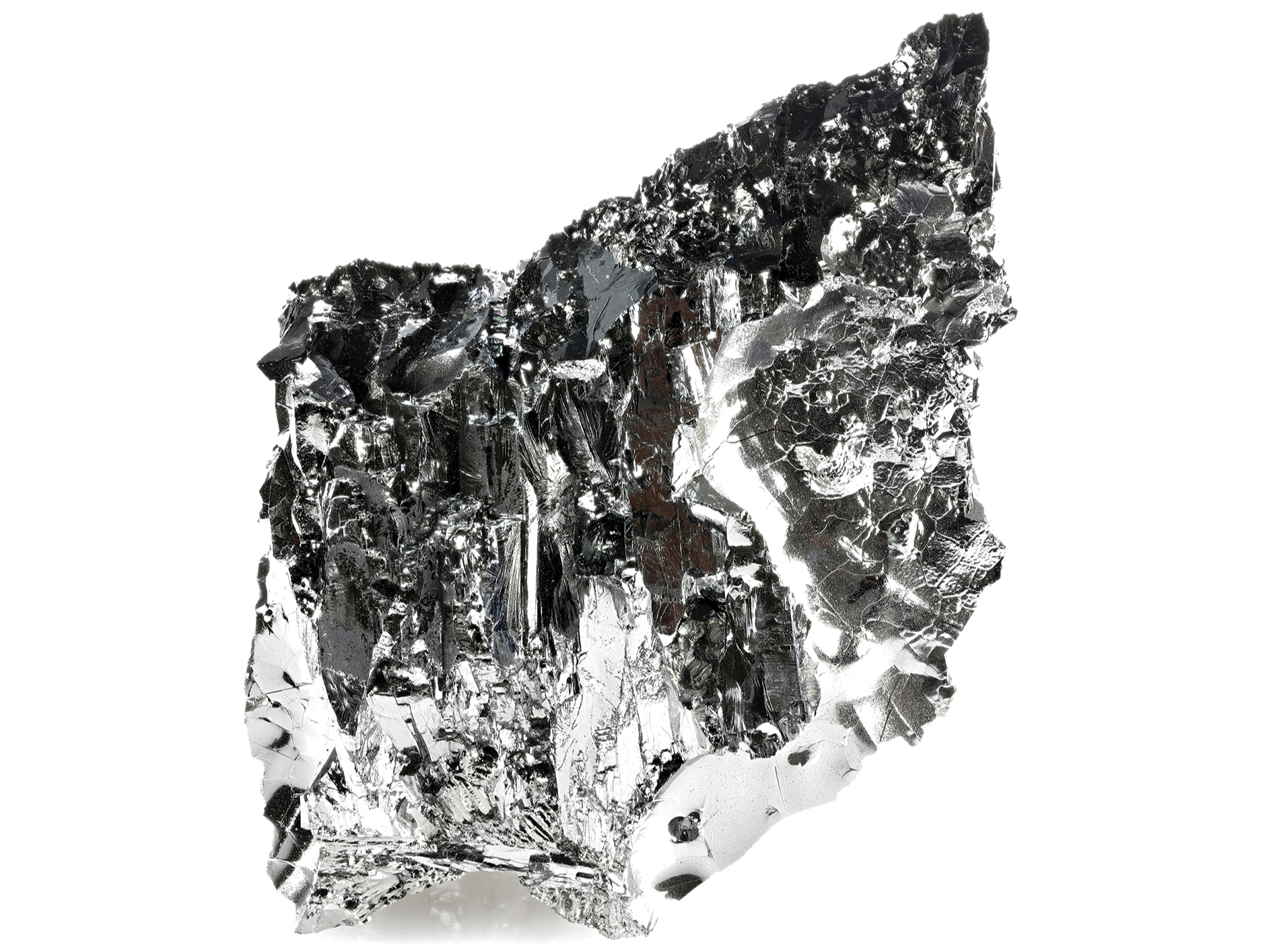
Tellurium element is very rare, with a share in the earth’s crust of 0.001 to 0.01 ppm. Mined tellurium occurs in telluride minerals such as tellurium compounds with lead and silver (most common), gold, selenium, or platinum. [GTK ,2019] However, tellurium element is not typically mined directly in large quantities. In its natural state, mined tellurium appears as a silvery-white metalloid with a metallic shine.
Most tellurium metal originates from electrolytic copper refining, primary from anode slimes, the remainder comes from skimmings at lead refineries, flue dusts and gases produced during the smelting of copper, bismuth and lead-zinc ores.
Once extracted, tellurium undergoes distillation, electrolytic refining, and solvent extraction which yield to a high-purity tellurium (up to 99.999% purity).
Tellurium recovery from end-of-life products is currently limited, as many applications are dissipative, meaning tellurium is lost or dispersed rather than recovered. Metallurgical applications often contain tellurium in low concentrations, making separation during recycling difficult.
| Global production | Global producers | EU consumption | EU share | EU suppliers | Import reliance |
|---|---|---|---|---|---|
| 621t | China 70% Japan 10% Russia 8% Sweden 6% Canada 4% | 407t | 66% | Canada 35% Philippines 34% China 19% Sweden 8% Hong Kong 2% | 90% |
Tellurium can be traded as a commodity or traded in the metals market. Investors can buy stocks from publicly trading companies, such as Boliden, and First Tellurium, a smaller company from Canada. [Daily Metal Price ,2022]
Between 2008 and 2011 tellurium prices showed a significant increase to values almost 4 times higher than in the years before (maximum €259 per kg). From 2018 to 2021, tellurium prices remained stable, with a fluctuation between € 60 – 63 per kg. Prices in this period were mostly influenced by the production of the solar PV industry, electronics, semiconductors, and metal alloys. [Daily Metal Price ,2022]
From 2022 to early 2025 prices fluctuated between 63 euros (65 USD) in july 2022 and 106 euros (110 USD) at the end of 2024. [Daily Metal Price ,2025] One key factor of this price increase was the rising demand for CdTe solar cells, supported by U.S. incentives like the Inflation Reduction Act (IRA), which encouraged solar manufacturing expansion. First Solar, for example, significantly increased its production capacity to meet demand [Solar Energy Industries Association,2024]. Additionally, another factor was the limited tellurium supply, as it is primarily a byproduct of copper refining, making its availability dependent on broader mining industry trends. [First Tellurium,2023]
In February 2025, export controls on tellurium-related items were implemented by China, potentially impacting global supply chains. [SMM,2025] These measures may lead to increased prices and impact the production of CdTe thin-films solar panels in the US. [PV Magazine,2025]
Demand for Tellurium is primarily driven by its application in thin-film cadmium telluride solar panels, valued for their efficiency and cost-effectiveness. The world’s largest producer of Cd-Te solar panels is First Solar, though they do not provide public figures on the amount of tellurium they consume.
In the electronics sector, tellurium is utilised in semiconductors and thermoelectric devices. The ongoing advancement in electronic technologies continues to fuel the need for tellurium-based materials.
As highlighted on Figure 3, China processes 51.3% of Tellurium with leaders such as Jangxi Copper Company, while South Korea produces around 27% of processed tellurium with companies such as as Korea Zinc (Young Poong Group) and LS-Nikk. Japan produces 6.2% tellurium with companies such as Mitsubishi Materials Corporation and Shinko Chemical, Sweden produces 5% tellurium with Boliden, Russia processes 4,9% with Nornickel as a leader, and Canada also produces Tellurium with companies such as 5N Plus and First Tellurium.
Many tellurium applications are dissipative, meaning the material is lost or dispersed rather than recovered. In metallurgical applications, tellurium is typically present in low concentrations, making it difficult to separate during recycling, which leads to further dispersion instead of concentration.
Currently, only a small fraction of tellurium is recovered from end-of-life electrical products. However, in the future, larger quantities may become available for recycling from cadmium telluride (CdTe) photovoltaic solar cells. Since CdTe technology is still relatively new, most installed solar panels have not yet reached the end of their operational lifespan, limiting current recycling opportunities. First Solar Recycling has commercialised a recycling technology which is expected to facilitate the production of tellurium from the upcoming quantities of end-of-life Cd-Te solar cells.
SOLAR POWER
The main application of tellurium is in the production of cadmium telluride (CdTe) solar panels. Within the solar power sector, crystalline silicon remains the most widely used material.
CdTe cells have the advantage of absorbing sunlight at optimal wavelength, enabling efficient energy conversion at shorter wavelengths. Additionnally, CdTe panels can also be manufactured at a lower cost than other photovoltaic technologies. However, the toxicity of CdTe must be consider, particularly in relation to the end-of-life disposal of the panels and recycling.
Tellurium, combined with cadmium, forms the active semicondutor layer in these photovoltaic thin-film solar panels. Although CdTe panels are the second most common type of solar cell (after crystalline silicon), they represent only 5% of the global photovoltaic market. Recycling solutions, such as First Solar's tellurium recovery process, are expected to enhance sustainability in the sector.
THERMO-ELECTRIC DEVICES
Thermo-electric devices are semiconductor electronic components that can turn a temperature variation into electricity or electricity into a temperature variation. These devices are widely used in power generation, heat pumps, and cooling systems.
This application sector also includes mercury-cadmium-telluride (MCT) which is used in infrared detectors, and CZT (cadmium-zinc-telluride) semiconductors, used for gamma- and x-ray detection and playing a key role in radiation mapping, nuclear medical imaging, astrophysics, and homeland security.
METALLURGY
Tellurium is used as an additive in steel or copper alloys to improve machinability, and in lead alloys to improve strength, hardness, and resistance to vibration.
RUBBER VULCANISING
Tellurium is used as a vulcanising agent and accelerator in the processing of rubber, enhancing the elasticity, durability, and mechanical strength of rubber products. One of the key tellurium compounds used in this process is tellurium diethyldithiocarbamate (TDEC). [Ataman Kimya,2023]
CHEMICAL MANUFACTURING
Tellurium compounds are used as catalysts in the production of synthetic fibre or in oil refining. Tellurium compounds are also employed as chemicals in photoreceptor devices.
Tellurium compounds also add blue and brown colours when used as a pigment in glass and ceramics.
Lastly, they can also be used as a chemical in rewritable CDs or DVDs, and as additives in lubricants.
HIGH PERFORMANCE ARTIFICIAL INTELLIGENCE CHIPS
With the deployment of artificial intelligence, chips consumption is highly increasing. Some AI chips now integrate tellurium oxides, which possess unique electrical properties that enhance data processing speed and energy efficiency
QUANTUM DOTS (QD) AND SENSORS
Quantum dots (QD) or semiconductor nanocrystals are small semiconductor particles with optical and electronic properties. Cadmium telluride quantum dots have been used as sensors. Other sensors include thin films, TeO2 sensors, nanostructures.
| Use | Percentage | Substitute | Sub share | Cost | Performance |
|---|---|---|---|---|---|
| Thermo-electric modules | 45% | no substitute | 46% | No substitute | |
| Thermo-electric modules | 45% | Silicon-germanium | 34% | Very high costs (more than 2 times) | Similar |
| Thermo-electric modules | 45% | Organic polymers | 10% | Similar or lower costs | Similar |
| Thermo-electric modules | 45% | Bismuth selenide | 10% | Similar or lower costs | Similar |
| Metallurgy | 25% | no substitute | 52% | No substitute | |
| Metallurgy | 25% | Selenium | 8% | Similar or lower costs | Similar |
| Metallurgy | 25% | Phosphorus | 8% | Similar or lower costs | Similar |
| Metallurgy | 25% | Calcium | 8% | Similar or lower costs | Similar |
| Metallurgy | 25% | Lead | 8% | Similar or lower costs | Similar |
| Metallurgy | 25% | Bismuth | 8% | Similar or lower costs | Similar |
| Metallurgy | 25% | Sulphur | 8% | Similar or lower costs | Similar |
| Chemical and other applications | 15% | no substitute | 50% | No substitute | |
| Chemical and other applications | 15% | various | 50% | Similar or lower costs | Similar |
| Rubber vulcanising | 10% | no substitute | 50% | No substitute | |
| Rubber vulcanising | 10% | Sulfur | 25% | Similar or lower costs | Similar |
| Rubber vulcanising | 10% | Selenium | 25% | Similar or lower costs | Similar |
| Solar power | 5% | Silicon wafer | 95% | Similar or lower costs | Similar |
| Solar power | 5% | no substitute | 4% | No substitute | |
| Solar power | 5% | CIGS thin film | 1% | Slightly higher costs (up to 2 times) | Similar |
| Solar power | 5% | Amorphous silicon thin film | 0% | Similar or lower costs | Similar |
Table 2 highlights uses and possible substitutes of tellurium - related products for solar power, ruber vulcanising, chemical manufacturing, metallurgy, and thermo-electric modules production.
SOLAR POWER
While CdTe is the most cost-effective thin-film technology, there are several alternatives as thin film solar panels:
-
Silicon wafer solar panels are the dominant type of photovoltaic (PV) technology in the solar energy market, capture about 95% of the market. They are made using crystalline silicon (c-Si), which is processed into thin wafers and assembled into solar cells. They can be slighlty more expensive than CdTe based panels.
-
Copper gallium indium diselenide (CIGS) solar panels: These offer high efficiency, similar to traditional silicon panels and they use toxic cadmium at lower levels than CdTe panels. The main disadvantages of CIGS panels are high production costs.
-
Amorphous silicon solar panels : These use very little toxic material and are less liable to cracks compared to traditional panels. They are ideal for lightweight and portable applications but have low efficiency (~5-10%).
-
Organic photovoltaic (OPV) cells. OPV cells also struggle with the efficiency, but they offer a lot of benefits for the building-integrated photovoltaic market, as they can be coloured or made transparent to fit the purpose. [Energysage,2019]
When comparing these technlogies, it is important to consider the criticality of the materials used in their production. Some elements used in thin-film solar panels, such as silicon, indium and gallium were all assessed as being ‘critical’ in previous and/or current EU criticality assessments (European Commission, 2014, 2017, 2020). Indium, gallium and selenium are by-product metals, like tellurium.
THERMO-ELECTRIC MODULES
Silicon germanium, bismuth selenide and organic polymers can be used to substitute for some Bismuth Telluride (BiTe) thermal devices.
METALLURGY
In free-machining steels several materials can be used instead of tellurium: bismuth, calcium, lead, phosphorus, selenium, and sulphur.
RUBBER VULCANISING
Selenides and sulphides can be used as substitutes for tellurium in the vulcanisation process in rubber production.
CHEMICAL MANUFACTURING
Tellurium as a catalyst can be replaced by other catalysts or non-catalysed processes. Alternatives for niobium and tantalum tellurides as electrical-conducting solid lubricants are selenides and sulphides of those metals.
The increasing adoption of renewable energy sources in Europe has led to a heightened demand for CdTe solar panels, thereby boosting tellurium consumption. The international energy agency has predicted that the demand for tellurium could reach 1400 tonnes by 2040, putting pressure on supply capacities that are at 500 tonnes in 2022. [IEA,2022]
Production of tellurium metal
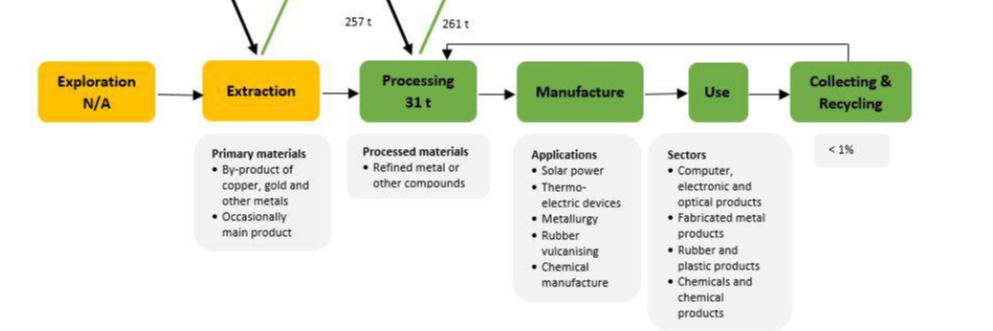
- To reach the refining stage, copper, and its associated by-products including tellurium, undergo a number of processing stages. These include traditional mining techniques (either underground or from surface mines), crushing and grinding, and froth flotation to concentrate the ore. During these initial phases the recovery rate of tellurium is as low as 10% and the focus is on recovering copper or other base metals which will be more economically rewarding due to the larger quantities available. Later, the concentrated ore undergoes roasting, smelting to produce matte, which is then converted into copper blister. During the smelting and converting stages the recovery rate of tellurium is 50%.
- Electrolytic refining uses slabs of copper blister as anodes and pure copper or stainless steel as cathodes immersed in an electrolyte. An electrical current is passed through the electrolyte and as the anodes dissolve, copper atoms transfer to the cathodes. Tellurium is either insoluble during this process, settling to the bottom of the electrolytic cell into what is known as ‘anode slimes’ or muds, or is held in suspension in the electrolyte. During the treatment of anode slimes as much as 90% of the available tellurium is recovered, since the equipment used is optimised to ensure the highest possible recovery rate of tellurium. These muds or liquids can subsequently be treated to recover tellurium and/or other metals such as silver, gold or platinum group metals using a variety of proprietary techniques. The resulting tellurium-containing products, such as crude tellurium dioxide (approximately 70% Te), copper telluride (20–45% Te) or low grade tellurium concentrates (approximately 10% Te), are subsequently further refined to produce tellurium metal.
It is reported that metallic tellurium and tellurium dioxide are produced mostly from anode slimes in the EU (Finland, Belgium) by Umicore and Aurubis. However, the produced amounts and the pyrometallurgical methodology which is followed are not specified.
Supply from end-of-life products
The ‘end-of-life recycling rate’ of tellurium was assessed as 1% [European Commission,2023]. As previously stated, tellurium's end-use applications often result in dissipation, limiting recycling opportunities. The secondary resources from which tellurium is extracted are scrapped selenium-tellurium photoreceptors [USGS,2025] employed in older photocopiers in Europe and defective end-of-life solar panels.
In the future, more significant quantities of tellurium are likely to become available for recycling from cadmium-tellurium photovoltaic solar cells as they reach their end of lives.
- First Solar has commercialised a process for tellurium recycling by spent CdTe PV modules. The collected PV modules are reduced in a shredder and crushed into small pieces from 4 to 5 mm. Then, leaching with sulphuric acid and hydrogen peroxide enables to obtain tellurous acid (H2TeO3), which undergo solid–liquid separation where semiconductor materials are extracted, and liquids are separated from solid materials (i.e. glass). Precipitation and filtration is carried out to treat the extracted liquor by a three-stage precipitation process with an increasing pH using sodium hydroxide for pH control. The thickened slurry is filtered consisting a semiconductor material rich in tellurium. First Solar Recycling currently operates in Malaysia, Vietnam, Germany, India and Ohio. [First Solar,2025]
- Kunming University has developed a vulcanisation-vacuum distillation process for the separation of tellurium and cadmium through the recycling of CdTe PV modules but has not commercialised it at the time of writing this factsheet.
Taking into the account of the expansion of photovoltaic technologies and the optimisation of recycling processes, it is expected that recycling technologies will become more significant.
Market analysis, trade and prices
| Global production | Global producers | EU consumption | EU share | EU suppliers | Import reliance |
|---|---|---|---|---|---|
| 621t | China 70% Japan 10% Russia 8% Sweden 6% Canada 4% | 407t | 66% | Canada 35% Philippines 34% China 19% Sweden 8% Hong Kong 2% | 90% |
Globally, the total production of processed tellurium is reported to be 806 tonnes. The largest producer of tellurium is China, accounting for 51% of global production. South Korea follows with 27%, while Japan, Sweden, and Russia each contribute 6%, 5%, and 5%, respectively. Canada has the smallest share among the listed producers, with just 2% of global production.
The European Union has a relatively modest role in global consumption compared to other regions, since the EU consumes 127 tonnes of tellurium annually, representing 16% of the total global consumption. However, the EU is heavily reliant on imports to meet its demand, with 58% of its tellurium supply coming from external sources.
This data demonstrates the EU’s dependency on multiple external suppliers for tellurium. The primary suppliers of tellurium to the EU are the Philippines, which provides 56% of the imports, and Canada, which accounts for 26%. China and Russia supply smaller shares, contributing 6% and 4%, respectively.
| Processing/refining | |
|---|---|
| CN Code | Title |
| 28045090 | Tellurium |
Table 4 present one CN code for tellurium metal.
Figure 5 presents the EU trade flows of metallic tellurium (CN 28045090) from 2000 to 2023, illustrating import and export quantities in tonnes. The graph demonstrates fluctuations in both import and export volumes over the years, highlighting the EU’s dependency on tellurium imports.
Over time, tellurium trade flows have experienced notable variations. From 2000 to 2006, there was a gradual increase in both imports and exports, culminating in a significant export spike in 2008. In the following years, between 2008 and 2010, imports fluctuated, with a decline in 2009, followed by a period of stabilization. From 2010 to 2017, imports remained relatively stable with minor fluctuations, while exports exhibited periodic peaks. Between 2019 and 2020, both imports and exports declined. Between 2016 and 2020, the EU imported an average of 507.5 tonnes of tellurium per year, while exports averaged 346 tonnes per year, indicating that the EU was a net importer of tellurium during this period. However, from 2020 to 2022, there was a notable surge in tellurium imports, peaking in 2022 before declining again in 2023.
Figure 6 illustrates the European Union's imports of metallic tellurium (CN 28045090) from 2000 to 2023, measured in tonnes, categorized by country of origin, including Canada, the Philippines, China, and other nations.
Between 2000 and 2010, tellurium imports remained relatively low, with occasional peaks. A significant increase occurred between 2004 and 2007, largely driven by imports from unspecified sources categorized under "Rest of the World." This trend was followed by a decline after 2008.
From 2011 to 2016, imports remained at lower levels, with minimal contributions from major suppliers. However, from 2016 onward, imports began to rise again, with notable peaks in 2018 and 2020, mainly driven by supplies from Canada and the Philippines, along with smaller contributions from China.
A sharp increase in imports was observed in 2022, reaching the highest levels recorded in the dataset. During this period, China emerged as a significant supplier, alongside Canada and the Philippines. This rise may reflect growing demand for tellurium in the EU, particularly for applications in solar energy (cadmium telluride photovoltaic panels), semiconductors, and other industrial uses.
The decline in 2023 suggests a potential adjustment in market demand, changes in supply availability, or geopolitical factors affecting trade flows. The overall trend highlights the EU's reliance on external sources for tellurium, with fluctuations in supply patterns likely influenced by global economic conditions, industry demand, and trade policies.
Tellurium can be traded as a commodity or traded in the metals market. Investors can buy stocks from publicly trading companies, such as Boliden, and First Tellurium, a smaller company from Canada. [Daily Metal Price ,2022]
Between 2008 and 2011 tellurium prices showed a significant increase to values almost 4 times higher than in the years before (maximum €259 per kg). From 2018 to 2021, tellurium prices remained stable, with a fluctuation between € 60 – 63 per kg. Prices in this period were mostly influenced by the production of the solar PV industry, electronics, semiconductors, and metal alloys. [Daily Metal Price ,2022]
From 2022 to early 2025 prices fluctuated between 63 euros (65 USD) in july 2022 and 106 euros (110 USD) at the end of 2024. [Daily Metal Price ,2025] One key factor of this price increase was the rising demand for CdTe solar cells, supported by U.S. incentives like the Inflation Reduction Act (IRA), which encouraged solar manufacturing expansion. First Solar, for example, significantly increased its production capacity to meet demand [Solar Energy Industries Association,2024]. Additionally, another factor was the limited tellurium supply, as it is primarily a byproduct of copper refining, making its availability dependent on broader mining industry trends. [First Tellurium,2023]
In February 2025, export controls on tellurium-related items were implemented by China, potentially impacting global supply chains. [SMM,2025] These measures may lead to increased prices and impact the production of CdTe thin-films solar panels in the US. [PV Magazine,2025]
The increasing adoption of renewable energy sources in Europe has led to a heightened demand for CdTe solar panels, thereby boosting tellurium consumption. The international energy agency has predicted that the demand for tellurium could reach 1400 tonnes by 2040, putting pressure on supply capacities that are at 500 tonnes in 2022. [IEA,2022]
Production of tellurium metal
- To reach the refining stage, copper, and its associated by-products including tellurium, undergo a number of processing stages. These include traditional mining techniques (either underground or from surface mines), crushing and grinding, and froth flotation to concentrate the ore. During these initial phases the recovery rate of tellurium is as low as 10% and the focus is on recovering copper or other base metals which will be more economically rewarding due to the larger quantities available. Later, the concentrated ore undergoes roasting, smelting to produce matte, which is then converted into copper blister. During the smelting and converting stages the recovery rate of tellurium is 50%.
- Electrolytic refining uses slabs of copper blister as anodes and pure copper or stainless steel as cathodes immersed in an electrolyte. An electrical current is passed through the electrolyte and as the anodes dissolve, copper atoms transfer to the cathodes. Tellurium is either insoluble during this process, settling to the bottom of the electrolytic cell into what is known as ‘anode slimes’ or muds, or is held in suspension in the electrolyte. During the treatment of anode slimes as much as 90% of the available tellurium is recovered, since the equipment used is optimised to ensure the highest possible recovery rate of tellurium. These muds or liquids can subsequently be treated to recover tellurium and/or other metals such as silver, gold or platinum group metals using a variety of proprietary techniques. The resulting tellurium-containing products, such as crude tellurium dioxide (approximately 70% Te), copper telluride (20–45% Te) or low grade tellurium concentrates (approximately 10% Te), are subsequently further refined to produce tellurium metal.
It is reported that metallic tellurium and tellurium dioxide are produced mostly from anode slimes in the EU (Finland, Belgium) by Umicore and Aurubis. However, the produced amounts and the pyrometallurgical methodology which is followed are not specified.
Supply from end-of-life products
The ‘end-of-life recycling rate’ of tellurium was assessed as 1% [European Commission,2023]. As previously stated, tellurium's end-use applications often result in dissipation, limiting recycling opportunities. The secondary resources from which tellurium is extracted are scrapped selenium-tellurium photoreceptors [USGS,2025] employed in older photocopiers in Europe and defective end-of-life solar panels.
In the future, more significant quantities of tellurium are likely to become available for recycling from cadmium-tellurium photovoltaic solar cells as they reach their end of lives.
- First Solar has commercialised a process for tellurium recycling by spent CdTe PV modules. The collected PV modules are reduced in a shredder and crushed into small pieces from 4 to 5 mm. Then, leaching with sulphuric acid and hydrogen peroxide enables to obtain tellurous acid (H2TeO3), which undergo solid–liquid separation where semiconductor materials are extracted, and liquids are separated from solid materials (i.e. glass). Precipitation and filtration is carried out to treat the extracted liquor by a three-stage precipitation process with an increasing pH using sodium hydroxide for pH control. The thickened slurry is filtered consisting a semiconductor material rich in tellurium. First Solar Recycling currently operates in Malaysia, Vietnam, Germany, India and Ohio. [First Solar,2025]
- Kunming University has developed a vulcanisation-vacuum distillation process for the separation of tellurium and cadmium through the recycling of CdTe PV modules but has not commercialised it at the time of writing this factsheet.
Taking into the account of the expansion of photovoltaic technologies and the optimisation of recycling processes, it is expected that recycling technologies will become more significant.
Demand
Between 2012 and 2016, the EU had an average apparent consumption of 27 tonnes of tellurium per year. In contrast, for the period 2019-2020, the apparent average annual consumption increased significantly to 507 tonnes. This consumption is calculated based on EU imports and EU domestic product minus EU exports.
Overall, imports and exports remained relatively balanced, with the exception of 2012, when exports exceeded imports by more than three times.
These figures suggest that the evaluated trade code may not fully capture tellurium contained in other imported materials, such as intermediate copper products that undergo further refining within the EU, or tellurium compounds used in chemical manufacturing and rubber vulcanisation.
As previously stated, the primary suppliers of tellurium to the EU are the Philippines, which provides 56% of the imports, and Canada, which accounts for 26%. China and Russia supply smaller shares, contributing 6% and 4%, respectively.
Figure 10 illustrates the European use and end applications of tellurium in 2022, categorised into five key sectors. Overall, the chart shows that tellurium's primary use is in thermo-electric applications, followed by metallurgy and chemical applications, with rubber vulcanisation and solar power making up smaller portions of total demand.
Thermo-electric modules represent the largest share, accounting for 45% of tellurium consumption. This indicates the strong demand for tellurium in electronic and energy efficiency applications.
Metallurgy is the second-largest application, utilising 25% of tellurium, reflecting its importance in alloy production and other industrial metal enhancements.
Chemical and other applications account for 15%, highlighting tellurium's role in various chemical processes and specialised industrial uses.
Rubber vulcanising constitutes 10% of tellurium use, demonstrating its role in improving the performance of rubber products.
Finally, solar power represents 5% of the total consumption, indicating a small role of the EU in the production of cadmium telluride (CdTe) solar panels, which are used in thin-film photovoltaic technology.
Table 5 provides an overview of tellurium applications, their corresponding NACE (Nomenclature of Economic Activities) sectors, and the value-added contribution per sector for 2019. Each application is linked to a 2-digit NACE sector, which classifies the industry it belongs to.
For example, thermo-electric modules and solar power are categorized under C26 - Manufacture of computer, electronic, and optical products, contributing €65.7 billion in value-added terms. Metallurgy, classified under C25 - Manufacture of fabricated metal products (excluding machinery and equipment), represents the highest value-added sector at €180 billion. The chemical sector (C20 - Manufacture of chemicals and chemical products), which includes various tellurium-based applications, accounts for €147.1 billion. Additionally, rubber vulcanisation, falling under C22 - Manufacture of rubber and plastic products, contributes €90 billion to the economy.
| Applications | 2-digit NACE sector | Value added of NACE 2 sector | 4-digit CPA |
|---|---|---|---|
| Thermo-electric modules | C26 - Manufacture of computer, electronic and optical products | 71,500M€ | C26 - Manufacture of computer, electronic and optical products |
| Metallurgy | C25 - Manufacture of fabricated metal products, except machinery and equipment | 216,840M€ | C25 - Manufacture of fabricated metal products, except machinery and equipment |
| Chemical and other applications | C20 - Manufacture of chemicals and chemical products | 165,880M€ | C20 - Manufacture of chemicals and chemical products |
| Rubber vulcanising | C22 - Manufacture of rubber and plastic products | 107,000M€ | C22 - Manufacture of rubber and plastic products |
| Solar power | C26 - Manufacture of computer, electronic and optical products | 71,500M€ | C26 - Manufacture of computer, electronic and optical products |
Since the last criticality assessment in 2023, new applications for tellurium have emerged. The rapid expansion of artificial intelligence has significantly increased demand for semiconductor chips. Some of these chips incorporate tellurium oxides due to their exceptional electrical properties. Additionally, cadmium telluride quantum dots have been utilized as sensors, while tellurium dioxide is also being employed in advanced sensor technologies.
Thermo-electric devices are semiconductor electronic components that can turn a temperature variation into electricity or electricity into a temperature variation. These devices can be used for power generation or as a heat pump or for cooling.
This application sector also includes mercury-cadmium-telluride (MCT) used in infrared detectors and CZT (cadmium-zinc-telluride) semiconductors for gamma- and x-ray detection (radiation mapping, nuclear medical imaging, astrophysics, and homeland security)
Tellurium is used as an additive in steel or copper alloys to improve machinability, and in lead alloys to improve strength, hardness, and resistance to vibration.
Tellurium compounds are used as catalysts in the production of synthetic fibre or in oil refining. Tellurium compounds are also employed as chemicals in photoreceptor devices.
Tellurium compounds also add blue and brown colours when used as a pigment in glass and ceramics.
Lastly, they can also be used as a chemical in rewritable CDs or DVDs, and as additives in lubricants.
Tellurium is used as a vulcanising agent and accelerator in the processing of rubber, enhancing the elasticity, durability, and mechanical strength of rubber products. One of the key tellurium compounds used in this process is tellurium diethyldithiocarbamate (TDEC). [Ataman Kimya,2023]
The main application of tellurium is in the production of cadmium telluride (CdTe) solar panels. Within the solar power sector, crystalline silicon remains the most widely used material.
CdTe cells have the advantage of absorbing sunlight at optimal wavelength,enabling efficient energy conversion at shorter wavelengths. Additionnally, CdTe panels can also be manufactured at a lower cost than other photovoltaic technologies. However, the toxicity of CdTe must be consider, particularly in relation to the end-of-life disposal of the panels and recycling.
Tellurium, combined with cadmium, forms the active semicondutor layer in these photovoltaic thin-film solar panels. Although CdTe panels are the second most common type of solar cell (after crystalline silicon), they represent only 5% of the global photovoltaic market. Recycling solutions, such as First Solar's tellurium recovery process, are expected to enhance sustainability in the sector.
HIGH PERFORMANCE ARTIFICIAL INTELLIGENCE CHIPS
With the deployment of artificial intelligence, chips consumption is highly increasing. Some AI chips now integrate tellurium oxides, which possess unique electrical properties that enhance data processing speed and energy efficiency
QUANTUM DOTS (QD) AND SENSORS
Quantum dots (QD) or semiconductor nanocrystals are small semiconductor particles with optical and electronic properties. Cadmium telluride quantum dots have been used as sensors. Other sensors include thin films, TeO2 sensors, nanostructures.
| Use | Percentage | Substitute | Sub share | Cost | Performance |
|---|---|---|---|---|---|
| Thermo-electric modules | 45% | no substitute | 46% | No substitute | |
| Thermo-electric modules | 45% | Silicon-germanium | 34% | Very high costs (more than 2 times) | Similar |
| Thermo-electric modules | 45% | Organic polymers | 10% | Similar or lower costs | Similar |
| Thermo-electric modules | 45% | Bismuth selenide | 10% | Similar or lower costs | Similar |
| Metallurgy | 25% | no substitute | 52% | No substitute | |
| Metallurgy | 25% | Selenium | 8% | Similar or lower costs | Similar |
| Metallurgy | 25% | Phosphorus | 8% | Similar or lower costs | Similar |
| Metallurgy | 25% | Calcium | 8% | Similar or lower costs | Similar |
| Metallurgy | 25% | Lead | 8% | Similar or lower costs | Similar |
| Metallurgy | 25% | Bismuth | 8% | Similar or lower costs | Similar |
| Metallurgy | 25% | Sulphur | 8% | Similar or lower costs | Similar |
| Chemical and other applications | 15% | no substitute | 50% | No substitute | |
| Chemical and other applications | 15% | various | 50% | Similar or lower costs | Similar |
| Rubber vulcanising | 10% | no substitute | 50% | No substitute | |
| Rubber vulcanising | 10% | Sulfur | 25% | Similar or lower costs | Similar |
| Rubber vulcanising | 10% | Selenium | 25% | Similar or lower costs | Similar |
| Solar power | 5% | Silicon wafer | 95% | Similar or lower costs | Similar |
| Solar power | 5% | no substitute | 4% | No substitute | |
| Solar power | 5% | CIGS thin film | 1% | Slightly higher costs (up to 2 times) | Similar |
| Solar power | 5% | Amorphous silicon thin film | 0% | Similar or lower costs | Similar |
Silicon germanium, bismuth selenide and organic polymers can be used to substitute for some Bismuth Telluride (BiTe) thermal devices.
METALLURGY
In free-machining steels several materials can be used instead of tellurium: bismuth, calcium, lead, phosphorus, selenium, and sulphur.
CHEMICAL MANUFACTURING
Tellurium as a catalyst can be replaced by other catalysts or non-catalysed processes. Alternatives for niobium and tantalum tellurides as electrical-conducting solid lubricants are selenides and sulphides of those metals.
RUBBER VULCANISING
Selenides and sulphides can be used as substitutes for tellurium in the vulcanisation process in rubber production.
SOLAR POWER
While CdTe is the most cost-effective thin-film technology, there are several alternatives as thin film solar panels:
-
Silicon wafer solar panels are the dominant type of photovoltaic (PV) technology in the solar energy market, capture about 95% of the market. They are made using crystalline silicon (c-Si), which is processed into thin wafers and assembled into solar cells. They can be slighlty more expensive than CdTe based panels.
-
Copper gallium indium diselenide (CIGS) solar panels: These offer high efficiency, similar to traditional silicon panels and they use toxic cadmium at lower levels than CdTe panels. The main disadvantages of CIGS panels are high production costs.
-
Amorphous silicon solar panels : These use very little toxic material and are less liable to cracks compared to traditional panels. They are ideal for lightweight and portable applications but have low efficiency (~5-10%).
-
Organic photovoltaic (OPV) cells. OPV cells also struggle with the efficiency, but they offer a lot of benefits for the building-integrated photovoltaic market, as they can be coloured or made transparent to fit the purpose. [Energysage,2019]
Supply
Tellurium element is mined in one location in the EU, at the Krankberg Mine in the Boliden Area of Sweden as a byproduct of gold mining. Boliden, also operates a smelter/refinery at Rönnskär in Sweden, which recovers tellurium in addition to other metals.
Reported production of refined tellurium within the EU (i.e. from Sweden and Bulgaria) amounted to an average of 44 tonnes per year (averaged over the 2016-2020 period). The largest amount is produced in Sweden (around 40 tonnes annually for the same period). The annual production of 60 tonnes of copper telluride with a 15 wt.% tellurium content in Finland is referred by the Eurostat data. EU imported annually around 254 of tellurium during 2016-2020.
Aurubis operates copper refineries in Germany and Bulgaria, tellurium occurs in the anode slimes. Although the company mentions that tellurium is a recovered by-product no details are provided as to what form it takes or what happens to it.
Atlantic Copper operates a refinery in Spain that recovers copper telluride from its anode slimes. This material is then further refined elsewhere.
Metallo Chimique operates a copper refinery in Belgium, which is believed to have a small amount of tellurium in its anode slimes but these are sold as “tankhouse slimes” to other companies for treatment and recovery of those metals.
One company that processes these kinds of anode slimes is Umicore, located in Hoboken, Belgium. KGHM operate a copper refinery in Poland that may have a very small amount of tellurium in its anode slimes, but there is nothing on the company website to suggest that it is actually recovered.
There are also copper refineries in Austria, Cyprus, Finland and Italy but there is no information available as to whether tellurium occurs in the anode slimes of those plants. Not all of these copper refining plants source the feed material from within the EU. Similarly not all copper that is mined in the EU is refined within Europe.
MSA to be replaced
Production of primary tellurium
- To reach the refining stage, copper, and its associated by-products including tellurium, undergo a number of processing stages. These include traditional mining techniques (either underground or from surface mines), crushing and grinding, and froth flotation to concentrate the ore. During these initial phases the recovery rate of tellurium is as low as 10% and the focus is on recovering copper or other base metals which will be more economically rewarding due to the larger quantities available. Later, the concentrated ore undergoes roasting, smelting to produce matte, which is then converted into copper blister. During the smelting and converting stages the recovery rate of tellurium is 50%.
- Electrolytic refining uses slabs of copper blister as anodes and pure copper or stainless steel as cathodes immersed in an electrolyte. An electrical current is passed through the electrolyte and as the anodes dissolve, copper atoms transfer to the cathodes. Tellurium is either insoluble during this process, settling to the bottom of the electrolytic cell into what is known as ‘anode slimes’ or muds, or is held in suspension in the electrolyte. During the treatment of anode slimes as much as 90% of the available tellurium is recovered, since the equipment used is optimised to ensure the highest possible recovery rate of tellurium. These muds or liquids can subsequently be treated to recover tellurium and/or other metals such as silver, gold or platinum group metals using a variety of proprietary techniques. The resulting tellurium-containing products, such as crude tellurium dioxide (approximately 70% Te), copper telluride (20–45% Te) or low grade tellurium concentrates (approximately 10% Te), are subsequently further refined to produce tellurium metal.
As previously mentionned, main players are Aurubis, Atlantic Copper, Metallor Chimique, Umicore and Boliden.
Tellurium is one of the rarest elements in the earth’s crust with an abundance of only 10 parts per billion (ppb). It is also widely distributed meaning that concentrations which are sufficient in size to allow economic extraction in their own right are rare. Tellurium rarely occurs as a native metal, it is more commonly found in compounds with precious or base metals, primarily as tellurides but other compounds also exits. It is a chalcophile element, meaning it preferentially combines with sulphur rather than oxygen, but it cannot easily replace sulphur in a compound because it has a much larger ionic radius. Instead it preferentially forms tellurides with metals of large ionic radii such as gold, silver, bismuth, lead, mercury, and the platinum group elements.
Tellurium can occur in a wide range of deposit types including magmatic, metasomatic and hydrothermal types. It occurs especially in association with epithermal gold and silver vein deposits, which are formed by relatively low-temperature hydrothermal processes (<300°C) at shallow crustal depths, but it is also frequently present in copper or copper-gold porphyries, and sulphide deposits containing copper, nickel, lead, or iron.
| Country | Resources (tonnes) |
|---|---|
Resources are not documented, as the main source (90% of total production) for tellurium is anode slime from copper refining. However, potential sources include bismuth telluride and gold telluride ores.
| Country | Resources (tonnes) |
|---|---|
The reserves estimated by USGS include only tellurium contained in copper reserves assuming that more than half of tellurium contained in unrefined copper anodes is recoverable.
In 2018, a project by Deer Horn Capital Inc. moving towards pre-feasibility in Canada was reported, with indicated resources of 414,000 t containing 5.12 g/t gold, 157.50 g/t silver, and 160 ppm tellurium (66,000 kg Tellurium contained), as well as inferred resources of 197,000 t at 5.04 g/t gold, 146.50 g/t silver and 137 ppm tellurium (27 t Tellurium contained). (Cleantech, 2018; Deer Horn Capital, 2019)
| Country | Classification | Quantity (Mt of ore) | Grade (% Tellurium) | Reporting code | Reporting date | Deposit, Source | ||
|---|---|---|---|---|---|---|---|---|
As previously stated, resources are not documented.
| Country | Classification | Quantity (Mt of ore) | Grade (% Tellurium) | Reporting code | Reporting date | Source | ||
|---|---|---|---|---|---|---|---|---|
About 3,200,000 t reserves of tellurium ores are located in the EU and 2,100,000 t resources of tellurium ores, all of which are located in Sweden [Minerals4EU,2019]. There is continuing exploration at Kankberg mine (Sweden) to explore further gold resources and reserves.
Resources may also exist in other countries. Copper resources are known to exist in at least 18 European countries and gold resources in 19 European countries, as well as Sweden, and it is likely that some of these resources also contain tellurium which is not reported as a resource because it is a by-product. [Minerals4EU,2019]
The vast majority of the tellurium produced worldwide is as a by-product of electrolytic copper refining with smaller quantities extracted as a by-product of gold, lead or other metals. Within the EU, tellurium is mined as a by-product of gold at the Krankberg Mine in the Boliden Area of Sweden and it is also refined nearby at the Rönnskär Smelter. [Boliden,2025]
As previously mentionned, the secondary resources from which tellurium is extracted are scrapped selenium-tellurium photoreceptors [USGS,2025] employed in older photocopiers in Europe and defective end-of-life solar panels.
In the future, more significant quantities of tellurium are likely to become available for recycling from cadmium-tellurium photovoltaic solar cells as they reach their end of lives. First Solar has commercialised a process for tellurium recycling by spent CdTe PV module and operates in Malaysia, Vietnam, Germany, India and Ohio. [First Solar,2025] Institutions such as Kunming University are developing alternative vulcanisation-vacuum distillation methods to separate tellurium from cadmium, although these processes have yet to reach commercial implementation.
| MSA Flow | Value | ||
|---|---|---|---|
No information yet
No information yet
No information yet
Other considerations
Tellurium may damage fertility or the unborn child, is harmful if inhaled, causes allergic skin reactions, and may have long-lasting harmful effects on aquatic life [ECHA,2021]. Under the GESTIS international limit values with CAS4 No. 13494-80-9 states that Finland and Norway Tellurium exposure 8-hour limit is of 0.1 mg/m3 and Latvia’s and Romania’s is 0.01 mg/m3 and 0.05 mg/m3 respectively. [IFA,2021]
According to the Gestis substance database, tellurium when used has a risk of explosion when in contact with air (with tellurium dust) and bromine pentafluoride (with tellurium powder). In addition, tellurium can react dangerously with chlorine, fluorine, beryllium (rare), metal powder; chlorine fluoride; chlorine trifluoride; oxygen difluoride (heat); potassium (heat); lithium silicide; sodium (heat); silver bromate; silver iodate; zinc (heat); tin (heat). It has an LC50 inhalation value of > 2,42 mg/l/4 h and a LD50 oral value of > 5000 mg/kg [IFA,2022] [PubChem,2022]
The National Institute for Occupational Safety and Health of the United States (NIOSH, USA) recommends a permissible exposure limit of 0.1 mg/m3 in the air for Tellurium and compounds, and 0.2 mg/m3 for tellurium hexafluoride for exposure for up to 10 hours’ time-weighted average during a 40-hour week [NIOSH,2020]
This substance may be released into the environment as a result of industrial abrasion processing having a low release rate (e.g. cutting of textile, cutting, machining or grinding of metal). In addition, the low release rate of this substance can also occur from outdoor use in long-life materials (e.g. metal, wooden and plastic construction and building materials) and indoor use in long-life materials with low release rate (e.g. flooring, furniture, toys, construction materials, curtains, foot-wear, leather products, paper and cardboard products, electronic equipment) [ECHA,2021].
This substance can be hazardous to the aquatic environment, being labelled as a Chronic Category 4; H413 and therefore its release to the environment should be avoided as indicated in the precautionary statement standards. [IFA,2022] [PubChem,2022]
Technical rules for the use of Tellurium can be found in the GESTIS Substance database5. In addition, Tellurium is included under the German regulation of accident insurers for the use of respiratory protective equipment published in November 2021.
No data is available.
| Country | Export value (USD) | Share in total exports |
|---|---|---|
No information is available linking tellurium to particular social or ethical aspects.
No research and development trends could be identified
No projects have been identified