Overview
Potash mineral deposits are chemical sedimentary evaporites formed by evaporation of saline waters, producing sequential precipitation of salts from carbonates and sulfates to halite and potassium–magnesium chlorides. They occur as shallow-water deposits (thin, limited extent, low MgSO4, often mixed marine–nonmarine) and deep-water deposits (thick, laterally extensive, MgSO4-rich, formed in restricted marine basins), with mineable potash typically occurring as thin seams within halite-rich sequences. Major global deposits are found in large evaporite basins such as the Zechstein (Europe), Elk Point (Canada), Pripyat (Belarus), and Solikamsk (Russia), often structurally modified by halokinetic features like salt domes and diapirs Potash is extracted through conventional underground mining and solution mining, where water is injected into sylvinite beds to dissolve KCl and NaCl, followed by brine recovery and crystallization [Yancoal, 2019]. Ore processing includes crushing, desliming, flotation separation, drying, and hot-brine recrystallization to produce high-purity potassium fertilizers and chemicals. Globally, potash production reached about 67.5 million tonnes in 2023, with Canada contributing ~32% and Russia–Belarus together about one-third of supply [Government of Canada, 2025]. The EU accounts for about 7% of global production, mainly from Germany and Spain, though output has gradually declined in recent years. Demand is strongly driven by agriculture, which represents over 90% of potash consumption, and global potash demand is projected to grow at around up to ~4.5% CAGR, reflecting tightening supply conditions and sustained fertilizer demand growth.
| Global production | Global producers | EU consumption | EU share | EU suppliers | Import reliance |
|---|---|---|---|---|---|
| 44,682,779t | Canada 32% Russia 18% Belarus 14% China 13% Germany 6% Israel 5% Jordan 4% Laos 3% | 3,391,500t | 8% | Germany 65% Canada 9% Spain 8% Russia 6% Belarus 4% Israel 4% | 10% |
Figure 2 illustrates the evolution of average potash prices between 2000 and 2024. Prices remained relatively stable at around USD 150–200/t until the mid-2000s, before increasing sharply and reaching approximately USD 800/t in 2009. After a period of fluctuations between USD 600 and 900/t, prices surged to a record USD 1,800/t in 2022, mainly due to supply constraints, rising energy costs, and geopolitical disruptions. Prices fell significantly in 2023 but partially recovered to around USD 1,200/t in 2024. Prices expressed in EUR/t followed a similar trend throughout the period.
Figure 3 illustrates the sourcing of potash at both the extraction and global production levels. Within the EU supply chain, potash extraction is highly concentrated in Germany, which accounts for 65% of supply, followed by Canada (9%), Spain (8%), Russia (6%), Belarus (6%), and Israel (4%), while other countries collectively contribute 3.9%. This indicates that although the EU benefits from significant domestic production, it also relies on imports from major global producers. At the global level, potash production is more diversified but remains concentrated among a few countries. Canada is the dominant producer, accounting for 32% of global output, followed by Russia (18%), Belarus (14%), and China (13%). Other notable producers include Germany (6%), Israel (5%), and Jordan (4%), while the remaining countries contribute relatively small shares.
Potash is produced exclusively through primary extraction from mineral deposits. However, several efforts have been made—still at a non-industrial, experimental scale—to recover potassium from biomass and various residues, including wastewater and fly ash. These methodologies are typically complex and involve leaching the residues with acids, followed by the separation or concentration of potassium using zeolites or other filtration materials.
Potash applications in the EU are classified into two main sectors: fertilizer production, which accounts for about 95% of total use, and the manufacture of various chemical products. The main potash-based chemical products are:
Potassium hydroxide (KOH) – made by electrolysis of potash solution; used in batteries, soaps, biodiesel, and as an industrial base.
Potassium carbonate (K2CO3) – used in glassmaking, detergents, and specialty fertilizers.
Potassium sulfate (K2SO4) – a fertilizer for chloride-sensitive crops; also used in the glass and pharmaceutical industries.
Potassium nitrate (KNO3) – for fertilizers, fireworks, explosives, and heat treatment salts.
| Use | Percentage | Substitute | Sub share | Cost | Performance |
|---|---|---|---|---|---|
| Fertiliser | 95% | 83% | No substitute | ||
| Fertiliser | 95% | Potash has no official substitutes. However, potash exists in livestock manure, sewage sludge, and food waste that is reused as a biological fertiliser in agriculture. A significant amount of manure is used as fertiliser, due to containing potassium, res | 17% | Similar or lower costs | Similar |
| Chemicals | 5% | not assessed, below 10% | 100% | No substitute |
Potash exhibits very limited substitution potential, primarily because potassium is an essential plant nutrient. Fertilizer applications account for about 92% of total potash consumption, with 83% considered non-substitutable. Only a limited share (17%) can be partially replaced by secondary potassium sources such as livestock manure, sewage sludge, food waste, wood ash, or other biological fertilizers. However, these alternatives are constrained by availability, variable nutrient content, and scalability (Table 2) In industrial applications, substitution opportunities vary by sector. In glass and ceramics, potassium carbonate can be partially replaced by soda ash (Na2CO3), although this may reduce optical quality and alter product properties. In the chlor-alkali industry, potassium chloride can theoretically be substituted by sodium chloride, which is generally preferred because the resulting sodium hydroxide has a larger market and is better integrated into chemical supply chains. Similarly, in de-icing and water-softening applications, sodium chloride can directly replace potassium chloride at a lower cost, although with some environmental or health-related trade-offs.
The global potash market is projected to grow from approximately US$63–65 billion in 2024 to US$90–100 billion by 2030–2035, corresponding to a CAGR of 4–6%. Growth is driven primarily by fertilizer demand, particularly in major agricultural markets such as Brazil, India, China, and Latin America, as well as by increasing efforts to restore soil fertility and expand specialty crop cultivation. Industry forecasts indicate that global potash demand could grow by up to 4.5% annually, while global shipments are expected to reach 71–75 Mt in 2025. Despite increasing demand, the global supply surplus is projected to remain relatively stable at around 13–14% of production capacity through 2029.Several large-scale mining projects are expected to strengthen future supply and reduce market concentration risks. These include BHP’s Jansen Stage 1 project in Canada, which will add approximately 4.3 Mt/y of capacity from 2027, the Woodsmith Project in the UK with a planned production capacity of around 20 Mt/y, the Autazes Project in Brazil targeting 2.4 Mt/y of KCl, and the emerging Banio Potash Project in Gabon. Collectively, these developments are expected to diversify global potash supply and improve long-term supply security.
Potassium compounds are marketed according to application-specific specifications, ranging from fertilizer-grade products such as MOP (60–62% K2O equivalent) and SOP (50–52% K2O) to high-purity industrial products including KOH (85–90% purity) and K2CO3 (98–99% purity). Potassium substances are regulated in the EU due to their corrosive and reactive properties, while certain potassium compounds are authorised for cleaning and disinfection in organic farming. Potash mining and processing can generate significant environmental impacts, including salinisation of soils and water bodies, tailings and brine management challenges, ground subsidence, greenhouse-gas emissions, and potential effects on freshwater ecosystems and biodiversity. Consequently, improved waste management and sustainable disposal practices are increasingly important. Research and innovation are expanding potash applications beyond fertilizers, particularly in aqueous potassium-ion batteries, aluminium-ion batteries, and molten-salt thermal storage systems for concentrated solar power plants. In parallel, circular-economy approaches are being developed to recover potassium from industrial wastewaters and biomethanated distillery effluents, with studies reporting potassium recovery rates above 70%, highlighting the potential of secondary sources to supplement conventional potash production.
Market analysis, trade and prices
| Global production | Global producers | EU consumption | EU share | EU suppliers | Import reliance |
|---|---|---|---|---|---|
| 44,682,779t | Canada 32% Russia 18% Belarus 14% China 13% Germany 6% Israel 5% Jordan 4% Laos 3% | 3,391,500t | 8% | Germany 65% Canada 9% Spain 8% Russia 6% Belarus 4% Israel 4% | 10% |
Table 3 provides an overview of the potash supply and demand balance at the extraction stage, expressed in K2O-equivalent tonnes (average for 2019–2023). It is important to note that all production, consumption, and trade-related figures have been converted to K2O equivalent, which is the standard metric used internationally to compare potash products with different potassium contents. Global potash production averaged approximately 43.6 Mt K2O equivalent during the period. Production was highly concentrated, with Canada accounting for 32% of global output, followed by Russia (18%), Belarus (14%), China (13%), Germany (6%), Israel (5%), and Jordan (4%). Together, these countries represented more than 90% of global potash production, highlighting the geographical concentration of supply. Average EU consumption amounted to approximately 3.4 Mt K2O equivalent, corresponding to around 8% of global production. The EU supply base was dominated by Germany, which accounted for 65% of EU production, followed by and Spain (8%). The remaining supply originated from imports, primarily from Canada (9%), Russia (6%), Belarus (4%), and Israel (4%). Despite the presence of significant domestic production, particularly in Germany, the EU remained partially dependent on external suppliers, with an estimated import reliance of 10%.
| Mining | |
|---|---|
| CN Code | Title |
| 310420 | Fertilizers, mineral or chemical; potassic, potassium chloride |
| 310430 | Fertilizers, mineral or chemical; potassic, potassium sulphate |
Table 4 focuses on the two potash product categories used to assess EU trade flows. The largest category is potassium chloride (310420), which represents the dominant form of potash fertilizer traded globally and accounts for the majority of potash consumption in agriculture. The second category is potassium sulfate (310430), a higher-value potash fertilizer primarily used for chloride-sensitive crops, horticulture, and specialty agricultural applications.
Figure 5 illustrates the EU trade flows of potash used in fertilizer production and the manufacture of potassium chloride over the period 2000–2024. Until 2021, EU demand relied primarily on imports, which ranged between approximately 1.2 and 1.5 million tonnes (excluding 2009, the year of the global economic crisis, when imports did not exceed 411 thousand tonnes). During the same period, annual exports remained relatively limited, not exceeding 260 thousand tonnes. However, a significant shift in the balance between imports and exports has been observed since 2021. In 2022, the COVID-19 pandemic significantly reduced global potash manufacturing and distribution. Also, the domestic production has increased substantially, mainly due to new mining projects in Germany. As a result, exports surpassed imports in 2023, amounting to 1.16 million tonnes and 845 thousand tonnes, respectively.
Canada, Russia, Belarus, and Israel were the most important import partners during the examined period, together accounting for more than 70% of total EU potash imports. Following the Russian invasion of Ukraine, imports from Belarus were completely suspended; however, a certain volume continued to be imported from Russia, amounting to approximately 230 thousand tonnes in 2024 (Figure 6).
Figure 7 illustrates the EU trade flows of potash used in fertilizer production and the manufacture of potassium sulphate over the period 2000–2024. In contrast to potassium chloride, whose flows are primarily import-dependent, the production of potassium sulphate in the EU has been largely domestic, resulting in exports exceeding imports. Exports peaked during the period 2014–2018, reaching 144 thousand tonnes, while imports during the same period were approximately 37 thousand tonnes. Chile, Egypt, and Russia were the most important import partners over the examined period. Imports from Egypt have continuously increased since 2014 and currently (2024) account for about 60% of total imports, approximately 18 thousand tonnes (Figure 8).
Figure 9 shows the evolution of the average potash price between 2000 and 2024 in both USD/t and EUR/t. Prices remained relatively stable at around USD 150–170/t during 2000–2003 before increasing steadily and reaching approximately USD 800/t in 2009, driven by strong global fertilizer demand. After declining to around USD 600/t in 2010, prices fluctuated between USD 650 and 900/t during 2011–2020. A significant price surge occurred in 2021–2022, when prices increased from about USD 1,100/t to nearly USD 1,800/t, reflecting supply disruptions, high energy costs, and geopolitical tensions affecting major producing countries. Prices then dropped sharply in 2023 to approximately USD 150–200/t, before recovering to around USD 1,200/t in 2024. The EUR-denominated price follows the same trend, remaining slightly below the USD value throughout the period due to exchange-rate effects.
The global potash market is expected to expand from around US$ 63–65 billion in 2024 to US$ 90–100 billion by 2030–2035, reflecting a compound annual growth rate (CAGR) of approximately 4–6%. Agricultural use remains the dominant driver of demand, as potash is essential for soil fertility and crop productivity, particularly in highly cultivated regions such as Brazil, India, China, and Latin America. Additional demand growth is anticipated due to the rehabilitation of nutrient-depleted soils in major farming areas and the increased cultivation of non-traditional and specialty crops, alongside greater fertilizer application in emerging markets [globalmarketstatistics.com (potash),2025]. According to most recent Nutrien-based outlook places global potash demand growth at up to ~4.5% (upper-end estimate in recent analyst and market guidance), reflecting stronger-than-historical assumptions driven by tight supply conditions and sustained agricultural demand [spglobal (potash),2025]. According to the industry body International Fertilizer Association (IFA), global potash shipments are expected around 71-75 million tonnes in 2025 [spglobal (potash),2025]. The IFA also estimates that the theoretically available supply surplus (i.e., capability minus demand) will remain fairly stable at around 14% of supply capability in 2029, compared to ~13% in 2024 [IFA,2025] [IFA,2025].
One of the major projects is the Jansen Stage 1 potash mine in Saskatchewan, Canada (by BHP). It is designed to add ~4.3 million tonnes/year of capacity. However, it has experienced cost overruns and delays, pushing its first production to mid 2027 [BHP,2025]. Major potash mining projects are concentrated in a few strategic regions and are expected to reshape long-term global supply. An additional advanced mining projectis the Woodsmith in the UK, an underground mine in North Yorkshire developed by Anglo American to extract polyhalite and potash from one of the world’s largest evaporite deposits, with a planned production scale of ~20 Mt/year and a multi-decade mine life. In the United States, the Michigan Potash Project aims to develop domestic solution-mined potash to reduce import dependence, while additional North American expansions in the Saskatchewan basin continue to reinforce Canada’s dominant export position [uk.angloamerican (potash),NA]. In Brazil, the Autazes Project represents a major new underground potash mine designed to produce about 2.4 Mt/year of KCl, targeting Brazil’s strong import dependence (>90%) and improving fertilizer security through inland river logistics [ir.brazilpotash.,NA]. Additionally, Banio Potash Project in Gabon (by Millennial Potash Corp.), is emerging as a potential supply source, with favourable drilling results and a strategic Atlantic coast shipping route [millennialpotash.com,2025].
The above mining projects will contribute to the reduction of potash supply risk.
Demand
According to the International Fertilizer Association, about 86% of the global potash supply was used for plant nutrition in 2019. Animal feed, the food industry and other industrial
sectors accounted for the remainder [European Union,2022].
Figure 10 illustrates apparent consumption (demand) of potash, showing EU production, export and import and calculated demand (production+import-export). In 2022 Europe became net exporter of potash, instead of being net importer by huge margin between 2000-2021. EU production of potash has slowly declined from 4.3 million tonnes in 2000 to 2.8 million tonnes in 2024.
The EU is the fifth-largest potash producer in the world, accounting for 9% of global production in 2024. EU domestic production accounted for 73% of EU sourcing in 2020. Potash is produced in Germany (87% of total EU output) and Spain (13% of total EU output) [European Union,2022]. The European Union import reliance remains relatively low, not exceeding 10%.
Potash is used primarily in fertilizers to support plant growth, increase crop yield and disease resistance, and enhance water preservation. Small quantities are used in manufacturing potassium-bearing chemicals such as soaps and detergents, glass and ceramics, dyes, explosives and alkaline batteries. Minor amounts are also used in pharmaceuticals, in water softening, sidewalk deicing, and as a table salt substitute [Government of Canada,2025].
Figure 11 shows that fertilizers dominate global potash consumption, accounting for approximately 92% of total demand in 2020, while chemical and industrial applications represent the remaining 8%. This distribution highlights the critical role of potash as a source of potassium for agricultural production and food security.The chemical sector encompasses a diverse range of applications based on potassium compounds derived from potash. Major uses include the production of potassium hydroxide (KOH) for soaps, detergents, batteries, pharmaceuticals, and specialty chemicals; potassium carbonate (K2CO3) for glass manufacturing, ceramics, and electronics; and potassium nitrate (KNO3) for specialty fertilizers, pyrotechnics, and chemical processes. Potassium compounds are also used in water treatment, oil and gas drilling fluids, de-icing products, and various metallurgical applications. In the glass and ceramics industry, potassium carbonate is used in specialty and optical glasses, crystal glassware, and ceramic formulations, where it improves transparency, refractive index, strength, and thermal properties.
Table 5 and Figure 13 show the economic significance of potash applications within the EU chemical sector. Both fertilizer and chemical applications of potash are linked to the manufacture of chemicals and chemical products (NACE C20), which generated a gross value added of approximately €165.9 billion in 2022. Figure 13 illustrates the evolution of the value added of this sector between 2011 and 2022, showing a generally upward trend from about €100 billion in 2011–2013 to €166 billion in 2022. Growth accelerated after 2015, reaching around €147 billion in 2019, followed by a temporary decline to €140 billion in 2020, likely reflecting the economic impacts of the COVID-19 pandemic. The sector subsequently recovered, increasing to approximately €150 billion in 2021 and reaching its highest value in 2022.
| Applications | 2-digit NACE sector | Value added of NACE 2 sector | 4-digit CPA |
|---|---|---|---|
| Fertiliser | C20 - Manufacture of chemicals and chemical products | 146,000M€ | C20 - Manufacture of chemicals and chemical products |
| Chemicals | C20 - Manufacture of chemicals and chemical products | 146,000M€ | C20 - Manufacture of chemicals and chemical products |
Potash (mainly KCl and at lesser extent as K2SO4) provides potassium (K) — essential for plant growth, water regulation, disease resistance, and yield. It is mainly used in cereals, corn, soy, potatoes, and fruit cultivations. The most important potassium compounds and their uses are [Garrett, D.E.,1996]:
Potassium hydroxide (KOH) → used in soaps, detergents, battery electrolytes, biodiesel production.
Potassium carbonate (K2CO3) → used in glass, ceramics, and specialty soaps.
Potassium bicarbonate → food additive, fire extinguishers.
Potash is also used in smaller amounts in specific glass types (optical glass, TV glass, labware), in pharmaceuticals as it improves clarity, hardness, and melting behavior of drugs. Potassium chloride brine is used to stabilize clays and shale formations during drilling. Potassium permanganate is used in water treatment for of iron, manganese oxidation and taste/odor removal [Garrett, D.E.,1996].
The principal use of potash is as a source of potassium in fertilisers. As shown in Figure 11, 92% of potash is used for this application. Potassium is one of three essential nutrients for plant growth; potash provides a soluble source which is easily applicable and cheap. It is essential in determining the osmotic pressure of plant fluids; plants with low potassium have inefficient water use. Specifically potassium nutrition has been associated with increased yields, fruit size, improved fruit colour, increased shelf life and shipping quality. Potash can be applied as a solid single-nutrient fertiliser or as a multi-nutrient fertiliser.
A significant share of non-fertiliser potash is used in the chemical industry to produce potassium compounds. One of the largest applications is potassium hydroxide (KOH), produced by electrolysis of KCl. The global KOH market was valued at about $3.44 billion in 2024. Around 33.9% of KOH demand comes from fertiliser production, while ~66% is used in industrial applications. KOH is essential in chemical synthesis and is used to produce compounds such as potassium carbonate (K2CO3) and potassium nitrate (KNO3). Rising demand for K2CO3 — used in detergents, glass, cosmetics, food, pharmaceuticals, and agriculture — has become a major driver of KOH production. Large chemical companies have expanded caustic potash capacity to supply downstream products including potassium bicarbonate, formate, and carbonate. Potassium carbonate (K2CO3) is widely used in glass manufacturing, chemical processing, soaps, and specialty products [Ullmann, F.,2000].
Glass industry
The glass industry is a major non-fertiliser consumer of potash-derived compounds. Potassium carbonate (K2CO3) and potassium nitrate (KNO3) are widely used in specialty glass and ceramics because they improve clarity, strength, transparency, and durability. K2CO3 lowers the melting point of silica and enhances glass quality, making it important in optical glass, television screens, and specialty ceramics. Glass manufacturing accounts for about 20% of global K2CO3 demand and is a key driver of the potash-derived carbonate market [Shelby, J.E. ,2005].
Pharmaceutical and Food Sectors
Potash-derived compounds are widely used in pharmaceuticals, healthcare, and food processing, where high-purity grades are essential. In pharmaceuticals, potassium chloride (KCl) is used in electrolyte replacement therapies and low-sodium salt substitutes, while potassium bicarbonate and potassium citrate are used in antacids and kidney stone treatments. Demand for high-purity potassium hydroxide (KOH) and potassium carbonate (K2CO3) has increased due to their role in pharmaceutical synthesis and active pharmaceutical ingredients (APIs). In the food industry, potassium nitrate (KNO3) is used as a curing agent for meats such as bacon and ham, helping preserve color and prevent bacterial growth. Potassium carbonate is used in cocoa processing, baking, and traditional foods such as noodles to improve flavor, texture, and color. Demand for K2CO3 in food processing in the Asia-Pacific region recently grew by about 12%, reflecting strong regional culinary uses [Sweetman, S.C.,2009].
De-Icing and Water Treatment Uses
Potash compounds are used in de-icing and water treatment applications. Potassium chloride (KCl) is sometimes used as a de-icing salt because it is less harmful to soil and vegetation than sodium chloride. Potassium-based deicers such as potassium acetate and potassium formate are especially important for airport runways and industrial systems due to their low corrosion and reduced environmental impact. Potassium formate, derived from KOH, has become increasingly popular as a runway deicer in Europe. Although de-icing represents a smaller market than fertilisers, it remains an important non-fertiliser outlet for potash products. In water treatment, potash compounds are used for water softening, pH regulation, and purification. KCl is commonly used as an alternative regenerant salt in water softeners to avoid adding sodium to treated water. Potassium permanganate (KMnO4) is also widely used in municipal water treatment to remove iron and manganese, control odor and taste, and treat contaminants, making it an important specialty potash chemical despite its smaller volumes [ Shi et al.,2009].
| Use | Percentage | Substitute | Sub share | Cost | Performance |
|---|---|---|---|---|---|
| Fertiliser | 95% | 83% | No substitute | ||
| Fertiliser | 95% | Potash has no official substitutes. However, potash exists in livestock manure, sewage sludge, and food waste that is reused as a biological fertiliser in agriculture. A significant amount of manure is used as fertiliser, due to containing potassium, res | 17% | Similar or lower costs | Similar |
| Chemicals | 5% | not assessed, below 10% | 100% | No substitute |
Potash has very limited substitution potential, reflecting its essential role as a source of potassium in agriculture. Fertilizer applications account for approximately 92% of total potash consumption, of which 83% has no viable substitute. The remaining 17% can be partially substituted through the use of secondary potassium-containing materials, such as livestock manure, sewage sludge, and food waste recycled as biological fertilizers. These alternatives generally provide similar agronomic performance at similar or lower costs, although their availability is limited and they cannot fully replace conventional potash fertilizers. For chemical applications, which represent about 8% of total demand, no suitable substitutes have been identified, resulting in a 100% non-substitutable share (Table 6).
Potassium as fertilizer has no substitute. While farmers may switch between different potassium-bearing fertilizers—such as from potassium chloride (KCl) to potassium sulfate (SOP) or potassium nitrate—these are not substitutes for the element itself. They are simply alternative formulations that still rely on potassium as the active nutrient. Moreover, SOP is often produced from KCl or extracted from limited natural potash sources, meaning it remains dependent on the same primary raw material. Organic sources like kelp or wood ash can provide minor amounts of potassium, but they are not viable at scale.
Glass and Ceramics:
Potash (usually in the form of potassium carbonate, K2CO3) is used in specialty optical glass and high-quality glassware because it imparts excellent clarity and a higher refractive index. However, soda ash (sodium carbonate, Na2CO3) can be used as an alternative alkali in glassmaking (and indeed is used for most common glass, like window glass and bottles). If necessary, manufacturers can formulate glass with sodium instead of potassium to some degree. The trade-off is in performance: substituting K2CO3 with Na2CO3 can lower the optical quality and alter properties of the glass (potash glass is superior for certain optical or decorative uses) [Mauro, J.C.,2019].
Chemical Manufacturing (Chlor-alkali process)
One of the largest chemical uses of salt is the production of chlorine and caustic soda via electrolyzing sodium chloride brine. Potassium chloride can be fed into a similar process to produce chlorine and caustic potash (KOH) instead. However, industry overwhelmingly uses sodium chloride because the co-product (NaOH) is more useful and integrated in chemical supply chains than KOH. KOH has more limited markets, so most chlorine producers stick with NaCl to get NaOH. Potassium chloride is only used intentionally when KOH is specifically needed (for example, in certain battery electrolytes or specialty chemicals). If KCl were not available, those processes could theoretically use NaCl and then find ways to convert NaOH to KOH or adjust their chemistry – but more likely, they would import KOH directly or avoid those processes [Ullmann, F.,2000].
De-icing and Water Softening:
Potassium chloride is sometimes used for de-icing roads and as a regenerant in household water softener units (replacing sodium chloride in those uses). In both cases, sodium chloride can directly substitute KCl. For de-icing, sodium salt is the standard (though it can be more damaging to soil and concrete, and lacks the fertilizing benefit of KCl). Economically, NaCl is far cheaper (KCl costs 2–3× more), so if potash prices are high or supply constrained, users would readily switch to sodium salt for de-icing. In water softeners, sodium chloride is actually the default choice; potassium chloride is a premium alternative marketed for people on low-sodium diets. If KCl supply were tight, consumers would simply revert to NaCl. This substitution is straightforward: the only drawback is added sodium in softened water, which is a minor health concern for some [Crittenden et al.,2012].
Supply
EU potash supply chain is supported by both domestic production and imports, with an average consumption of approximately 3.68 Mt K2O equivalent during 2020-2024, representing about 8% of global potash production. The EU sourcing structure is dominated by Germany, which provides 65% of the EU supply, followed by Spain (8%), highlighting the importance of domestic extraction within the Union. Nevertheless, the EU also relies on imports from major global producers, particularly Canada (9%), Russia (6%), Belarus (4%), and Israel (4%).
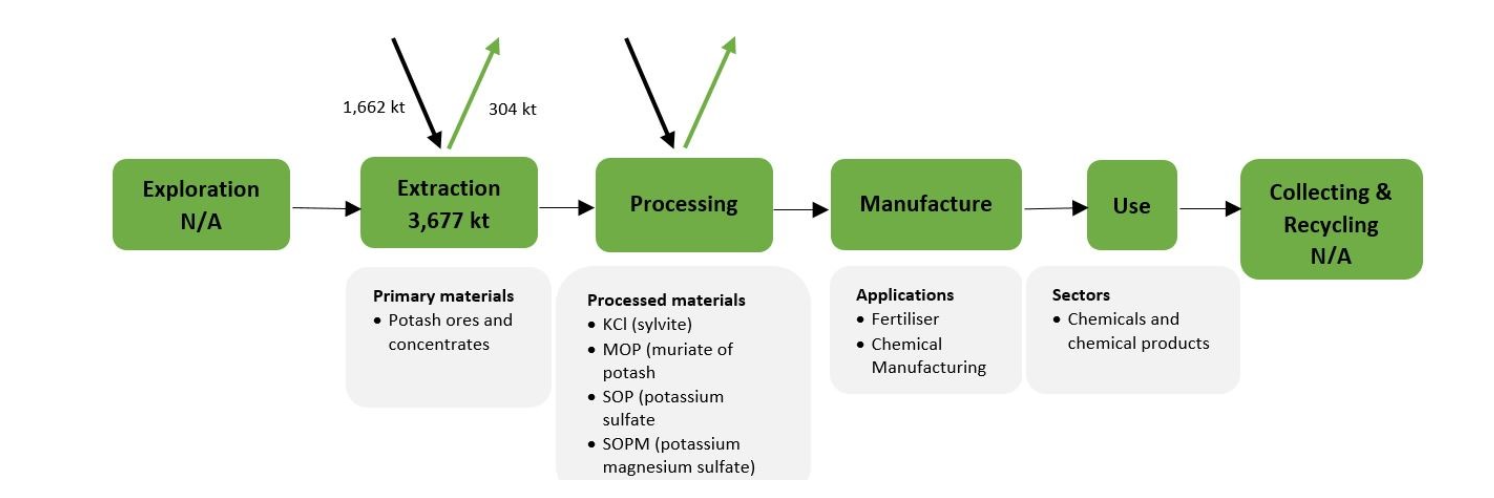
Figure 14 presents a simplified Material System Analysis (MSA) of potash flows in the EU market, based on data developed within the SCRREEN2 project, which currently represents the most recent EU-wide assessment of potash material flows. No more recent comprehensive MSA for potash has been identified at the European level. The analysis shows that the EU extracts approximately 3,677 kt of potash (K2O equivalent) annually, derived from potash ores and concentrates. During the extraction stage, the system receives around 1,662 kt of imports and exports approximately 304 kt. The extracted material is subsequently processed into a range of commercial potash products, including potassium chloride (KCl or sylvite), muriate of potash (MOP), sulfate of potash (SOP), and potassium magnesium sulfate (SOPM). These processed materials are then supplied to manufacturing activities, where they are primarily used in the production of fertilizers and, to a lesser extent, in chemical manufacturing. The final use phase is dominated by the agricultural sector, although chemical and industrial applications also contribute to demand [SCRREEN 2 (potash),2023].
Potassium is the seventh most abundant element in the Earth's crust, accounting for approximately 2.4–2.6 wt.% of crustal rocks. Although potassium is widely distributed in common rock-forming minerals such as feldspars, micas, and clays, these sources are generally not economically suitable for fertilizer production. Commercial potash resources occur primarily in evaporite deposits, which formed through the evaporation of ancient inland seas and saline basins over geological timescales. These deposits contain concentrated potassium-bearing salts that can be economically mined and processed into fertilizers and industrial potassium compounds. The principal potash minerals are sylvite (KCl), carnallite (KMgCl3·6H2O), kainite (KMg(SO4)Cl·3H2O), and langbeinite (K2Mg2(SO4)3). Among these, sylvite is by far the most important commercial source and is typically mined from underground evaporite deposits in Canada, Russia, Belarus, Germany, and China. Potash is commonly extracted either through conventional underground mining, where ore is excavated and concentrated by flotation, or through solution mining, where water is injected into the deposit to dissolve potassium salts that are subsequently recovered from brines. In addition to conventional mining, significant potash production originates from natural brine resources, particularly the Dead Sea (Israel and Jordan) and the Great Salt Lake (USA). In these operations, solar evaporation concentrates potassium-rich brines, producing potash products with lower energy requirements than conventional underground mining. Globally, the largest potash reserves are concentrated in Canada, which hosts more than half of the world's known reserves, followed by substantial resources in Russia, Belarus, China, Germany, Israel, and Jordan. This high geographical concentration makes the global potash supply chain vulnerable to geopolitical and trade disruptions [Ciceri et al. ,2015] [Jasinski, M.,2019].
Potash mineral deposits are chemical sedimentary rocks that formed by the evaporation of saline waters (e.g. seawater) resulting in the precipitation of salt minerals [Dill, H.G. ,2010] . Salt deposits may be broadly split into two groups: (1) present day, or geologically young shallow-water salt deposits and (2) ancient deep-water salt deposits. Shallow water deposits typically occur in semi-arid to arid coastal environments and are characterized by their limited thickness and restricted lateral extent. The low magnesium sulphate content of shallow water deposits indicates precipitation from nonmarine, or mixed marine-nonmarine waters. Whereas deep water deposits form thick, laterally extensive deposits enriched in magnesium sulphate; this enrichment in magnesium sulphate is indicative of formation by precipitation of seawater in a restricted marine basin. Deep water deposits are typically bedded, with carbonate minerals occurring at the base of the sequence followed by calcium sulphates, halite, magnesium sulphates and then magnesium and potassium chlorides. Mineable potash deposits are generally associated with thick halite deposits, where the potash occurs as thin seams near to the top of the halite beds [Prud’homme, M. and Krukowski, S.T. ,2006] [Dill, H.G. ,2010] [Pohl, W.L. ,2011].
Halokinetic deposit type refers to various halokinetic structures, including diapirs, salt walls, pillows, and other structurally deformed salt accumulations. Halokinetic deposits originated as relatively flat-lying and undeformed salt rock and related basin-wide evaporite deposits, but were subsequently deformed by faults, regional deformation, and (or) lithostatic loading.
Potash-bearing basins may host tens of millions to more than 100 billion metric tons of potassium oxide (K2O). Examples of these deposits include those in the Elk Point Basin in Canada, the Pripyat Basin in Belarus, the Solikamsk Basin in Russia, and the Zechstein Basin in Germany [Orris, G.J., Cocker, M.D., Dunlap, P., Wynn, Jeff, Spanski, G.T., Briggs, D.A., and Gass, L., with contributions from Bliss, J.D., Bolm, K.S., Yang, C., Lipin, B.R., Ludington, S., Miller, R.J., and Slowakiewicz, M.,,2014].
European potash production is primarily from the Zechstein Formation, a large (c. 200,000 km3) Permian evaporite sequence that outcrops in Germany, the United Kingdom, the Netherlands and Poland. A large proportion of the Zechstein formation is found beneath the North Sea, where it plays an important role a cap rock for the North Sea oilfield [Pohl, W.L. ,2011] .
Potash can also be extracted from brine or brine-related processes such as evaporation of inland and seawater derived brines, or the extraction of alunitic clays from acidic salt lake environments. The focus of this system is on the formation of inland potassium enriched brines that are near the surface within salt lakes, playas or paleovalleys. These brines form the resource for extraction of potash via onsite evaporation in the mining process [GSWA ,2022]. Potassium bearing minerals are mined from underground ore deposits or extracted from salt lakes and brines. (e.g. Great Salt Lake in Utah and the Dead Sea) [USGS,2024].
| Country | Resources (million tonnes) | |
|---|---|---|
Potash resources are extremely large and widely distributed globally, greatly exceeding current reserves and annual production levels. According to the USGS [USGS (potash) 2,NA], identified world potash resources are estimated at approximately 250 billion tonnes K2O equivalent, occurring mainly in large evaporite basins and salt lake brine systems. Major resource-bearing regions include the Elk Point Basin (Canada), Pripyat Basin (Belarus), Solikamsk Basin (Russia), Zechstein Basin (Central Europe), and extensive brine deposits in China, South America, and the Dead Sea region.
| Country | Resources (tonnes) | |
|---|---|---|
| Russia | 2200 | |
| Canada | 1100 | |
| Laos | 1000 | |
| Belarus | 750 | |
| United States | 220 | |
| China | 200 | |
| Chile | 100 | |
| Spain | 100 | |
| Israel | Large | |
| Jordan | Large | |
| Other countries | 3000 | |
| Total | >5900 |
The global potash reserves expressed as K2O equivalent, according to the most recent USGS data, are presented in Table 8 [USGS (potash),2026].
| Country | Deposit / project | Company | Resources MtK2O content | Resource Category | ||
|---|---|---|---|---|---|---|
| Germany | South Harz | South Harz Potash Ldt. | 570 | JORC (Measured, Indicated &Inferred) | ||
| Spain | Cabanasses, Vilafruns | ICL Group Ltd. | 115.3 | JORC (Measured, Indicated &Inferred) | ||
| Spain | Muga-Vipasca | Highfield Resources Ltd. | 33.3 | JORC (Measured, Indicated &Inferred) | ||
| Spain | Sierra del Perdon | Highfield Resources Ltd. | 8.7 | JORC (Measured, Indicated &Inferred) | ||
| Spain | Pintanos | Highfield Resources Ltd. | 8.4 | JORC Inferred | ||
| TOTAL 735.7 |
For Europe, there is no complete and harmonised dataset that presents total EU resource and reserve estimates for potash. The Minerals4EU project has been the only EU-level repository of some mineral resource and reserve data for potash, but this information, published in 2014, did not provide a complete picture for Europe [European Commission,2017].
Data of EU potash resources are given in table 9. JORC compliant resources are reported from South Harz Potash District of Germany and from South Pyrenean evaporite basin of Spain.
In Central Sweden a JORC compliant potash resource has been given for Häggån polymetallic deposit in which Vanadium is the primary commodity. Combined indicated and inferred resources are 76,4 million tonnes (Mt) of K2O. The deposit lies within Cambrian to Lower Ordovician age geological unit known as the Alum Shale Formation. Low grade potassium content is hosted by potassium aluminium silicate mineral, roscoelite (K(V3+, Al, Mg)2AlSi3O10(OH)2). Recovery of vanadium from this mineral by pressure acid leaching would involve destruction of the mineral matrix, recovering the component elements, including both vanadium and potassium, to solution [Aura Energy ,2023].
European (non-EU) potash resources are known from North Yorkshire, United Kingdom, where world's largest known deposits of polyhalite is being mined in Boulby mine and planned in nearby Woodsmith mine. The company ICL Boulby states to have an estimated 1 billion tonnes of polyhalite resources in late Permian horizon, some of which are currently mined, making ICL UK the sole producer of polyhalite worldwide [ICL Boulby ,2025].
| Country | Deposit / project | Company | Reserves MtK2O content | ReseveCategory | ||
|---|---|---|---|---|---|---|
| Germany | South Harz | South Harz Potash Ldt. | 10.5 | JORC (Proven & Probable) | ||
| Spain | Cabanasses, Vilafruns | ICL Group Ltd. | 24.9 | JORC (Proven & Probable) | ||
| Spain | Muga-Vipasca | Highfield Resources Ltd. | 10.6 | JORC (Proven & Probable) | ||
| TOTAL 46.0 |
According to the S&P Global Market Intelligence, there are two active potash mining regions in the EU that contain JORC compliant reserves. Data of EU potash reserves are given in Table 10.
In Germany’s South Harz Potash District comprises Zechstein Evaporites - a potash-enriched evaporite sequence of Permian era. Three perpetual mining licenses and two exploration licenses, owned by South Harz Potash ltd. are valid in the area.
In Spain ICL Iberia (Iberpotash) operates mines in the Province of Barcelona and Highfield Resources ltd. has started mine construction in the province of Zaragoza. Geologically these deposits are part of the Upper Eocene South Pyrenean evaporite basin that is divided into two subbasins (Navarrese and Catalan) 300 km apart. Both contain a lower marine evaporite sequence and potash deposits [Cendón, D.I, Ayora, C., Pueyo, J.J., Taberner, C. ,2023].
Global potash production was estimated at 67.5 million tonnes in 2023 (of potassium chloride, 60 to 63% K2O). Canada is the dominant producer of potash, with approximately 22 million tonnes (32% of the total). Russia and Belarus are among the top producers. Their combined output reached 22.5 million tonnes in 2023, accounting for approximately one-third of global supply (33%) [Government of Canada,2025].
The EU is the fifth-largest potash producer in the world, accounting for 7% of global production in 2020. EU domestic production accounted for 65% of EU sourcing (Production + Imports) in 2020. Potash is produced in Germany (87% of total EU output) and Spain (13% of total EU output). EU production has been gradually decreasing in recent years: from about 3.9 million tonnes in 2014 to 3.3 million tonnes (K2O equivalent) in 2020 [European Union,2022].
Figure 15 shows global mine production of Potash in metric tonnes, reported as K2O equivalent.
Potassium recycling is inherently challenging because, unlike metals, potassium is not accumulated in durable products but is predominantly used in fertilizers. The main opportunities for potassium recovery arise from secondary biological and industrial streams. Agricultural residues, livestock manure, sewage sludge, food waste, wood ash, and digestates from anaerobic digestion contain significant amounts of potassium that can be returned to soils as fertilizers. However, these materials are generally used directly as nutrient sources rather than processed into purified potash products. Outside agriculture, potassium is used in products such as glass, ceramics, detergents, chemicals, and specialty industrial materials. In these applications, potassium is often chemically bound within the product matrix (e.g., potassium carbonate in glass or potassium compounds in ceramics), making recovery technically complex and economically unjustified. End-of-life recycling of glass typically focuses on recovering the glass itself rather than extracting potassium compounds. Similarly, potassium-containing chemicals are usually consumed during industrial processes and become diluted in waste streams.
| MSA Flow | Value | ||
|---|---|---|---|
A number of reseraches have been focused on the extraction of potash from various residues, however these methods have not still been applied at industrial levels. It deserves to be mentioned the following cases:
Potassium was efficiently recovered from fly ash using sulfuric acid as a leaching mean [Wang et al.,2016].
According to a recent study [Moslehi et al.,2025], ash from biomass incineration can serve as a secondary source for nutrient recovery. Potassium can be selectively leached with water, separating it from phosphorus and impurities. Removal of potassium enriches the phosphorus content in the remaining solid (>10 wt%). Crystallization and precipitation enable the recovery of both potassium and phosphorus.
Highly efficient regeneration of natural zeolite was developed in conjunction with the removal of high concentrations of ammonia and potassium from the reverse osmosis effluent of anaerobic-digested wastewater by fixed-bed ion exchange [Guo et al.,2013].
A number of zeolite materials have been used for the recovery of potassium from wastewaters. More specifically, the K sorption capacity of the ammonium acetate-treated zeolite was higher than that of the natural zeolite, but the loss of K sorption capacity with the repeated uses was greater with the ammonium acetate-treated zeolite. Overall, the results show that the manganese nodule can potentially be used to recover K under certain conditions, but the zeolite-based absorbents are generally better for K recovery from K-containing waters [Shin et al.,2021].
Recycling of potash from new scrap (i.e. chemicals generated during the production process) is not possible as potassium-bearing salts, mainly potassium chloride (KCl), but also K2SO2, KNO3, etc. consist ionic salts disolved in water.
The processing of potash ores comprises four stages: (1) potash ore is crushed and ground to release the potash minerals from the ore, at this stage clay minerals are also removed from the ore (i.e. desliming); (2) potash minerals are separated from unwanted salt minerals (e.g. halite) by froth-floatation; (3) the potash minerals are dried and size-graded; and finally (4) further purification takes places by dissolving the potash minerals in hot brine to remove impurities. Upon cooling a high-purity precipitate is formed, which may be used in the production of fertilizers and potassium chemicals [European Commission,2017].
Solution mining of Potash deposits is practiced around the world, including Canada, the USA and Germany. Solution mining involves dissolution of the potash with water. Wells are drilled into the potash-bearing area (sylvinite bed) and water, later brine, is pumped down the wells to dissolve the potassium chloride (KCl) (potash product) and sodium chloride (NaCl) (waste salt) that is in the sylvinite bed. Brine is returned to the surface and is conveyed to the process plant through pipelines and separated by mechanical evaporation and crystallization [Yancoal ,2019].
Other considerations
Potassium is classified under Annex VI of Regulation (EC) No 1272/2008 (CLP Regulation) with code H260 [eur-lex.europa.eu (potash),2011] as water-reactive and with H314 code for being corrosive to the skin, while caustic potash is classified with code H302 for its acute toxicity and code H314 for being corrosive to the skin. Annex VII of EU Regulation (EC) No 889/2008 lists caustic potash as authorised to be used in organic production for cleaning and disinfection of buildings and installations for animal production to prevent cross-infection and diseases. Potassium nitrate is a registered substance under REACH, with no current Authorisations or Restrictions. Potassium can produce negative effects when breathed in. Inhalation of dust or mists can irritate eyes, nose, throat and lungs. Higher exposures may cause a build-up of fluid in the lungs, this can cause death. Skin and eye contact can cause severe burns leading to permanent damage [lenntech.com,2023].
Potash mining can have significant environmental impacts. Waste streams, including tailings and brine, often contain high concentrations of salts that can leach into soil and water, causing salinisation. Underground mining of water-soluble salts carries a risk of subsidence as voids form and overburden relaxes, as observed in Belarus. Production generates large volumes of waste and requires substantial energy, contributing to greenhouse gas emissions and ecological footprint. High salinity from mining discharges can reduce species richness in freshwater ecosystems, alter surrounding vegetation, and degrade habitats. Elevated potassium or salt concentrations in water bodies near mining or fertilizer-use zones remain a concern. Effluents from processing plants often contain salts, brine, and reagents that require careful disposal to prevent contamination. The scale of environmental impacts depends on mining methods, geology, climate, hydrogeology, and waste-management practices. While salinisation and waste generation are well documented, long-term biodiversity effects and water-quality impacts are less understood. Effective mitigation, such as proper tailings management and controlled effluent disposal, can reduce many of these risks [UNEP (potassium),NA] [Ushakova et al. ,2023].
The energy requirement for producing 1 ton of K2O in form of KCl (common potash fertilizer) exceeds 15 GJ. This amount is relatively high compared for example with the pig iron production which requires 4-6 GJ per tonne [Farahani et al. ,2024]. Waste-brine and salt-laden effluents from potash mines can lead to freshwater salinization. Surface-water chloride concentrations can reach up to 6 g/L. Soil near potash mines often shows salt contamination: in some floodplain soils near potash operations, concentrations of Na+, K+, Cl- can be 7–10 times higher than background. Dust levels underground in potash mines — during ore crushing/handling — can exceed 2,000 mg/m³, far above typical safety thresholds (e.g. ~5 mg/m³ allowed) [Isaevich et al.,2022] [Ushakova et al. ,2023].
Potash products are marketed according to their K2O-equivalent content and purity, with specifications varying by application. In the fertilizer sector, the dominant product is muriate of potash (MOP, KCl), which typically contains 60–62% K2O equivalent and at least 95–98% KCl, making it suitable for bulk agricultural use. For chloride-sensitive crops, sulfate of potash (SOP, K2SO4) is preferred, containing approximately 50–52% K2O with very low chloride levels (<1–2%). Potassium nitrate (KNO3), used in high-value horticulture and fertigation, generally contains 44–46% K2O equivalent and is produced at purities exceeding 98% [fertechinform,2021].
Industrial applications require significantly higher purity standards. Potassium hydroxide (KOH) used in batteries, chemicals, soaps, and pharmaceuticals is commonly supplied at 85–90% purity in solid form or as 45–50% aqueous solutions, while battery and electronic applications often require very low impurity levels. Potassium carbonate (K2CO3) used in glass, specialty chemicals, and electronics is typically produced at 98–99% purity, and food- and pharmaceutical-grade potassium salts generally exceed 99% purity [Jasinski, M.,2019].
Belarus: According to The Observatory of Economic Complexity (OEC) trade data, share of potassic fertilizers of the total export in the year 2023 was 26.4 % for Belarus, 12.9 % for Jordan and 9.7 % for Laos. Table 12 shows the top 3 countries of which the export of potassic fertilizers forms highest shares of country's total exports [OEC,2025].
| Country | Export value (USD) | Share in total exports |
|---|---|---|
| Belarus | 2,01 billion | 26,4 |
| Jordan | 1,91 billion | 12,9 |
| Laos | 0,84 billion | 9,7 |
Potash mining raises several social and ethical concerns. Large-scale projects can displace local communities, disrupt livelihoods, or affect Indigenous lands, making fair consultation and compensation essential. Worker safety, fair wages, and protection from hazardous exposures, such as dust and brine, are critical ethical obligations. Health impacts on nearby communities, equitable sharing of economic benefits, and respect for cultural heritage must also be considered. Additionally, transparency, anti-corruption measures, and responsible sourcing in the global supply chain are important to ensure ethical operations [miningwatch.ca,2012].
Aqueous potassium-ion batteries
Aqueous potassium-ion batteries (AKIBs), utilizing fast diffusion kinetics of K+ and abundant electrode resources, are an emerging technology offering high power density and low cost. Many efforts have been made by far to enhance the electrochemical performances of AKIBs, and some encouraging milestones have been achieved. To provide a deep understanding of the progress, challenges, and opportunities of the emerging AKIBs, the recent advances in both cathode and anode materials, and electrolytes of the AKIB systems are comprehensively summarized and discussed. Additionally, the research efforts on the optimization of electrode material properties, the revealing of the reaction mechanism, the design of electrolytes, and the full cell fabrication for AKIBs are highlighted. Finally, insights into opportunities and future directions for achieving high-performance AKIBs and their applications are proposed [Zheng et al. ,2022].
Potash for aluminium batteries
Molten salts form a good alternative to the common electrolyte. Also in this case, the advantages of molten salts are high electrical conductivity, fast electrode kinetics and hence less polarization, and wider electrochemical windows. Aluminium can be electrodeposited from these nonaqueous media and therefore the electrolytes are suitable for developing rechargeable aluminium batteries. Since the 1970s, many research studies have been carried out for developing aluminium secondary batteries since, even though no commercial products have been made yet [Elementarium (Zr),2024].
Potash for concentrated solar power (CSP) plants
Molten salts of eutectic mixtures of NaNO2, NaNO3, KNO2, are used as heat storage and heat transfer material apart from the water. These are widely used in CSP plants (eutectic mixture is employed as standard material for CDP hence in technologies with high TRL) [Vijjapu and Tiwari,2021].
ALION project: high specific energy aluminium-ion rechargeable decentralized electricity generation sources
ALION project has developed an aluminium-ion battery technology for energy storage application indecentralised electricity generation sources. ALION pursues an integral approach comprising electroactive materials based on “rocking chair” mechanism, robust ionic liquid-based electrolytes as well as novel cell and battery concepts, finally resulting in a technology with much lower cost, improved performance, safety and reliability with respect to current energy storage solutions. The project covers the whole value chain from materials and component manufacturers, battery assembler, until the technology validation in specific electric microgrid system including renewable energy source. Therefore, the finalobjective of this project is to obtain an Al-ion battery module validated in a relevant environment, with a specific energy of 400 W.h/kg a voltage of 48 V and a cycle life of 3000 cycles [ALION,2019].
Potash recovery from synthetic potassium rich wastewater and biomethanated distillery effluent using tartaric acid as a recyclable precipitant
Potassium is one to the essential elements for plant and animal life due to its vital nutritional roles. Globally, more than 95 % of the potassium chemicals is utilized as fertilizer. Due to shortage of land and vulnerability to climatic conditions, potash production through conventional evaporation process seems difficult in long run. Hence, its recovery from the potassium rich industrial effluents such as biomethanated spent wash (BMSW), can be an attractive option. In a recent research, tartaric acid (a recyclable precipitant) was used for potash recovery from potassium rich synthetic wastewater. At an optimum solution pH of 3.5, more than 70 % of the total potassium was precipitated out as potassium bitartrate Subsequently, the tartaric acid was regenerated by converting KHT into potassium nitrate (KNO3). Around 77 % potassium could be converted into KNO3 using Mg(OH)2 and HNO3 with 80 % regeneration of tartaric acid. Based on the results, it can be suggested that the selective extraction using tartaric acid has high potential for potash recovery from waste streams. A detailed study should focus on the optimization of conditions for recovery of potassium from real effluent and its purity in the residue should be verified. In addition, suitable conditions for regeneration of tartaric acid should also be obtained [Khatri and Garg,2022].
Deep well injection for the waste brine disposal solution of potash mining in Northeastern Thailand
Under the pressure of the existing world population growth trends, the decreasing pastoral fields and the increasing duration and incidences of drought and heat stress, the potash fertilizers demand dramatically increase to enhance the world food production. Asia currently consumes 40 % of the world's potash market, yet 70 % of world potash exports come from mines in Canada and Europe. Weak collective efforts to produce potassium fertilizers economically pose the risk of global shortages of potash goods and threatening global food security. While the Khorat Plateau in Northeastern Thailand is noted to contain active and promising regional potash deposits, developing a proper potash industry in the region has largely been unsuccessful due to major constraints such as the challenge of establishing a brine disposal solution. This study demonstrates the performance of deep well injection (DWI) as an environmentally friendly alternative to secure waste brine production from the potash mine. The groundwater numerical model demonstrates the movement and penetration of the concentrate during and after deep well injection [Pumjan et al.,2022].