Overview
The rare-earth elements (REEs) are a group of 17 elements that exhibit special electronic, magnetic, catalytic and optical properties. They are enablers: they can have a profound effect on the performance of complex engineered systems.
The REEs are commonly categorised into two groups - the light REEs (LREEs) and the heavy REEs (HREEs) there is no universally agreed definition for each of these two groups; for the purposes of the SCRREEN3 factsheets the LREEs are defined as lanthanum (La), cerium (Ce), praseodymium (Pr), neodymium (Nd), promethium (Pm), samarium (Sm) and europium (Eu); the HREEs are defined as gadolinium (Gd), terbium (Tb), dysprosium (Dy), holmium (Ho), erbium (Er), thulium (Tm), ytterbium (Yb), lutetium (Lu) and yttrium (Y).
Scandium (Sc) is often considered to be a REE, but is not grouped as either a LREE or a HREE. It should be noted that Pm does not occur naturally on Earth as its isotopes all have relatively short half lives.
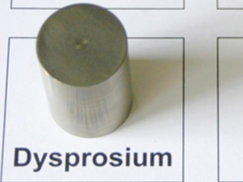
This factsheet is focused on 3 HREES, linked to their referencing in the Eurostat nomenclature, namely dysprosium (Dy), gadolinium (Gd) and terbium (Tb). The image to the right shows Dy metal (source: BRGM).
Due to their high magnetic susceptibility Dy and Tb y are primarily used to improve the coercivity and thermal resilience of neodymium-iron-boron (NdFeB) magnets. As regards Gd, its main uses include Magnetic Resonance Imaging (MRI) to enhance image quality and detect abnormalities.
These three HREES are particularly sensitive because their production in recent years has been tied to Chinese imports of raw materials from Myanmar and refining steps controlled at >90% by China.
Furthermore, on 4 April 2025, China announced export controls targeting Tb metal, compounds and alloys (including NdFeB magnets and alloys containing Tb); and Dy metal, compounds and alloys (including NdFeB magnets and alloys containing Dy), followed in October 2025 by tighter requirement for licenses applications on technologies and equipment used in the REEs and magnets production. Although trade negotiations between China and the USA in early November 2025 resulted in the suspension for one year of restrictions announced on 9 October 2025, tensions will remain high on such materials and technologies.
| Global production | Global producers | EU consumption | EU share | EU suppliers | Import reliance |
|---|---|---|---|---|---|
| 6,329t | China 66% United States 13% Myanmar 10% Australia 6% | 184t | 3% | China 48% Japan 35% Norway 7% Korea, South 4% United Kingdom 3% | 100% |
gure 3).
Gadolinium
Gd has unique magnetic, electrical, and optical properties. It is one important non-renewable strategic element widely used in many fields and industries, including medical imaging, electronics, and nuclear reactors. As an essential material in MRI contrast agents, gadolinium plays a crucial role in modern healthcare technology. Additionally, its applications in manufacturing phosphors, magnets, superconductors, and neutron absorption materials make it a valuable resource in scientific and industrial advancements.
Gadolinium is used in Europe mainly in medical diagnostics, to improve the image quality of medical testing equipment such as X-ray and Magnetic Resonance Imaging (MRI) (40%), in metallurgy (10 %) and for the realization of magnets (10%). The remaining 40 % is used for the manufacture of electrical equipment, computers, electronics and optical products (see figure 4 and table 7).
| Use | Percentage | Substitute | Sub share | Cost | Performance |
|---|---|---|---|---|---|
| Magnets | 90% | No substitute | 100% | No substitute |
Market analysis, trade and prices
| Global production | Global producers | EU consumption | EU share | EU suppliers | Import reliance |
|---|---|---|---|---|---|
| 6,329t | China 66% United States 13% Myanmar 10% Australia 6% | 184t | 3% | China 48% Japan 35% Norway 7% Korea, South 4% United Kingdom 3% | 100% |
At the extraction phase, no official data exists on the production of Heavy Rare Earths. Myanmar's role has been crucial in the few last years, however only estimates exist. From 2018 to 2024 and base on trade data between China and Myanmar, it can be estimated than Mynamar was responsible for 75% of dysprosium and terbium oxides global production. Figures vary in the order of magnitude of 5,000 t REO (Rare Earths Oxides) global production annually for these 3 elements, with at least 2,500 t for dysprosium alone.
At the processing phase, no official data exist either, but China is known to hold at least 98% of refining facilities for Heavy Rare Earths.
| Processing/refining | |
|---|---|
| CN Code | Title |
| 28053031 | Gadolinium, terbium and dysprosium, of a purity by weight of >=95% (excl. intermixtures and interalloys) |
| 28469060 | Compounds of gadolinium, terbium or dysprosium, inorganic or organic |
Understanding Changes in CN Codes for REEs (2000-Present)
Before presenting the trade data, it is important to understand how the classification of REE products has evolved in the EU’s customs system. In this section, we have included a flowchart that outlines the evolution of certain CN codes over time. CN codes are used in the EU to classify goods for customs and trade purposes. These codes are periodically revised to reflect shifts in trade patterns, technological advancements, and the need for more-detailed product categorization. In 2000, four CN codes were used to classify REEs. By 2015, some of these codes were split into more specific categories, and further refinements were introduced in 2023.
As of 2025, two codes specifically targets the HREES for magnets as illustrated in Table 4 : 28053031 and 28469060.

Figures 7 & 8 show the estimated EU trade flows and imports respectively, of Gd, Tb or Dy metals. As noted above, CN code 28053031 has been in use since 2023. On earlier years, assumptions have been taken on precedently used CN codes in order to homogenize the statistics.
Apart from a spike in 2019 at 3 t of imports, quantities for these materials are very limited in annual flows, <1t for imports and all the more for EU exports, close to zero. The main explanation is that in the form of metals, those 3 heavy rare earths are directly embedded in products imported to Europe (magnet alloys, magnets and even components containg magnets), harder to trace.
As noted above, CN code 28469060 has been in use since 2023. For earlier years, assumptions have been taken on precedently used CN codes in order to homogenize the statistics.
Annual figures from 2020 to 2024 are very stable, close to 200 t. Since 2023, Japan is the main trade partner, having replaced China at this first position. Norway also appears in the list of import countries since 2022, with materials transiting in the country.
To be added
Demand for Dy and Tb, essential for high-performance Neo magnets, is expected to rise quickly over the next decade, driven by EVs, robotics, wind turbines, and other clean-energy technologies. Magnet applications are already the fastest-growing use of REEs and are likely to keep expanding. Gadolinium uses is also expected to grow, although its markets remains more niche.
Since the military coup of 2021 in Myanmar, exploitation of these heavy rare earths in the Kachin state have had huge repercussions on the global market. Prices spikes showed in Figure 9 reflect the different episodes of closure and re-opening of the Myanmar/China border between 2018 and 2025. Period of low prices often corresponds to high stockpiling levels on the Chinese domestic market.
On the supply side, global production of magnet HREEs will need to expand significantly to meet this rising demand. China continues to dominate, especially in processing, alloy and magnet-making, though new projects around the world are under development. In Europe, production of dysprosium and terbium oxides is expected to come by 2027-2028 thanks to 2 specific projects : Caremag in France, with an output of 600 t of Dy and Tb oxides [Carester,2025] and in Estonia [Neo Performance Materials,2025].
Still, supply shortfalls are likely in the late 2020s unless new capacity comes online faster. Recycling and alternative magnet designs may help ease pressure, but most forecasts expect ongoing tight markets, with price volatility and strategic competition for resources.
Demand
Further increase of demand for those 3 heavy rare earths is expected in the coming years. Dysprosium and terbium consumption is driven by the demand for Nd-Fe-B permanent magnets, whose growth by 2030 is projected to be between 6% and 10% per year [Adamas Intelligence,2024]. Reducing the amount of dysprosium used in these magnets or substituting them (with alternative technologies, particularly in the wind or automotive sectors) could lower these prospects, although marginally [JRC,2023] .
Data shown in Figure 10 reflect that EU demand and imports of the HREEs globally coincide since, meaning that the total consumption is reliant on imports.
EU is 100% dependent on imports, coming almost exclusively from China in the form of metals, and from China, Japan and Norway as regards HREEs compounds in recent years.
As illustrated below, the main applications of dysprosium, terbium and gadolium taken as a group are in permanent magnets, both globally and in the EU. As regards Gd, metallurgy is another important sector of uses. Other individual niche applications of each of these elements are described here after.
Table 5 describes the NACE sectors in the EU nomenclature where those elements are the most uses, namely magnets, which has been linked to the manufacture of electrical equipment as the best proxy.
| Applications | 2-digit NACE sector | Value added of NACE 2 sector | 4-digit CPA |
|---|---|---|---|
| Magnets | C27 - Manufacture of electrical equipment | 125,000M€ | C27 - Manufacture of electrical equipment |
| Other | C32 - Other manufacturing | 70,000M€ | C32 - Other manufacturing |
Dysprosium and terbium main uses are in NdFeB magnets. Their addition makes it possible to reinforce the resistance to demagnetization of the magnet at high temperatures, and go from maximum use temperatures of 80°C to more than 200°C [BRGM,2015]. Questions of prices and availibility can be a limit to such uses, although they are always favoured when geopolitical and economic conditions are good, as no viable substitute exist in terms of performance, unless using other technologies.
The most important use of these heavy rare earths, when economic conditions allow, are their addition in certain metallurgical alloys where they can improve the quality and strength of the final material [BRGM,2015].
Terfenol D is one of these specific alloys. Its composition is : Tb0.3Dy0.7Fe1.9. It is known for its important magnetostriction, meaning that its shape changes in response to magnetic fields (magnetostriction of up to about 2000 ppm at low magnetic fields). It was used for electroacoustic transducers sonars developed by the American army in the 1950s and is still widely used in high performance actuators, sensors, and transducers due to its fast response and high energy density. In 2025, China has announced the completion of Inner Mongolia’s first demonstration line of production of Terfenol-D [Rare Earths Exchange,2025]
Other applications of Tb can include the manufacture of special inks for the protection of banknotes [BRGM,2015].
Dy and Gd are neutron absorbers and can thus be used, in small quantities, in control rods of nuclear reactors [BRGM,2015].
See above
| Use | Percentage | Substitute | Sub share | Cost | Performance |
|---|---|---|---|---|---|
| Magnets | 90% | No substitute | 100% | No substitute |
In most of its applications, gadolinium, dysprosium and terbium are irreplaceable without a loss in performance. However, for economic reasons, many research and development efforts have focused on reducing the amount of them used in some metallurgical applications.
Techniques to reduce the quantity of dysprosium in NdFeB magnets have been tried and patented since the 2010s, in particular by Japanese firms like TDK with its HAL (High-Anisotropy field Layer) production process [TDK Tech Journal,2011]. Such research continues as of today [Wang et al.,2025]. The only other option is a technology substitution, for instance in Offshore Wind installations, either with cooling systems to allow the uses of magnets at high temperatures or replace permanent magnets by equivalent technologies.
Supply
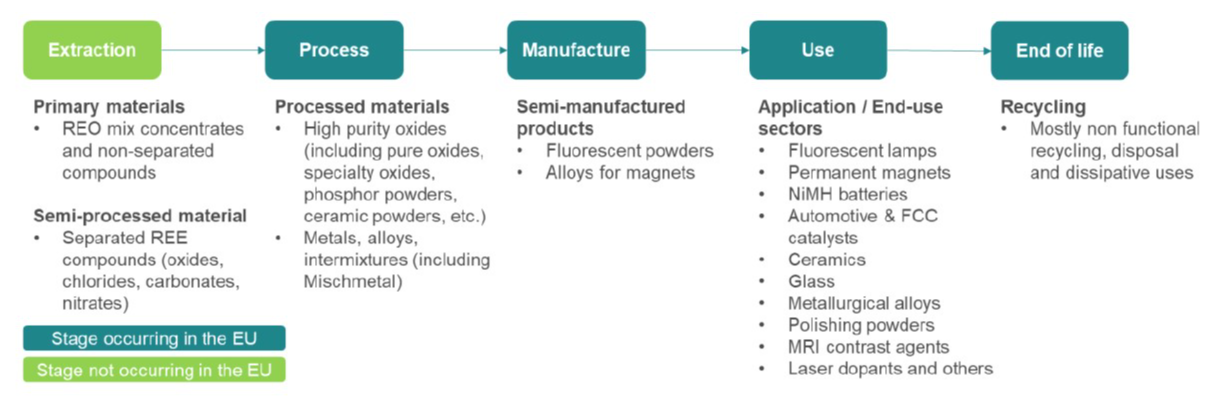
In the EU, a handful players are found at different stages of the REE value chain. Some have the ability to separate individual HREOs (in Estonia and France), and to manufacture REE-based products for various industries (such as phosphors, catalysts and polishing powders, etc.) but not metallic REEs.
There are also alloys makers and magnet manufacturers in Germany, Estonia and Slovenia operating from imported processed materials (strip-cast alloy). Just outside of the EU there is Nd, Pr-Nd and Pr metal and (Pr,Nd)-Fe-B-type magnet alloy-making capability in the UK, and some Sm-Co alloy production. More projects are likely to emerge, like Estonia annoucing new capacity in 2025 and in France, both for alloy-making and magnet recycling by 2027.
Although critical, a large proportion of REE consumption today comes from finished products imported into to the EU (magnets, alloys, hard drives, laptops, electric or hybrid vehicles, etc.).
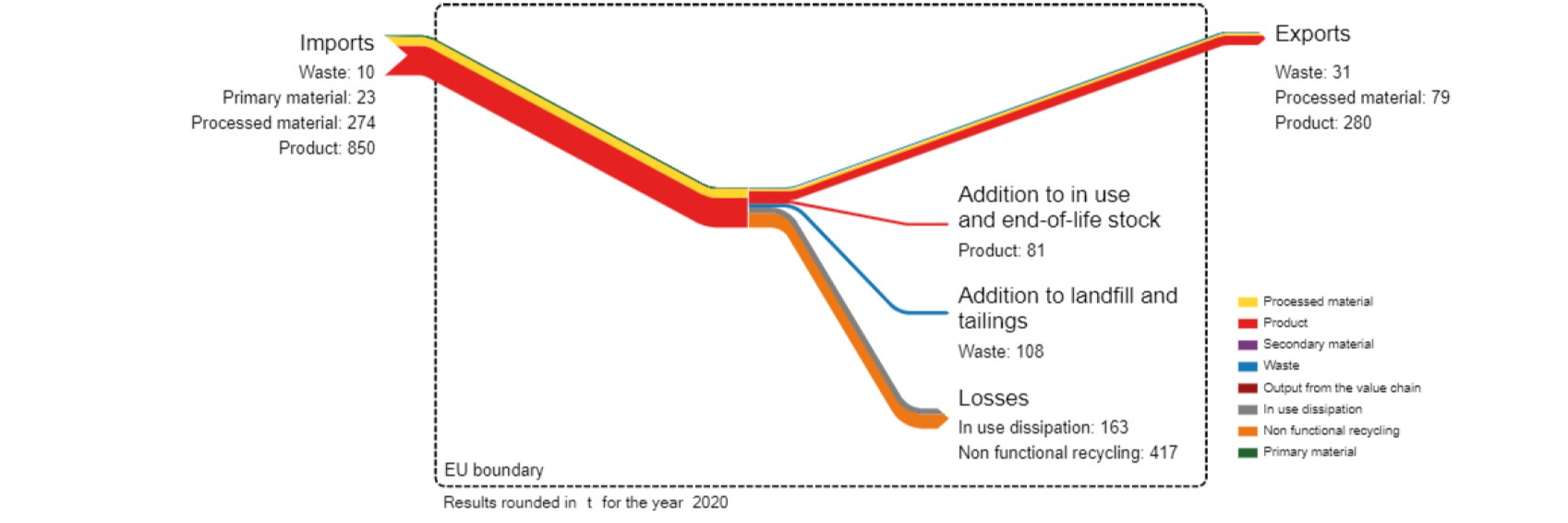
Currently not available
REEs do not occur in free elemental form but form mineral compounds. While there are hundreds of known REE-bearing minerals, almost all REEs produced today are derived from just four mineral types: bastnaesite, monazite, xenotime and ionic clays. The magnet HREEs are primarily derived from ionic clays. Main deposits of ionic clays result from surface alteration of acidic igneous rocks pre-enriched with REEs in the South-East provinces of China (Jiangxi, Guangxi, Guangdong, Hunan) [BRGM,2015] and similar geological contexts in Myanmar for instance.
Monazite and xenotime are also a minor source of these elements. Monazite typically contains higher quantities of HREEs than bastnaesite. lt also typically contains significant quantities of radioactive thorium. Monazite minerals are primarily mined as by-products of heavy-mineral-sands (HMS) operations, where the primary targets are minerals that contain titanium and zirconium (Zr) (such as the Namakwa Sands HMS operation in South Africa); some hard-rock deposits are mined with monazite as the primary target (such as the Mount Weld mine in Western Australia).
The main global source of Heavy Rare Earths is made up of a set of lateritic clay deposits in southern China. These clays mainly kaolinite / halloysite, illite, smectites developed by alteration surface of acidic igneous rocks (granites, pyroclastites) already relatively rich in REEs [BRGM,2015] . Trivalent Rares Earth ions, mobilized by the alteration of minerals Rare Earths such as apatite or xenotime, are preferentially adsorbed on these clays, often referred to as “ion adsorption clays”, or “ionic clays”. In the alteration process, cerium, elsewhere generally the most abundant of the rare earths, was oxidized in the tetravalent form, which is less easily adsorbable. Ionic clays are therefore generally very depleted in cerium, and by difference enriched in other REEs, in particular Heavy Rare Earths.
| Country | Resources (tonnes) |
|---|
No data exist on resources by country for these infividual elements. For global REE Mineral Resources (expressed in Mt TREO equivalent), please refer to the Light Rare Earths for Magnets factsheet.
Reserves estimations on REEs are only given by [USGS,2025] in terms of rare earth oxides. There are estimated at 130 Mt. Still, these numbers only consider all rare earths combined. This figure takes into account a certain number of estimates in countries that do not comply with international standards for declaring reserves (including Vietnam, Russia, Brazil and India) and for which mining projects have not been the subject of feasibility studies. For comparison, these reserves were estimated at 88 Mt in 2002.
| Country | Classification | Quantity (Mt of ore) | Grade (% Heavy Rare Earth Elements for magnets) | Reporting code | Reporting date | Deposit, Source | ||
|---|---|---|---|---|---|---|---|---|
The EU has mineral resources containing an estimated 3.3 Mt of TREO equivalent [Heugen,2025] , the vast majority of which is present in Sweden (3.2 Mt), most notably at Kiruna (2.5 Mt) and Norra Kärr (0.6 Mt). It should be noted that non-EU neighbours Greenland and Norway have significant quantities of estimated REE mineral resources, with 40.1 Mt and 9.2 Mt of contained TREO equivalent respectively.
| Country | Classification | Quantity (Mt of ore) | Grade (% Heavy Rare Earth Elements for magnets) | Reporting code | Reporting date | Source | ||
|---|---|---|---|---|---|---|---|---|
No CRIRSCO-guided REE mineral reserves have been reported for any EU country.
China is the most important location for REE-ore mines. Bayan Obo in Inner Mongolia is an Fe-REE mine dominated by LREE minerals. Other locations include Dalcao, Sichuan, Maoniuping, and Weishan. China has also extracted IACs via operations in its southern provinces such as Jiangxi and Guangdong, although increasing such production has shifted to Kachin state in Myanmar.Other REE mines of note include Mountain Pass in California, USA, and the Mount Weld REE mine in Western Australia. There are also various HMS operations in southern Africa, Australia and SE USA, which produce monazite and xenotime as a by-product.The USGS estimates that the global production of mined REO ores in 2024 was approximately 390 kt of TREO equivalent [USGS,2025x] ]. Of this, 270 kt is estimated to be mined in China, 45 kt in the USA, 31 kt in Myanmar, 13 kt in Australia, 13 kt in Thailand, and 13 kt in Nigeria.There is no mining of REE ores in the EU.
Manufacturing scrap & end-of-life (EoL) REPMs (primary practical stream): short-loop (so-called Neo magnet-to-magnet recycling, using hydrogen decrepitation (HD) to produce magnetic powders from scrap, for subsequent magnet production) and long-loop (hydrometallurgical / pyrometallurgical processing to produce separate, purified REOs) pilot and demo plants are operating in the EU, the USA, Canada and the UK. Neo magnets are the primary target with high recovery and compelling process economics because feed grades are ~30 wt% REE in such magnets. EU pilots (e.g., SUSMAGPRO) proved technical feasibility, but volumes are still modest; the EU notes recycling rates remain <1% of available EoL REPM mass due to collection / design barriers [SUSMAGPRO ,2019-2023].
Mine/process tailings (Europe focus): LKAB (Sweden) ReeMAP is developing extraction of REEs (including magnet LREEs) together with phosphoric acid from apatite-rich tailings; a processing facility is underway.Phosphate fertilizer by-products: Processing transfers >60% of phosphate-rock REEs into phosphogypsum (PG); global PG tonnages are significant, so even hundreds of ppm concentrations can add up. Industrial routes are under active R&D and early demo; radionuclide management and logistics are key constraints either way, with commercial output targeted around 2029–30. This is the closest EU tailings-to-REEs industrial pathway with concrete timing.
Bauxite residue (red mud): Typical total REE ~0.1 wt%; extensive EU work [Rao Borra et al. ,2015] [Rao Borra et al.,2016] shows leaching is feasible but requires careful iron / aluminium handling to be economic. Industrial deployment in Europe is not yet at scale; this is a medium-term option where alumina refineries and permitting align [Rao Borra et al. ,2015].
Coal ash (US-led): US DOE/NETL programs quantify typical total REE <~300 ppm (median Nd ~86 ppm), but very large ash inventories make it possibly attractive if shown to be economic; pilot separations are advancing with public funding. Europe has less coal-ash runway as coal retires.
Phosphate fertilizer by-products: Processing transfers >60% of phosphate-rock REEs into PG; global PG tonnages are huge, so even hundreds of ppm concentrations can add up. Industrial routes are under active R&D and early demo; radionuclide management and logistics are key constraints [Khalil et al.,2025].
| MSA Flow | Value | ||
|---|---|---|---|
A possible source of heavy rare earths recovery could come from the treatment of waste from old abandoned mines and the potential recovery of REEs from mine waste streams arising from drainage, phosphogypsum residues and waste from U mines M. O. S. Chowdhury and D. Talan 2025, Zhuoling Lin et al. 2024. . In Australia, there are over 52,000 abandoned mines (C. J. Unger et al. 2012, C. J. Unger et al. 2012), which offer a scalable opportunity for commercial production of rare earths, while enabling environmental remediation.
In contrast to EoL waste, industrial in-process or pre-consumer Neo-magnet scrap (the offcuts, machining swarf, and defective parts generated during magnet manufacturing) is much easier to recover. Such scrap is high-grade (magnet alloy itself) and relatively clean (no epoxy or electronics). In practice, magnet producers today recycle virtually all of this scrap internally by re-melting or re-pressing it. Around 20-30% of the raw material in Neo magnet production becomes scrap, but virtually none is discarded, and it is normally fed back into the production loop [Okon Recycling ,2025]
New initiatives are building on this by collecting manufacturing scrap into dedicated recycling streams. For example, the UK REEVALUATE project involving Less Common Metals, Ionic RE, and Vacuumschmelze, targets grain-diffusion scrap from permanent-magnet factories. It notes that about 36% of the valuable REEs in magnets appear as scrap during manufacturing [REEVALUATE Projetc,2024-2027] nd aims to chemically recover those Pr/Nd/HREE oxides for reuse. Likewise, France’s Carester (Caremag project) is constructing a plant to refine recycled magnet chips and even make new magnet alloy [Caremag,2020-2026];
Because pre-consumer scrap is of known composition and high concentration, recycling it is comparatively straightforward. Short-loop “magnet-to-magnet” methods (e.g. HD followed by sintering) can directly convert manufacturing scrap into new magnets with minimal processing steps. In fact, several magnet makers (e.g. Noveon, Vacuumschmelze) already blend some scrap powder into sintered magnets today. The result is essentially circular: any oxide or alloy residue can be sent back (e.g. to hydrometallurgical refinement) with low loss. In summary, recycling of industrial in-process pre-consumer Neo-magnet scrap is well-established as an industrial practice. Manufacturers routinely reclaim internal scrap, and current R&D efforts are formalizing this into “industrial scrap to magnet” supply chains;
There are a number of specific processes of potential use for making use of scrap / EoL REPMs:
Hydrogen processing of magnet scrap (HPMS): first developed by the University of Birmingham and being commercialized by HyProMag, HPMS is a direct "magnet-to-magnet" route where Neo magnets are exposed to hydrogen gas at room temperature. The hydrogen causes the magnets to decrepitate into a demagnetized alloy powder, which can then be reprocessed into new magnets without going through full metallurgical separation. This method is energy-efficient, avoids acid use, and has reached pilot-to-commercial scale in the UK and Germany [Burkhardt et al,2023]
Hydrometallurgy : The main industrial approach is strong-acid (or base) leaching of shredded magnets, followed by separation of REOs via solvent extraction or precipitation [U.S. Department of Energy,2022]. This method precisely recovers Nd, Pr, Dy, etc , and is used commercially. A drawback is that ~70% of the magnet is Fe, so large reagent volumes and downstream Fe-removal (e.g. pH adjustment to precipitate Fe) are needed.Selective processes often roast the scrap to oxides so that iron remains as insoluble iron oxide while REEs dissolve [US. Department of Energy,2023]
Pyrometallurgy: High-temperature processes (oxidation, carbothermal reduction or molten-salt chlorination) separate REEs from Fe without aqueous effluent For example, oxidizing Neo magnet scrap at ~1000°C then smelting can yield a metal alloy (mostly Fe) and a slag rich in Pr/Nd/HREE oxides. Molten-salt methods (e.g. Mg-chloride electrolysis) can selectively chlorinate and extract Pr/Nd/HREE into salt phases. Such methods avoid water use, but are energy-intensive and still largely at pilot scale [Xiao, F., Hu, W., et al. ,2023]
Electrochemical & advanced separation: Experimental routes use electrolysis or ionic liquids to dissolve magnets and electrodeposit REEs, or novel sorbents to capture REEs from solution. For instance, one approach electrolyzes shredded Neo magnets in molten salts, selectively extracting Nd metal into the melt [Xiao et al.,2022]
Other considerations
REEs have broadly similar hazard profiles because of their similar chemistry. They are mostly stable trivalent metals (Ln³+) and have no known biological function in humans. Any presence in tissues results from environmental or occupational exposure.
Respiratory hazards (pneumoconiosis, persistence): Inhalation of REE dust/fumes can cause interstitial lung disease (REE pneumoconiosis), with granulomatous fibrosis. Case reports include photoengravers and lens polishers exposed to Ce/La/Nd dusts; REEs can persist in lung tissue for years [Brouziotis, Giarra and Libralato,2022]
Irritation & fire: REE powders can mechanically irritate skin/eyes; soluble salts may be more irritating than insoluble oxides. Some metals (e.g., Ce) are readily combustible. Ce can ignite in air at ~65–80 °C; Ce(IV) oxide is a strong oxidizer at high temperature. so fine metal powders/alloys demand strict ignition control [Kemakta Konsult AB, Geological Survey of Finland,2014]
Systemic toxicity (dose/form dependent): Oral uptake of oxides/carbonates is generally low; if REE ions enter blood (e.g., soluble salts or inhaled fine particles), deposition in liver/bone/lung and interference with calcium-related pathways are described [Brouziotis, Giarra and Libralato,2022]
Persistence of REEs in the body: Due to their low solubility, many REE compounds, once deposited in the body (especially in the lungs or bones), tend to persist for a long time. The body has a hard time clearing insoluble particles; for instance, La oxides inhaled into lungs can remain for years. Autopsy studies of exposed workers have found elevated REE levels in lung tissue long after exposure ceased. Similarly, if REE ions do get into circulation, they often end up in bone (because of chemical similarity to calcium) and can reside there with very slow turnover. There is no active biological pathway to eliminate lanthanides efficiently, so bio-persistence is a concern. Once in, these element linger [Wang and Wang,2025].
In general, all REE mining is environmentally intensive, due to low ore grades and co-occurring toxic elements such as Th and U, which necessitate large volumes of waste rock and chemical processing. Consequently, any mine producing REE ores will impose significant ecological and pollution burdens. However, HREEs and LREEs are frequently produced from different types of deposits using different methods, which leads to differences in the nature of their impacts. For instance, in contrast of LREE extraction, HREEs like Dy and Tb are commonly extracted from Ion Adsorption Clays deposits using in-situ leaching with chemical solutions, which causes relatively more severe water and soil contamination but less air pollution [Zapp,2022].
Refining magnet LREEs and HREES involves aggressive chemical processes. Ores are crushed and leached with strong acids or alkalis, then subjected to solvent extraction to isolate each element. These steps produce acid or alkaline wastewater and hazardous gases (for instance, bastnaesite ore digestion releases hydrogen fluoride gas, a poisonous byproduct, unless scrubbed). In China, poorly managed REE processing resulted in ammonia-laden water and acid drainage entering local streams [Zapp,2022].
China: In recent decades, China historically led REE production but at a heavy environmental cost, as described above. Weak regulation allowed widespread soil, water, and air pollution from REE mining and refining, including direct discharge of chemical tailings and untreated wastewater into rivers. In southern provinces such as Jiangxi, unregulated in-situ leaching left landscapes scarred, polluted rivers with ammonium and heavy metals, and threatened downstream drinking-water supplies. These environmental and health costs eventually pushed Beijing to reform its approach.In recent years, China has dramatically tightened its regulatory framework to make REE extraction processes more sustainable. The government consolidated producers into state-owned groups and imposed strict quotas on mining and separation, with allocations contingent on meeting environmental and safety criteria [Huld,2025] [Berners,2024] .
European Union: The EU has no domestic REE mining, but it places strong emphasis on sustainability and regulatory oversight for any current or future REE supply chains. In 2023–2024, the EU advanced the CRMA to secure critical materials such as REEs in a “secure and sustainable” manner [European Critical Raw Materials Act,2025] This framework not only sets targets to increase European extraction and processing but also empowers the EU to set environmental standards and screening criteria for raw materials mined, refined, or recycled within Europe.
In practice, any REE project in an EU country must comply with stringent environmental regulations. A key concern in REE mining is the Th and U content of ores. The EU’s Basic Safety Standards (Euratom directive) apply in such cases, meaning companies must handle radioactive waste and residues under strict radiation protection rules (monitoring, controlled disposal, etc.) [Kemakta Konsult AB, Geological Survey of Finland,2014] The EU also promotes “responsible sourcing” partnerships, expecting that imported REEs are produced under acceptable environmental standards. In summary, the EU's normative approach is to minimize environmental damage at every step, by enforcing high standards at home and encouraging or requiring them abroad, even if that means higher costs or slower development of raw material projects [European Critical Raw Materials Act,2025]. Notably, this strict approach has meant that proposed REE mine projects in Europe, such as the Norra Kärr project in Sweden, have faced intense scrutiny over risks to water resources and have been delayed or halted due to environmental concerns.
The economic value of the magnet HREEs and other REEs exported by China, the largest producer, is negligible in terms of overall gross domestic product. The vast majority of REEs produced in China, either from ores mined in China or from ores and concentrates imported into China, go on to be used within the Chinese supply chain for the production of downstream components and products. Thus, having access to these materials provides significant economic advantage over other countries. In 2025, China has also directly used the control of exports of Sm compounds, and other REEs, as means of gaining leverage in negotiations with the USA over the tariffs unilaterally imposed by the USA on China, across a wide range of products.
| Country | Export value (USD) | Share in total exports |
|---|---|---|
The extraction and refining of magnet LREEs and other REEs raise significant social and ethical concerns. Major producer countries have historically traded environmental and human well-being for economic gain. In China, rapid expansion since the 1990s caused severe pollution and health crises in mining communities. Around Baotou (Inner Mongolia), home to the Bayan Obo mine, toxic tailings leached into soil and water; villages reported abnormal rates of birth defects, orthopedic problems and a virtual “cancer epidemic” in the 2000s [ Amy Hawkins,2025].
The extraction of HREEs having increasingly shifted to Myanmar since 2018, all enviromental and health issues that southern provinces of China had known for decades have been transplanted there. Since 2021, REE ore exports to China have doubled, now exceeding China’s domestic heavy REE quotas. In Myanmar’s Kachin state, unregulated in-situ leaching has led to widespread water and soil contamination. Villagers report dead livestock, skin infections from river contact, and reduced fish stocks. Workers often lack protective equipment and face serious health risks, while social impacts include school dropouts, rising substance abuse, and the exploitation of women in mining zones. Many operations are controlled by armed groups, with revenues allegedly linked to conflict and displacement of Indigenous Kachin communities. Numerous reports highlight this very preoccupating situation, such as 2025 Earthrights International's Policy Brief [EarthRights International,2025].
Global research efforts are increasingly focused on making the extraction and refining of rare earth elements more sustainable and low-carbon. Traditional solvent-extraction-based refining is highly polluting, so Western countries and others are pursuing alternatives argusmedia.com. One key trend is the development of cleaner hydrometallurgical processes that use green solvents (e.g. biodegradable or ionic liquids) instead of toxic reagents, drastically cutting hazardous waste. Likewise, improved energy-efficient pyrometallurgy (for instance, using advanced furnaces or direct electrolysis) is being explored to reduce energy use and CO2 emissions [Gajendra,2025]. In practice, researchers are combining such methods, for example, using limited roasting followed by selective leaching, to maximize rare earth recovery while minimizing chemical consumption and greenhouse gases. There is also growing interest in bio-based techniques: using bio-leaching microbes or plant-derived surfactants in mineral processing to replace petroleum-based chemicals. All these approaches aim to reduce the environmental footprint of LREE mining and refining [Gajendra,2025].