Overview
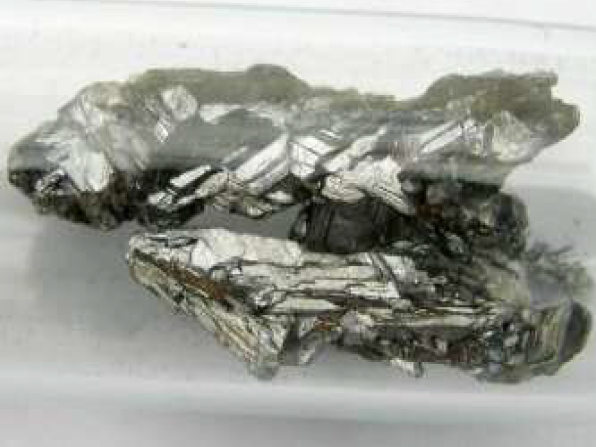
Arsenic is a metalloid that can behave as a metal or as a nonmetal. Arsenic is rarely found as a pure element but is a component in sulfur-containing minerals, the most common of which are arsenopyrite and pyrite. Peru, China, the Philippines and Chile are the primary producer countries. Arsenic is extracted as a by-product from copper [Amer, A.M.,2003] , gold and lead smelter flue dust, as well as from roasting arsenopyrite, the most abundant ore mineral of arsenic. It can also be recovered from realgar and orpiment. [USGS mineral summaries,2000-2025] [smenet.org,2025].
| Global production | Global producers | EU consumption | EU share | EU suppliers | Import reliance |
|---|---|---|---|---|---|
| 44,471t | Peru 44% China 42% Morocco 11% | 993t | 2% | Belgium 72% China 27% | 23% |
Arsenic prices are dependent on the form in which it is brought onto the market (either as arsenic metal from China or arsenic trioxide from China or Morocco). Yearly average prices have fluctuated between € 1.2/kg to € 4.08/kg over the last ten years up to 2024, with a significant price drive between 2021 and 2023 [ISE,2025] [USGS,2025]. Demand for gallium-arsenide, driven by high-tech applications and the growth of the digital industry, are some of the factors contributing to price pressures while supplies have remained stable. Stricter environmental regulations on arsenic use and disposal have reportedly continued to impact production costs and market prices as well [USGS mineral summaries,2000-2025].
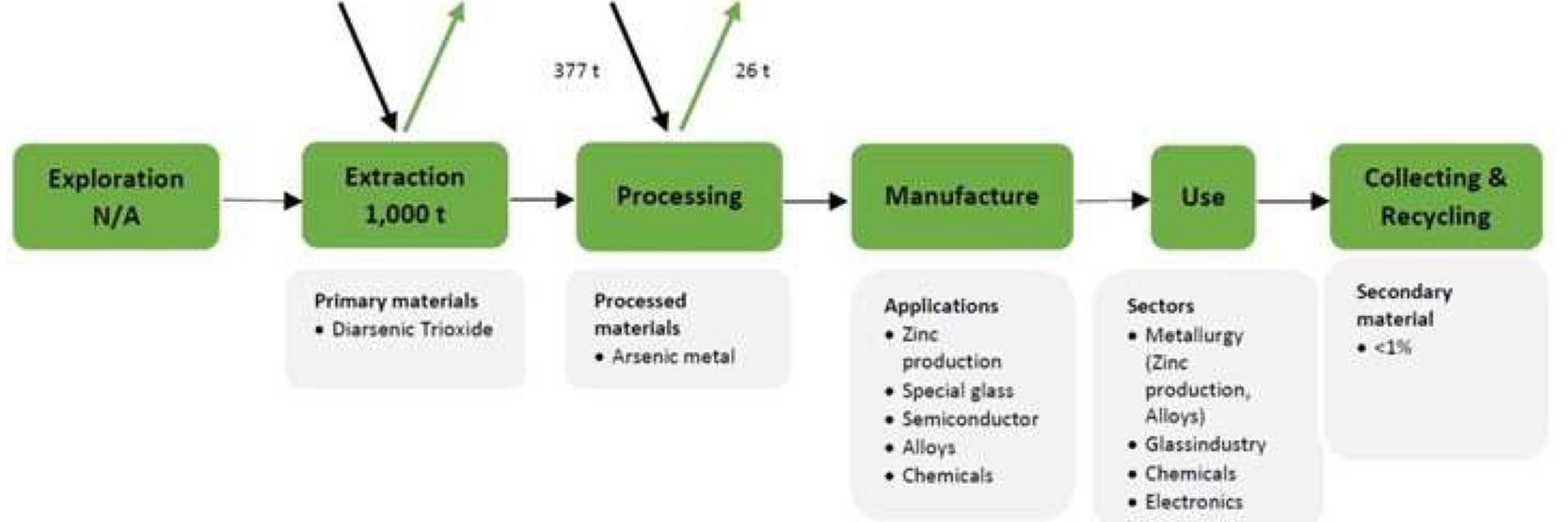
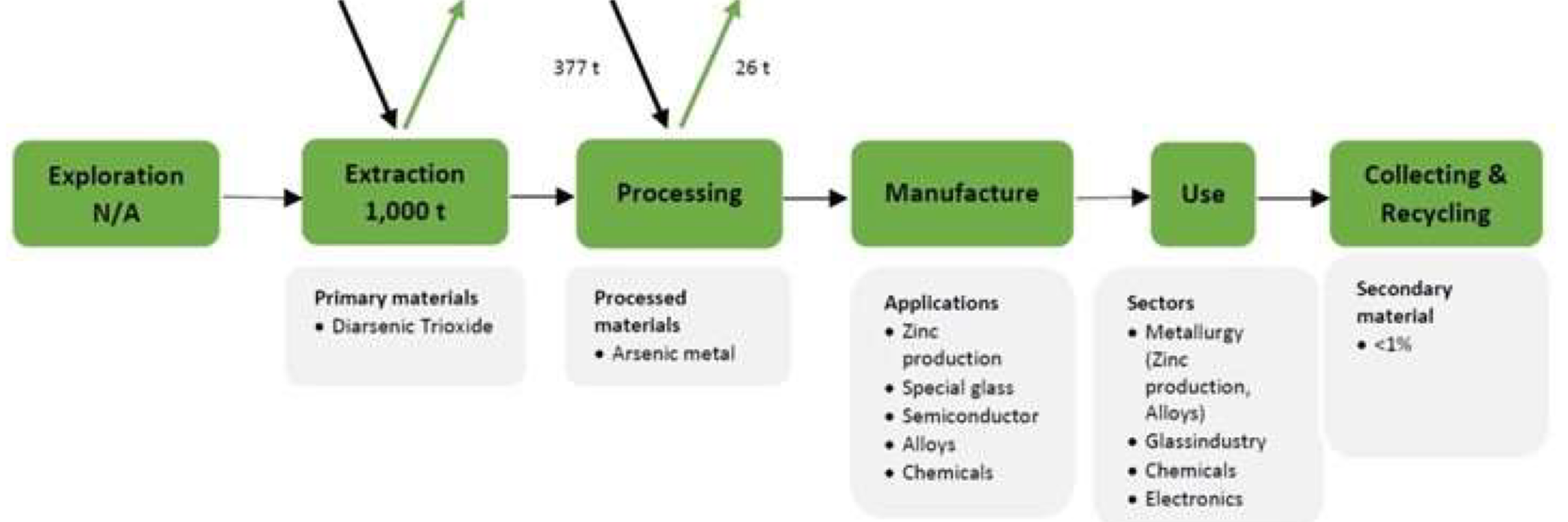
The recovery of arsenic is mainly achieved by heating arsenopyrite (FeAsS) or loellingite (FeAs2) under the exclusion of air at 700°C in horizontal clay pipes. Thereby arsenic is sublimated and collected in cooled collectors and condensed. However, the production of diarsenic trioxide as a by-product during the extraction, processing and purification of copper, lead, cobalt and gold is the most important method of producing arsenic. Arsenic is primarily recovered to be stored in a stable form to reduce pollution. The oxide is dissolved in water, oxidized in a pentavalent state, and then precipitated in the form of calcium arsenate, Ca3(AsO4)2, scorodite, FeAsO4,2H2O or amorphous ferric arsenate adsorbed to iron(III) oxyhydroxide [L'Elementarium,2025] [USGS mineral summaries,2000-2025].The vast majority of arsenic supplies for the EU stem from China (ca. 95%). Latest USGS data shown below in tonnes of diarsenic trioxide.

There is no documented recycling of arsenic. According to the UNEP [UNEP,2019] report “Recycling Rates of Metals,” the Old Scrap Ratio, Recycled Content, and End-of-Life Recycling Rate are all below 1%. There is no data with respect to the methodologies used for the recycling of arsenic in the EU, and no more recent data on overall recycling rates for arsenic are available.
The major application area for arsenic compounds in the EU is the production of zinc, i.e., the electrowinning of zinc, and the manufacturing of glass, accounting for a combined 87% share.
| Use | Percentage | Substitute | Sub share | Cost | Performance |
|---|---|---|---|---|---|
| Zinc production (Electrowinning of zinc) | 0.69% | No substitute | 50% | no substitute | |
| Zinc production (Electrowinning of zinc) | 0.69% | Antimony potassium tartrate ((K2Sb2(C4H2O6)2)) | 25% | Similar or lower costs | Similar |
| Zinc production (Electrowinning of zinc) | 0.69% | Diantimony trioxide (Sb2O3) | 25% | Similar or lower costs | Similar |
| Glassmaking | 0.18% | Sodium nitrate | 25% | Similar or lower costs | Similar |
| Glassmaking | 0.18% | No substitute | 25% | no substitute | |
| Glassmaking | 0.18% | Cerium oxide | 25% | Similar or lower costs | Similar |
| Glassmaking | 0.18% | Potassium nitrate | 25% | Similar or lower costs | Similar |
| Chemicals | 0.07% | not assessed, under 10% | 100% | no substitute | |
| Alloys | 0.05% | not assessed, under 10% | 100% | no substitute | |
| Electronics | 0.01% | not assessed, under 10% | 100% | no substitute |
Table 2 lists possible substitutions for arsenic for various applications, including their cost and performance considerations.
Arsenic trioxide production experienced fluctuations in recent years but the overall trend shows a decline. The arsenic world market is foreseen to shrink further due to the tighter environmental regulations which are to be applied [MC Group,2025]. At the same time, it is expected that specific industrial applications, such as marine timber, plywood roofing, and utility poles, will continue to use CCA-treated wood. The use of high-purity arsenic metal will also continue to be an important input for military, space, and telecommunications and in solar cells. In addition, new prospects for arsenic trioxide arise from the increased penetration of GaAs-based LEDs and GaAs wafers in Wi-Fi applications [MC Group,2025] [USGS mineral summaries,2000-2025]. The EU is heavily dependent on arsenic metal from China (about 95%), in addition to Japan and Hong Kong. There are potential mineral resources and producing mines for arsenic within the EU that are mainly related to gold-bearing volcanic mass sulphide deposits or carbonate replacement, as well as gold epithermal mineral systems. The COVID-19 pandemic did not seem to have any real impact on production; however, delays in the shipment of pure arsenic from Asia to Europe, as well as a rise in transport costs, were reported.
People are also exposed to elevated levels of inorganic arsenic (As) through contaminated drinking water, using contaminated water in food preparation and irrigation of food crops, industrial processes, eating contaminated food and smoking tobacco. Long-term exposure to inorganic arsenic, mainly through drinking-water and food, can lead to chronic arsenic poisoning. Skin lesions and skin cancer are the most characteristic effects. The WHO [WHO,2022] provides guidelines for the values of arsenic in drinking water and risk management recommendations. The EU has regulations in place limiting the amount of arsenic in water and food.
Market analysis, trade and prices
| Global production | Global producers | EU consumption | EU share | EU suppliers | Import reliance |
|---|---|---|---|---|---|
| 44,471t | Peru 44% China 42% Morocco 11% | 993t | 2% | Belgium 72% China 27% | 23% |
Arsenic production (processing stage) is highly geographically concentrated, with China (43%) and Peru (43%) having a combined market share of 85%. 31% of EU supplies come from China, however, the dominant supplier for the EU is Belgium, with a 68% share. Commercial-grade arsenic trioxide is recovered as a by-product from dust and residues produced during the treatment of ores or concentrates of metals such as copper, gold, and lead. The subsequent reduction of arsenic trioxide results in pure arsenic metal [USGS mineral summaries,2000-2025]. Globally, the main use of arsenic is for the production of gallium-arsenide, indium-arsenide and indium-gallium-arsenide semiconductors found in solar cells, in electronic equipment, and in various forms of herbicides, pesticides and insecticides [L'Elementarium,2025]. The biggest market players include Managem Mining Group, Hunan Gold Group, China National Gold Group Corporation and Chenzhuo Tangtao Environmental. Other significant producers include Dundee Precious Metals Tsumeb, Teck Resources Ltd., and Belgium-based Umicore.
| Processing/refining | |
|---|---|
| CN Code | Title |
| 28048000 | Arsenic |
Eurostat reports two trade codes, including arsenic: CN8 28048000 “Arsenic” and CN8 28112910 “Sulphur Trioxide "Sulphuric Anhydride"; Diarsenic Trioxide”. For the criticality assessment, only arsenic metal (CN8 28048000) is considered. The EU is a net importer of arsenic metal (CN8 28048000) between 2000 and 2023. The annual imports of arsenic metal during this period range between 200 to over 800 t, with peaks in 2007 (840.3 t) and 2017 (796.3 t). The exports are significantly lower and only exceeded 100 t in 2009 and 2021. In recent years (2021-2023), imports have increased again after the COVID-19 low of 179.8 t in 2020.
In 2023, close to 95% of EU imports outside of EU came from China, while 5.6% came from Japan. In 2024, close to 100% of EU imports came from China. This means the arsenic metal market is one of the most highly concentrated markets for EU imports and, therefore, highly vulnerable to geopolitically motivated trade disruptions.
Arsenic prices are dependent on the form in which it is brought onto the market (either as arsenic metal from China or arsenic trioxide from China or Morocco). From 2012 to 2016, prices for arsenic metal increased from € 1.3/kg to € 1.7/kg but remained well below the 2007-2009 prices. Although increased demand for gallium-arsenide is driven by high-tech applications and the growth of the digital industry, arsenic prices have remained moderately stable between 1200 and 1700 EUR/t. A combination of high supply risk and a diversified market policy in China are key price drivers. On the other hand, there is a growing demand for overseas imports in China. Arsenic price volatility was around 22% between 2016 and 2020. In this period, price volatility was mostly disturbed by the price changes from € 1.2/kg in 2018 to € 1.7/kg in 2019. After 2019, the arsenic price started to decrease again but recovered quickly post-COVID-19. Since 2020, prices have increased significantly, reaching up to € 4.13/kg in 2023 and remaining at similar levels, above € 4/kg in 2024 [USGS mineral summaries,2000-2025]. Price volatility is likely to remain due to the geopolitical situation and emerging trade wars.
Although tighter environmental regulations in many jurisdictions put pressure on arsenic metal and arsenic trioxide production, it is expected that specific industrial applications, such as marine timber, plywood roofing, and utility poles, will continue to use chromated-copper-arsenate (CCA)-treated wood, while high-purity arsenic metal continues to be an important commodity to produce GaAs, indium-arsenide, and InGaAs semiconductors that are used in aerospace devices, biomedical devices, military applications, mobile devices, optoelectronic devices, photovoltaic applications, satellites, and wireless communications. There is a continued strong demand for this market, which is highly concentrated [USGS mineral summaries,2000-2025]. The EU is heavily dependent on arsenic metal from China (about 90%), in addition to Japan and Hong Kong. There are potential mineral resources for arsenic within the EU. However, none of them is currently in operation or economically feasible. Finland has an unexploited resource of around 2400 metric tons of As metal of total endowment. The COVID-19 pandemic did only have a brief impact on production; however, delays in the shipment of pure arsenic from Asia to Europe, as well as a rise in transport costs, were reported.
Demand
Although the EU is importing arsenic, the demand is mainly covered by one domestic source, i.e., Belgium supplies 67% of EU needs of arsenic (content). The average import reliance of arsenic is 31.0 % for 2008-2020.
Arsenic metal market is one of the most highly concentrated markets for EU imports and, therefore, highly vulnerable to geopolitically motivated trade disruptions. In 2023, close to 95% of EU imports came from China, while 5.63% came from Japan. In 2024, close to 100% of EU imports came from China. While demand has recovered from a 2021 low, this is largely covered by higher import volumes, as production in the EU has remained at below 760 metric tons per annum.
High-purity arsenic metal is used to produce GaAs, indium-arsenide, and InGaAs semiconductors that are used in aerospace devices, biomedical devices, military applications, mobile devices, optoelectronic devices, photovoltaic applications, satellites, and wireless communications. The chemical industry, alloy production, glass-making and zinc-production are other use cases for arsenic. A further application of arsenic is pesticides [USGS mineral summaries,2000-2025].
The vast majority of arsenic (69%) goes into zinc production for electrowinning of zinc. Glassmaking (18%), chemicals (7%), alloys (5%), and electronics (1%) are further EU uses/end-uses of arsenic.
| Applications | 2-digit NACE sector | Value added of NACE 2 sector | 4-digit CPA |
|---|---|---|---|
| Zinc production (Electrowinning of zinc) | C24 - Manufacture of basic metals | 90,000M€ | C24 - Manufacture of basic metals |
| Glassmaking | C23 - Manufacture of other non-metallic mineral products | 86,399M€ | C23 - Manufacture of other non-metallic mineral products |
| Chemicals | C20 - Manufacture of chemicals and chemical products | 165,880M€ | C20 - Manufacture of chemicals and chemical products |
| Alloys | C24 - Manufacture of basic metals | 90,000M€ | C24 - Manufacture of basic metals |
| Electronics | C26 - Manufacture of computer, electronic and optical products | 71,500M€ | C26 - Manufacture of computer, electronic and optical products |
Globally, arsenic is an important element for semiconductor production. High-purity arsenic metal is used to produce GaAs, indium-arsenide, and InGaAs semiconductors that are used in aerospace devices, biomedical devices, military applications, mobile devices, optoelectronic devices, photovoltaic applications, satellites, and wireless communications. The chemical industry, alloy production, glass-making and zinc production are other use cases for arsenic. A further application of arsenic is pesticides [USGS mineral summaries,2000-2025]. In Europe, arsenic is primarily used in the Zn industry and in glassmaking.
The main application of diarsenic trioxide in the EU is the electrowinning process for zinc production. Its main purpose is the removal for impurities such as copper, cobalt, nickel, etc. Arsenic metal is also used in lead alloys to improve strength and castability. Furthermore, it is used as antifriction additive in alloys for bearings.
Diarsenic trioxide is used in the special glass sector to produce lighting glass, optical glass, laboratory and technical glassware, etc., for decolourization purposes, as enamel, or as a fining agent. Germanium-arsenide-selenide or gallium arsenide is used for specialty optical materials. Gallium arsenide is additionally an alternative for zinc selenide in laser systems for lenses and rear mirrors, providing high toughness and durability.
The chemicals industry mainly produces other arsenic compounds, as well as ultra-pure arsenic metal for the semiconductor and electronics industry (see Electronics chapter). Applications of arsenic, which are not at all relevant in the EU production, are also within the agricultural sector.
Arsenic metal is used for alloys, e.g., lead alloys. It is also used in building & construction work and municipal supply (e.g. electricity, steam, gas, water) and sewage treatment [ECHA,2023].
Arsenic compounds for application in the electronics sector. High-purity arsenic metal is used to produce gallium-arsenide, indium-arsenide, and indium-gallium-arsenide semiconductors. These semiconductors have many applications in the electronics sector, e.g. in LEDs, infrared detectors, lasers, computers, biomedical, and communications. They are also used to produce photovoltaic panels. Additionally, arsenic is investigated as a doping agent for cadmium telluride solar panels to increase the cell voltage of these thin film solar devices. Traditionally, copper is used for this treatment. However, studies have shown great potential for arsenic, phosphorus, and antimony [Kartopu, G. et al.,2019]. Most of the arsenic consumption for semiconductors takes place in China. Arsenic is also used in the production of lead-acid batteries [Spyros Schismenos, Michail Chalaris, Garry Stevens,2021]. The use of arsenic in the electronics sector takes mainly place in China but is not completely absent in the EU and thus is already described in the applications of arsenic in the EU.
| Use | Percentage | Substitute | Sub share | Cost | Performance |
|---|---|---|---|---|---|
| Zinc production (Electrowinning of zinc) | 0.69% | No substitute | 50% | no substitute | |
| Zinc production (Electrowinning of zinc) | 0.69% | Antimony potassium tartrate ((K2Sb2(C4H2O6)2)) | 25% | Similar or lower costs | Similar |
| Zinc production (Electrowinning of zinc) | 0.69% | Diantimony trioxide (Sb2O3) | 25% | Similar or lower costs | Similar |
| Glassmaking | 0.18% | Sodium nitrate | 25% | Similar or lower costs | Similar |
| Glassmaking | 0.18% | No substitute | 25% | no substitute | |
| Glassmaking | 0.18% | Cerium oxide | 25% | Similar or lower costs | Similar |
| Glassmaking | 0.18% | Potassium nitrate | 25% | Similar or lower costs | Similar |
| Chemicals | 0.07% | not assessed, under 10% | 100% | no substitute | |
| Alloys | 0.05% | not assessed, under 10% | 100% | no substitute | |
| Electronics | 0.01% | not assessed, under 10% | 100% | no substitute |
Table 6 lists possible substitutions for arsenic for various applications, including their cost and performance considerations.
Zinc production: possible alternatives for diarsenic trioxide in the electrowinning of zinc are diantimony trioxide (Sb2O3) and antimony potassium tartrate (K2Sb2(C4H2O6)2).
Sodium and potassium nitrate as well as cerium oxide represent possible substitutes with a similar or lower price-point and similar performance.
No suitable substitute exists.
Alloys: There is no current option to substitute in the application in lead alloys as these are being phased out. Copper foil: The study by the European Commission on Inorganic arsenic compounds [European Commission ,2018 b] found an application of an alternative for arsenic in copper foils; the name was not disclosed. At the time of the study, it had been used for approximately 30% of the production, showing similar physical properties. Gold electroplating: no suitable alternatives considering technical and economic feasibility have been found.
Semiconductors: Gallium-arsenide can be replaced by indium-phosphide, gallium-nitrate and silicon-germanium. Specifically, for power amplifiers, Ga-As can be replaced with silicon-based complementary metal oxides for mid-tier third-generation handsets. For defence-related applications: So far, no effective substitute for gallium-arsenide-based integrated circuits exists. For heterojunction bipolar transistors, silicon-germanium is also an effective substitute for GaAs use. Alternatives for GaAs laser diodes include indium phosphide for some specific wavelengths, and helium-neon laser competes with GaAs in visible laser diode applications [USGS mineral summaries,2000-2025].
Supply
According to USGS data [USGS mineral summaries,2000-2025] the EU production of arsenic oxide was 1000 tonnes produced through the smelting or roasting of nonferrous metal ores, concentrates or copper smelter dusts in Belgium. This production corresponds to ca. 750 tonnes of elemental arsenic. The EU demand for 2023 was 1122 tonnes, was largely covered by EU production (ca. 750 tonnes) and imports of about 390 tonnes, corresponding to an import reliance of ca. 24% [Eurostat,2025]. However, this estimation is incomplete for arsenic because there were no figures on the trade of diarsenic trioxide.
The company Vital Materials Co. based in Belgium, manufactures gallium arsenide substrates, which are used as semiconductors in wireless communication applications. Another Belgian company, KBM Affilips manufactures a wide range of master alloys, such as lead-arsenic, copper arsenic, or lead-arsenicantimony alloys. Overall, eight companies have registered arsenic use with ECHA in Belgium, France, Spain, Slovakia, Germany, and Luxembourg. Only two companies produce diarsenic trioxide in the EU. Also, the number of importers is very limited. ECHA’s study concludes a very low level of complexity of the arsenic supply chain, as 88% of arsenic used in the EU is concentrated in the industry sectors of: glass production and recycling, electronics, chemicals and copper and zinc metallurgy (as As is used for the manufacturing of specific alloys). A few dozen companies use arsenic trioxide in their production chain [European Commission ,2018 b].
n.a.
n.a.
Significant quantities of arsenic are associated with copper-gold deposits in Chile, the Philippines, and many other countries. However, arsenic is primarily obtained as a secondary byproduct during the processing of other metal ores, particularly gold, silver, copper, and lead. It is rarely mined as the primary ore [USGS,2025] [Minerals Education Coalition,2025].
World reserves data are unavailable, as arsenic is mainly produced as a by-product via the processing of various ores, but are thought to be more than 20 times the annual world production in 2021 (59,000 t) according to USGS data [USGS mineral summaries,2000-2025]. There are recoveries of orpiment (As2S3) and realgar (AsS) occurrences in China, Peru and the Philippines.
China has stockpiled orpiment and realgar from gold mines for later recovery of arsenic. Arsenic occurrences are associated with copper-gold ores in Chile and gold deposits in Canada. It can also be recovered from enargite, a copper mineral.
No data available.
| Country | Classification | Quantity (Mt of ore) | Grade (% Arsenic) | Reporting code | Reporting date | Deposit, Source | ||
|---|---|---|---|---|---|---|---|---|
There are potential mineral resources for arsenic within the EU. However, none of them is currently in operation or economically feasible. Finland has an unexploited resource of around 2400 metric tons of As metal of total endowment. Another example of EU arsenic resources is the Olympias mine in northern Greece, which hosts a gold-rich polymetallic (Pb, Zn, Au, Ag) carbonate replacement deposit and produces sphalerite, galena and arsenopyrite concentrates. The mine produces approximately 120,000 tonnes of gold-arsenopyrite-pyrite concentrate with Au grades up to 35 g/t and an As content from 7 to 14%. The majority of such concentrates from the EU are shipped to China with some quantities delivered to Russia as well. Concentrate producers, however, are not paid for the presence of As but are penalised instead. According to Minerals4EU (2019), exploration activity exists in Portugal and Poland. In Portugal, there were 10 active exploration licences in 2013 for occurrences including arsenic with various other commodities. In Poland, one exploration licence was active in 2013, exploring an occurrence of arsenic with other minerals.
| Country | Classification | Quantity (Mt of ore) | Grade (% Arsenic) | Reporting code | Reporting date | Source | ||
|---|---|---|---|---|---|---|---|---|
No data available.
China and Peru lead the global plant production of arsenic trioxide (or calculated equivalent) with 27000 and 24000 metric tons, accounting for ca. 88% of global production in 2024, based on USGS estimates [USGS,2025]. Morocco and Belgium are the only other significant producers, with ca. 6000 and 1000 metric tons, respectively.
Source: [USGS,2025]
| SOURCE | COMMODITY | COUNTRY | TYPE | UNIT_MEAS | PROD_2023 | PROD_EST_ 2024 | PROD_NOTES | CAP_2023 | CAP_EST_ 2024 | CAP_NOTES | RESERVES_2024 | RESERVE_NOTES |
| MCS2025 | Arsenic | United States | Plant production, arsenic trioxide or calculated equivalent. | metric tons | ||||||||
| MCS2025 | Arsenic | Belgium | Plant production, arsenic trioxide or calculated equivalent. | metric tons | 1000 | 1000 | 1500 | |||||
| MCS2025 | Arsenic | China | Plant production, arsenic trioxide or calculated equivalent. | metric tons | 24000 | 24000 | 30000 | |||||
| MCS2025 | Arsenic | Japan | Plant production, arsenic trioxide or calculated equivalent. | metric tons | 40 | 40 | estimated 2023 | 60 | ||||
| MCS2025 | Arsenic | Morocco | Plant production, arsenic trioxide or calculated equivalent. | metric tons | 6000 | 6000 | 8000 | |||||
| MCS2025 | Arsenic | Peru | Plant production, arsenic trioxide or calculated equivalent. | metric tons | 30000 | 27000 | 37000 | |||||
| MCS2025 | Arsenic | Russia | Plant production, arsenic trioxide or calculated equivalent. | metric tons | 500 | 200 | estimated 2023 | 4000 | ||||
| MCS2025 | Arsenic | World total (rounded) | Plant production, arsenic trioxide or calculated equivalent. | metric tons | 61500 | 58000 | 81000 |
There is no documented recycling of arsenic taking place. According to UNEP reports [UNEP,2019] [UNEP,2011], the “Recycling Rates of Metals” Old Scrap Ratio, Recycled Content, and End-of-Life Recycling Rate are all below 1%. There are no data on the methodologies used for the recycling of arsenic in the EU. Vacuum pyrolysis has been proposed as an environmentally friendly technique for the recovery of As from GaAs-based E-waste, such as end-of-life light-emitting diodes (LEDs). Arsenic and gallium can be recovered efficiently at a heating temperature of 1273 K, a processing time of 60 min, and a vacuum pressure of ∼20 Pa, while the total recovery efficiency can reach 95 wt% %. Ga, As-Ga, and As are recovered in district zones and entered the reactor (Zhan et al. 2018) [Zhan, L., Xia, F., Xia, Y., Xie, B.,2018].
| MSA Flow | Value | ||
|---|---|---|---|
Other considerations
People are also exposed to elevated levels of inorganic arsenic (As) through contaminated drinking water, using contaminated water in food preparation and irrigation of food crops, industrial processes, eating contaminated food and smoking tobacco. Long-term exposure to inorganic arsenic, mainly through drinking water and food, can lead to chronic arsenic poisoning. Skin lesions and skin cancer are the most characteristic effects. WHO [WHO,2022] provides guidelines for values of arsenic in drinking water and risk management recommendations. The EU has regulations in place limiting the amount of arsenic in water and food. Occupational exposure to arsenic would be via inhalation and dermal contact. Occupational exposure to inorganic arsenic compounds may take place, for example, in the formation of substances involving alloys with arsenic metal or in thermal processes where arsenic is present as an unintentional impurity in raw materials. Furthermore, arsenic compounds are present in dust formed by the processes. The number of workers potentially exposed to inorganic arsenic in the workplace is high [European Commission,2018]. DIRECTIVE (EU) 2019/983 regulates the protection of workers from the risks related to exposure to carcinogens or mutagens at work. According to the EU harmonised classification and labelling (CLP), this substance is toxic if swallowed, is toxic if inhaled, is very toxic to aquatic life and is very toxic to aquatic life with long lasting effects. Moreover, some uses of this substance are restricted under Annex XVII of REACH. Regulation (EC) No 1223/2009 lists in its Annex II substances that are prohibited for use in cosmetics, among others arsenic and its compounds. Directive 2009/48/EC on the safety of toys (formerly 88/378/EEC) include 55 allergenic substances that are prohibited in toys, allergenic substances that require labelling, and migration limits for other substances which may not be exceeded. Maximum levels for arsenic in certain foods have been established by Commission Regulation (EC) No 2015/1006 (future section 3.5 of the Annex to Regulation (EC) No 2006/1881, applicable from 1 January 2016 onwards). Regulation (EU) 2019/1009 sets limits for arsenic in fertilising products.
The arsenic content of copper concentrates on the world market has been increasing and there is a competition for concentrates with low content of arsenic. Around 30 % of world copper concentrates contain more than 0.1 % arsenic. Complex copper concentrates have an arsenic content greater than 0.2 % with no 20 upper limit. Many copper smelters able to process complex concentrates with high arsenic content prior to the 1990s, have either stopped this practice or closed for environmental reasons. Currently only a few copper smelters in the world can process complex concentrates, and there are ongoing attempts to reduce arsenic contents in concentrates. Arsenic is contained in some electrical and electronic components. According to the Technical Rules for Hazardous Substances in Germany, an exposure to cadmium and arsenic compounds is to be expected during treatment and recycling of waste electrical and electronic equipment (WEEE) in particular with recycling of photovoltaic modules which are not silicon-based [European Commission,2018].
Chronic arsenic poisoning, which develops very slowly, is called arsenicism. It comes mainly from groundwater intended for consumption, polluted with arsenic. The WHO guideline value for drinking water is 10 μg/L. In Bangladesh, 27% of shallow wells have an arsenic concentration above 50 μg/L, affecting 33 to 77 million people [L'Elementarium,2025].
Arsenic is still widely used in the steel sector, especially in countries with lower environmental standards. It not only affects the quality of steel products, but also causes environmental consequences such as soil degradation, water contamination, air pollution and associated biodiversity loss and public health risks [Sulong Zhu, Chengkang Gao, Kaihui Song, Guo Tian, Dengting Guo, Xiaojun Li,2023]. Direct trade and indirect trade aggravate arsenic environmental emissions in major importing countries, like China, while embodied trade aggravates arsenic environmental emissions in major exporting countries, like Peru and Chile. As the use of arsenic has decreased due to health concerns, it is currently more likely to come from former industrial or agricultural activities that have left polluted soils. In 2000, it was estimated that since the beginning of the industrial era, the cumulative industrial production of arsenic had been 4.5 million t. Mine drainage water can contain up to 850 mg/L of arsenic while agricultural soils treated with pesticides containing arsenic can reach concentrations of 700 ppm arsenic. In addition to anthropogenic sources (mineral processing, chemical industry, etc.), arsenic can also be emitted by bacteria, volcanoes, forest fires and soil erosion.
Arsenic is an element of earth’s crust and a component of many minerals. It is naturally released into the environment naturally through the weathering, oxidation and erosion of sulphide minerals. These sulphide minerals can form soils with very high concentrations of arsenic, and the arsenic can dissolve in water [Izharul Haq, Anshu Singh, Ajay S Kalamdhad,2021] .
An estimated 25% of arsenic emissions into the atmosphere come from natural sources, mainly volcanoes. The majority of the arsenic released by all sources end up in the soil and the ocean. The rate of arsenic release from sulphide minerals can be accelerated by mining activities, which expose the minerals to weathering processes during excavation [Izharul Haq, Anshu Singh, Ajay S Kalamdhad,2021]. Arsenic oxide dust is produced during copper and gold smelting and coal combustion. When coal is burned, ash is produced, which contains most of the naturally occurring arsenic. More than 99 % of the ash is collected and is either sent to specially designed ash ponds or disposal sites or recycled into commercial products. Arsenic can also be leached out of some metal ores by cyanide or acid rock drainage, but can be captured and removed from wastewater before it is released into the environment.
Emissions of arsenic and compounds are covered by increasingly stringent regulations, namely the Directive (EU) 2016/2284 on the reduction of national emissions of certain atmospheric pollutants, and Directive 2006/118/EC on the protection of groundwater against pollution and deterioration.
Arsenic exports' share of the total value of exports remains below 0.1 % in each of the exporting countries, so their economic importance is limited.
| Country | Export value (USD) | Share in total exports |
|---|---|---|
The current emphasis of developing countries on policies that favour the intensification of mining exploitation as the main source of income has generated negative consequences for ecosystems and rural communities, mainly due to the release of highly toxic elements into the environment, including arsenic. Specifically in Latin America, the “As [arsenic] problem” is known in all of its 20 countries, resulting in diverse environmental and public health impacts [Bundschuh et al.,2021]. For these reasons, mining conflicts emerge as social conflicts between local populations, mining companies and the governments. There is documented evidence that conflicts can escalate to a more difficult and unfortunate dimension, and those contesting the social and environmental costs of extraction face threats and intimidation, the criminalization of dissent (i.e., imprisonment, restriction of rights), and even physical violence (i.e., beatings, killings) [Arce, Moises; Nieto-Matiz, Camilo,2024]. Latin America has seen significant increases in investments in the mining sector in the past decades, and the occurrence of mining-related conflicts has increased. The number of mining conflicts has been on the rise globally [Institute of Development Studies,2024] and in the EU, most often at the local or regional level, where the conflict focuses on project-specific issues: extraction, processing, waste management, or transport of minerals. The limited literature suggests that there are several and varying reasons which are fuelling mining conflicts in the EU, one the most important related to metals in the context of planned or realised openings of new mines. Top environmental concerns were: i) loss of landscape or aesthetic degradation, ii) groundwater pollution or depletion and iii) surface water pollution or decreasing water quality. Arsenic pollution of water is the main topic related to metal mining in Europe [Kivinen et al.,2020].
Research and development focus primarily on new, innovative, and sustainable technologies for removing arsenic from groundwater, specifically through adsorption [Easar Alam,2024]. The role of As as a dopant in semiconductor production is also further investigated and improved [Wu, R., Gu, R., Gotoh, T. et al.,2024].